
Finding the best endocrinologist for type 1 diabetes in India can feel like searching for a lifeline in a chaotic sea of medical jargon. When you are navigating an autoimmune condition that requires precise insulin ratios, active continuous glucose monitoring (CGM), and high-stakes pump titration, you don’t just need a healthcare provider—you need an elite clinical strategist.
Unfortunately, many patients fall into a risky trap: trusting their long-term care to general physicians or doctors using the title “diabetologist” based solely on short-term online certificate courses. In India’s medical landscape, knowing how to verify formal super-specialty credentials can mean the difference between thriving and facing severe, avoidable complications.
Whether you are a caregiver navigating a fresh pediatric diagnosis or an adult fighting to stabilize brittle, unpredictable blood sugar spikes, this comprehensive 2026 roadmap is your ultimate guide. We cut through the noise to reveal bonafide DM and DNB endocrine specialists across the country. From breaking down city-wise hospital infrastructure and comparing private versus government consultation costs to providing your exact first-appointment checklist, we have done the legwork.
Your health deserves absolute clinical precision. Let’s find the perfect expert to take control of your numbers today.
Endocrinologist vs Diabetologist vs General Physician: Who Should Treat Type 1 Diabetes?
Managing Type 1 diabetes requires precise, lifelong insulin therapy. Choosing the right doctor can prevent life-threatening complications. Here is the medical breakdown:
- Endocrinologists (The Gold Standard): These are hormonal super-specialists. In India, they hold an MBBS and MD, followed by a rigorous 3-year DM or DNB in Endocrinology. They possess the deepest clinical expertise to manage complex insulin regimes, pump therapy, and Continuous Glucose Monitors (CGMs).
- Diabetologists (A Misleading Title?): Surprisingly, there are very few formally recognized, independent degrees for “diabetology” in India. Many using this title are general physicians with short-term certificate fellowships. Legally, these certificates cannot substitute a formal endocrinology super-specialty degree.
- General Physicians (Primary Care): While vital for your overall health, they lack the specialized, high-stakes training required to safely navigate brittle Type 1 diabetes.
The Verdict: For safe, expert Type 1 care, always choose a bonafide endocrinologist. Protect your health by verifying their registered DM or DNB Endocrine qualifications prominently displayed in their clinic.
What Qualifications Should Your Type 1 Diabetes Doctor Have in India?
When managing Type 1 diabetes in India, verifying your specialist’s medical credentials is vital. Ensure your doctor holds these legally recognized qualifications:
- DM or DNB in Endocrinology: This is the gold standard. This rigorous, 3-year super-specialty training is completed only after obtaining an MBBS and an MD/DNB (in General Medicine or Pediatrics).
- Approved Foreign Degrees: Formal endocrinology qualifications from the USA, UK, Canada, Australia, and New Zealand are also legally recognized.
- Medical Council Registration: Legally, a bonafide specialist must register their additional qualifications and prominently display this certificate in their clinic.
What to Avoid: Be cautious of doctors using the title “diabetologist” based solely on short-term certificates or online fellowships. These courses are not registrable with medical councils and cannot substitute the comprehensive clinical expertise of a formal DM or DNB endocrinologist. Always verify their degrees before trusting them with your care.
Best Hospitals for Type 1 Diabetes in India: City-Wise Guide
Managing Type 1 diabetes effectively requires more than routine checkups. Because it is a complex autoimmune condition, your care team needs to be highly specialized. You need access to the latest medical technology—like Continuous Glucose Monitors (CGMs) and insulin pumps—alongside dedicated pediatric and adult endocrinologists, dietitians, and diabetes educators.
Here is a simplified, expert-approved guide to the top-tier medical institutions across India recognized for clinical excellence in endocrinology and Type 1 diabetes care.
Delhi & National Capital Region (NCR)
The Delhi-NCR region houses some of the most technologically advanced diabetes units in the country, spanning both premier public and private institutions. Following are some best hospitals, but for you… You always prefer Endocrinologist near you.
- Medanta – The Medicity (Gurugram): Features a dedicated, multi-disciplinary Endocrinology and Diabetology department. They provide fully integrated care, pairing top specialists with diabetic educators and nutritionists to build custom management plans.
- All India Institute of Medical Sciences (AIIMS, New Delhi): India’s flagship public medical institute. Globally renowned for its cutting-edge infrastructure, AIIMS offers elite endocrine care and highly subsidized treatments for complex cases.
- Max Super Speciality Hospital (Saket, New Delhi): Well-known for full-spectrum Type 1 diabetes management, offering extensive clinical support for advanced insulin pump therapy and daily CGM tracking.
- Artemis Hospital (Gurugram): Equipped with a dedicated endocrine unit designed to actively treat and prevent long-term diabetic complications like neuropathy (nerve issues) and retinopathy (eye issues).
- Indraprastha Apollo Hospital (New Delhi): Excellent for families, offering specialized pediatric endocrinology clinics, hands-on family education, and structured metabolic support.
- Fortis Memorial Research Institute (Gurugram): Provides comprehensive metabolic workups, advanced insulin titration, and intensive continuous care.
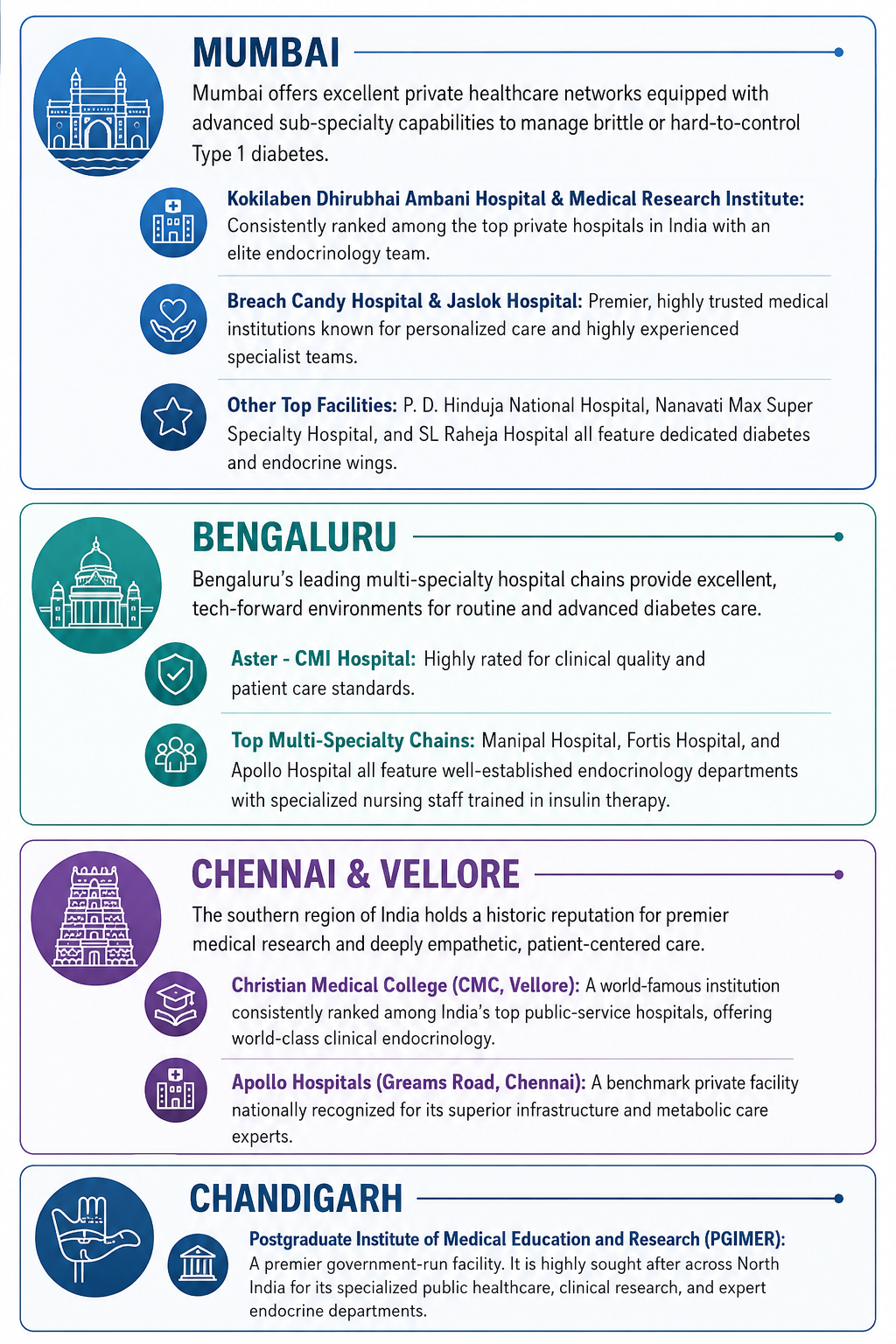
Mumbai
Mumbai offers excellent private healthcare networks equipped with advanced sub-specialty capabilities to manage brittle or hard-to-control Type 1 diabetes.
- Kokilaben Dhirubhai Ambani Hospital & Medical Research Institute: Consistently ranked among the top private hospitals in India with an elite endocrinology team.
- Breach Candy Hospital & Jaslok Hospital: Premier, highly trusted medical institutions known for personalized care and highly experienced specialist teams.
- Other Top Facilities: P. D. Hinduja National Hospital, Nanavati Max Super Specialty Hospital, and SL Raheja Hospital all feature dedicated diabetes and endocrine wings.
Bengaluru
Bengaluru’s leading multi-specialty hospital chains provide excellent, tech-forward environments for routine and advanced diabetes care.
- Aster – CMI Hospital: Highly rated for clinical quality and patient care standards.
- Top Multi-Specialty Chains: Manipal Hospital, Fortis Hospital, and Apollo Hospital all feature well-established endocrinology departments with specialized nursing staff trained in insulin therapy.
Chennai & Vellore
The southern region of India holds a historic reputation for premier medical research and deeply empathetic, patient-centered care.
- Christian Medical College (CMC, Vellore): A world-famous institution consistently ranked among India’s top public-service hospitals, offering world-class clinical endocrinology.
- Apollo Hospitals (Greams Road, Chennai): A benchmark private facility nationally recognized for its superior infrastructure and metabolic care experts.
Chandigarh
- Postgraduate Institute of Medical Education and Research (PGIMER): A premier government-run facility. It is highly sought after across North India for its specialized public healthcare, clinical research, and expert endocrine departments.
Pro-Tip: Look for the Right Expert Near Your Vicinity.
A great hospital is only as good as your primary physician. For Type 1 diabetes, always prioritize a bonafide endocrinologist (doctors holding a registered DM or DNB in Endocrinology) over a general physician.
Cost of Diabetes Specialist Consultation in India: Government vs Private Hospitals
Managing Type 1 diabetes involves recurring monthly out-of-pocket expenses—averaging ₹1,264 to ₹1,500—covering insulin, lab tests, and clinical fees. Choosing between public and private healthcare heavily dictates your consulting budget:
- Private Hospitals (Premium Out-of-Pocket): An endocrinologist consultation at top private networks (like Apollo, Medanta, or Fortis) typically ranges from ₹500 to ₹1,500 per visit. While more expensive, they provide immediate access to advanced multi-disciplinary teams, continuous glucose monitoring (CGM) tracking, and custom insulin pump titration.
- Government Hospitals (Free or Subsidized): Elite public facilities like AIIMS New Delhi provide world-class specialist care for nominal registration fees (often under ₹50). Furthermore, state-led initiatives—such as West Bengal’s dedicated Type 1 district clinics—offer entirely free outpatient care, including complimentary insulin, glucometers, strips, and laboratory testing.
The Bottom Line: Private care offers swift access to cutting-edge tech but requires higher out-of-pocket budgets. Government centers significantly ease the financial burden, making life-saving expert care highly accessible.
What to Expect at Your First Endocrinologist Appointment for Type 1 Diabetes
Your first consultation with an endocrinologist establishes your personalized Type 1 diabetes care plan. Treat this initial visit like a crucial strategy meeting to map out your long-term health.
1. How to Prepare
- Bring Your Data: Export at least two weeks of logs from your Continuous Glucose Monitor (CGM) or glucometer so your doctor can identify precise blood sugar trends.
- Write an Agenda: Note recent severe high or low episodes and list all prescriptions needing refills (insulin, sensors, pump supplies).
2. The Comprehensive Clinical Evaluation
Your specialist will perform an in-depth assessment:
- Physical Exam: Expect standard checks for blood pressure and BMI, along with thyroid palpation, an injection-site skin check (for lipohypertrophy), and a comprehensive neurological foot exam.
- Lab Work: The doctor will order an HbA1c test to evaluate your 3-month average. Because Type 1 is autoimmune, they will also screen for related conditions like thyroid dysfunction, celiac disease, and kidney function.
3. Key Topics to Discuss
- Glycemic Targets: Clearly define your personalized target ranges and A1C goals.
- Insulin Fine-Tuning: Collaborate to adjust your insulin-to-carbohydrate ratios, correction factors, and basal rates.
- Emergency & Sick-Day Protocols: Learn exactly how to manage doses independently during illness or exercise, and get their emergency contact info.
- Advanced Technology: Ask if you are a candidate for automated insulin delivery (AID) smart pump systems or ultra-rapid-acting insulins.
Questions You Must Ask Your Endocrinologist at Every Appointment
Treating your routine endocrinologist visit like a high-level strategy meeting ensures your Type 1 diabetes management evolves with your lifestyle. Bring your recent Continuous Glucose Monitor (CGM) data, and use this checklist of essential questions at every appointment:
1. Glycemic Targets & Data Adjustments
- “Based on my recent CGM logs, do my insulin-to-carbohydrate ratios, correction factors, or basal rates need tweaking to combat patterns like the dawn phenomenon?”
- “Am I hitting my personalized target glucose range and HbA1c goals for my current phase of life?”
2. Advanced Technology & Affordability
- “Am I a good candidate for the latest Automated Insulin Delivery (AID) smart pumps or ultra-rapid-acting insulins?”
- “If financial strain is an issue, are there patient assistance programs, co-pay cards, or more affordable generic options for my supplies?”
3. Co-morbidities & Preventing Complications
- “Given that Type 1 diabetes is autoimmune, does my blood work show normal markers for thyroid function (Hashimoto’s), celiac disease, and kidney health?”
- “What is the single most impactful lifestyle change I can make today to protect my long-term cardiovascular and nerve health?”
4. Lifestyle & Emergency Care
- “How should I adjust my insulin and carbohydrate intake to prevent severe hypoglycemia during physical workouts?”
- “What is my exact sick-day protocol for adjusting insulin independently during illness, and how do I contact your clinic for weekend emergencies?”
Reference
https://pmc.ncbi.nlm.nih.gov/articles/PMC10305924
https://www.ncbi.nlm.nih.gov/pmc/articles/PMC11445149
https://endocrinesocietyindia.org/fb_live.php
https://professional.diabetes.org/standards-of-care
https://diabetes.org/about-diabetes/type-1
https://pmc.ncbi.nlm.nih.gov/articles/PMC4413394
https://pmc.ncbi.nlm.nih.gov/articles/PMC4413394
https://www.ncbi.nlm.nih.gov/pmc/articles/PMC10031760
https://pmc.ncbi.nlm.nih.gov/articles/PMC5314831
https://www.ncbi.nlm.nih.gov/pmc/articles/PMC4076919
https://journals.sagepub.com/doi/10.1177/30502071241293567
https://www.ncbi.nlm.nih.gov/pmc/articles/PMC12431490
About the author
It’s me Mohammad Junaid Rain an MBBS student at GMC Nagpur, passionate about making evidence-based medical information accessible to every Indian. “medstuffs.com” is dedicated to clear, disease education for patients and caregivers.
Disclaimer: This article is for educational purposes only and does not substitute professional medical advice. Please consult your doctor for diagnosis and treatment.