
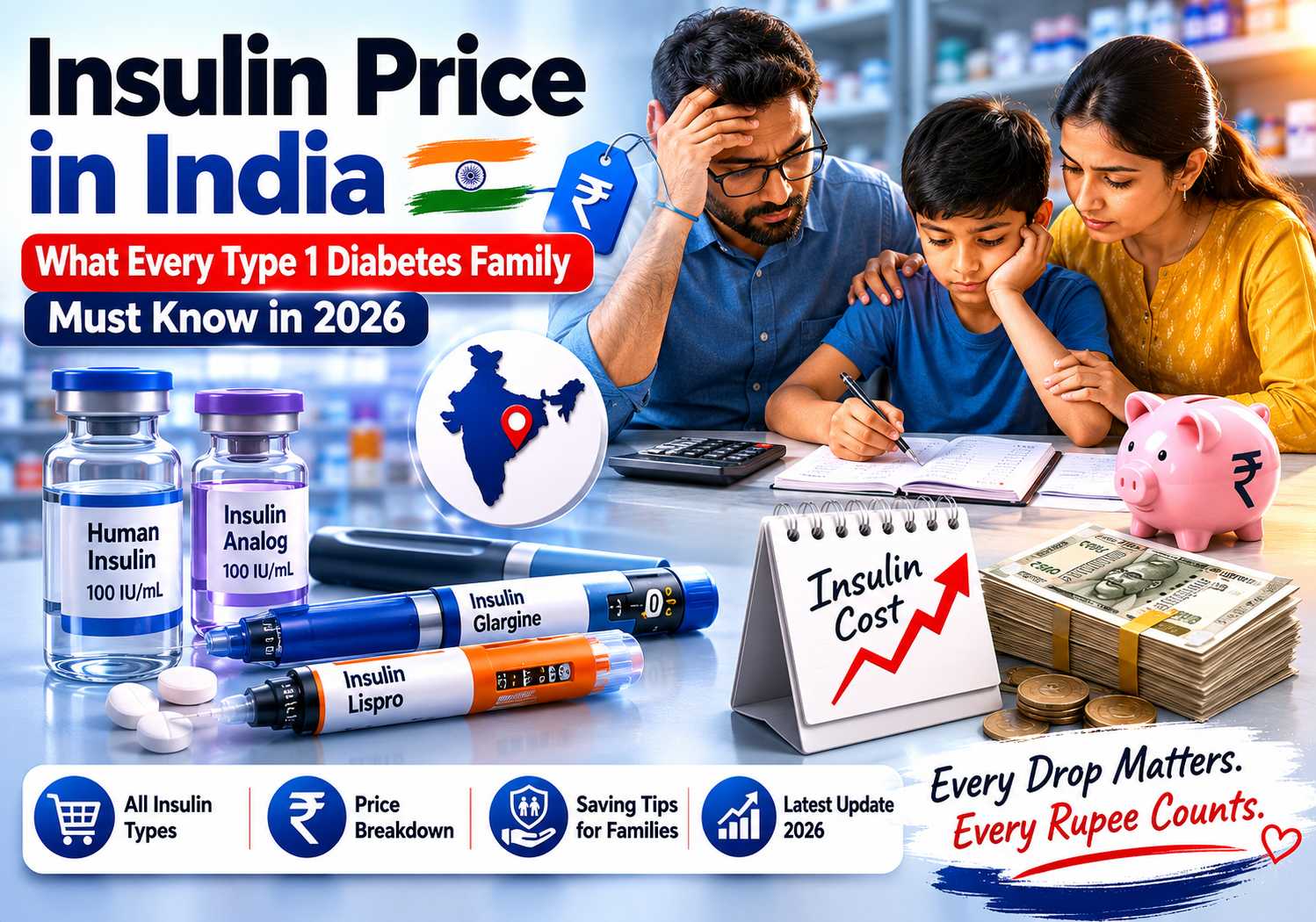
Insulin is not optional. For over 2 lakh Indians living with Type 1 diabetes, it is the difference between life and death — every single day.
Yet most families pay for it entirely out of pocket. No subsidy. No reimbursement. Just a monthly scramble to afford an injection that cannot be skipped.
Insulin price in India ranges from as low as ₹88 for a government-regulated human insulin vial to over ₹7,700 for a premium long-acting analogue pen — a near 90x difference for what is, at its core, the same life-saving hormone.
This guide cuts through that confusion. Across 11 detailed sections, you will find verified 2025 price lists for every major insulin brand, a straight comparison of biosimilar vs branded options, Jan Aushadhi availability, insurance realities, and eight proven strategies to reduce your monthly insulin bill — without compromising your control.
Knowledge is the cheapest medicine there is. Let’s start.
Why Insulin Affordability Is a Crisis for Type 1 Diabetes Families in India
Type 1 Diabetes (T1D) means the body cannot produce insulin. To survive, a child needs multiple daily insulin injections—making it a lifelong necessity. In India, this creates a severe financial crisis for families.
Here is why daily survival is so difficult:
- Massive Out-of-Pocket Costs: A typical family spends 6,000 – 10,000 Rs every month on diabetes care. With insulin vials costing up to 3000 Rs. each—plus the recurring cost of syringes, glucometers, and test strips—underprivileged parents are often forced to choose between food and their child’s life-saving medicine.
- No Outpatient Insurance: Indian health insurance rarely covers day-to-day outpatient (OPD) expenses like daily insulin. Unless a patient is hospitalized, families must pay for every single syringe out of their own pockets.
- Dangerous Rationing & DKA: High costs force some families to skip or cut insulin doses. This triggers Diabetic Ketoacidosis (DKA)—a life-threatening medical emergency where lack of insulin causes toxic acids to build up in the blood. DKA is a leading cause of death in children with T1D.
- Emotional Burnout: The endless pressure of funding daily survival takes a massive mental toll on both parents and young patients.
Where to Find Help: Do not lose hope. You can get high-quality generic insulin and testing kits at highly subsidized rates through government Jan Aushadhi Kendras. Programs like Udaan and Changing Diabetes in Children (CDiC) also provide free insulin and support to families in need.
Complete Insulin Price List India 2025-26
Managing diabetes shouldn’t feel like a financial penalty. In India, monthly insulin costs typically range from ₹150 to ₹3,200 depending on your specific brand and delivery system (vials, cartridges, or convenience pens). To protect families from skyrocketing out-of-pocket expenses, the National Pharmaceutical Pricing Authority (NPPA) strictly caps generic 40 IU/ml insulin—including Regular, NPH, and 30:70 premix varieties—at just ₹15.09 per ml.
Here is a simplified price breakdown you will encounter at typical Indian pharmacies (which frequently offer 15% to 20% online discounts):
- Premixed Insulins (30/70 & 50/50): Standard 3ml penfills like Insugen or Wosulin cost roughly ₹312. Well-known alternatives like Mixtard or Huminsulin range between ₹424 and ₹515. Traditional 10ml vials generally cost around ₹545 to ₹704.
- Long-Acting Basal Insulin (Glargine): These provide steady, 24-hour background blood sugar control. While localized options like Vibrenta cost as low as ₹75, premium, multi-variant pen kits like Lantus, Glaritus, or Xglar span from ₹640 up to ₹3,259.
The Smart Budget Alternative: Never ration your doses. If branded prices hit too hard, visit a government-backed Pradhan Mantri Bhartiya Jan Aushadhi Kendra to buy highly effective generic insulin at 50% to 90% cheaper rates.
Rapid-Acting Insulin in India: Novorapid, Humalog, Apidra — Prices & Differences
Think of rapid-acting insulins—Novorapid (Aspart), Humalog (Lispro), and Apidra (Glulisine)—as your mealtime bodyguards. Injected right before you eat, they absorb quickly into your bloodstream to block sudden post-meal blood sugar spikes.
How They Compare (The Speed Test)
While their timelines look slightly different on paper, large clinical studies show they perform equally well in real-world blood sugar control:
- Apidra: Kicks in fastest (15–30 minutes), peaks in 30–60 minutes, and lasts about 4 hours.
- Novorapid: Starts working in 21 minutes, peaks in 1–3 hours, and lasts around 5 hours.
- Humalog: Begins within 23–27 minutes, peaks in 1–2 hours, and lasts roughly 5 hours.
Cost & Availability in India
While insulin prices generally range between ₹150 to ₹2,500 depending on the delivery method, choosing pre-filled disposable pens offers great convenience but costs more than traditional vials.
- The Generic Gap: Unlike older background insulins, these advanced rapid-acting options are not yet available at low-cost Jan Aushadhi Kendras due to strict patent timelines and local market delays.
- Free Government Access: If retail costs strain your budget, look into public healthcare. States like Goa and Uttarakhand supply rapid insulin like Novorapid entirely free through local government hospitals.
Long-Acting Insulin India: Lantus vs Basalog vs Tresiba — Which Is Cheapest?
Think of long-acting (basal) insulin as a steady, 24-hour background tap that keeps your blood sugar stable between meals and while you sleep. If you are balancing a tight monthly budget, choosing the right brand can significantly lower your out-of-pocket medical expenses without compromising your health.
Here is how India’s three major long-acting options compare:
- Basalog (Biocon): The Most Affordable. Ranging from ₹574 to ₹1,813 across 6 delivery variants, Basalog is a “biosimilar.” Think of it as a highly regulated, equally powerful medical twin to the original brand. Clinical trials confirm it provides the exact same safety and blood sugar effectiveness at a much lower price.
- Lantus (Sanofi): The Original Brand. Lantus is the global reference product for insulin glargine. Because it is the parent brand, it carries a slightly higher price tag, ranging from ₹640 to ₹2,173 across its 4 variants.
- Tresiba: The Premium Option. Tresiba is a newer, ultra-long-acting analog insulin. While it lasts even longer and offers great dosing flexibility, it is currently the most expensive out-of-pocket option of the three.
Healthcare Affordability Tip: Never skip or reduce your insulin doses due to cost. If your doctor prescribes a newer analog like Tresiba but private retail prices are out of reach, look into state healthcare initiatives. State governments in regions like Goa and Uttarakhand supply these premium analog insulins entirely free of cost through local government hospitals.
Is Generic Insulin Safe for Type 1 Diabetes? What Indian Endocrinologists Say
Yes, what is commonly called “generic insulin” is highly safe and effective for Type 1 Diabetes. Because insulin is a complex molecule grown from living cells, medical experts technically call these copies biosimilar insulins rather than generics.
Here is what Indian top endocrinologists, clinical trials, and real-world data confirm:
- Trusted for Over a Decade: Indian biosimilars like Insugen (Biocon) and Wosulin (Wockhardt) have been used safely across India for over ten years under strict safety monitoring by the Drugs Controller General of India (DCGI).
- Gold-Standard Testing: Insulins available at government Jan Aushadhi Kendras are dual-tested and carry world-class WHO-GMP and NABL certifications. Manufacturers like Biocon produce a single global-quality product, meaning the affordable insulin you buy locally is identical to what they export internationally.
- Proven Equal in Trials: Large clinical studies show that budget-friendly options (like Basalog) perform identically to premium brands (like Lantus). They lower HbA1c levels equally well, with the exact same minimal risk of low blood sugar (hypoglycemia) or allergic reactions.
The Ultimate Rule for Safety: A biosimilar is perfectly safe, but its power depends entirely on the cold chain. From the manufacturer to your pharmacy and home, your insulin must be kept continuously refrigerated to remain effective.
Jan Aushadhi Kendra Insulin: Available Types & How to Find One Near You
The government’s Pradhan Mantri Bhartiya Jan Aushadhi Kendras (PMBJP) are a lifesaver for Indian families paying for diabetes care entirely out-of-pocket. These specialized pharmacies dispense high-quality, WHO-GMP certified generic medicines at heavily discounted prices.
Which Insulins Are Available?
While these centers dramatically cut your medical bills, they currently stock specific older and long-acting formulations:
- Insulin Glargine: Your steady, 24-hour background (basal) insulin. At these centers, it is manufactured by Biocon and sold exclusively as cartridges.
- Regular Insulin: Short-acting mealtime insulin (40 IU strength) available in traditional vials.
- NPH & Mixed Insulins: Intermediate-acting and premixed everyday choices, also available in standard vials.
The Exception: You cannot buy newer, rapid-acting analog insulins (such as Novorapid, Humalog, or Apidra) at Jan Aushadhi centers due to ongoing supply and patent timelines.
How to Find a Kendra Near You
With more than 8,600 stores operating across India, finding a local center is quick and easy:
- Download the App: Use the government’s official Jan Aushadhi Sugam mobile application to map nearby stores and instantly check medicine prices.
- Search Online: Use the “Locate Kendra” directory tool on the official Janaushadhi website.
- Use Google Maps: Simply type “Jan Aushadhi Kendra near me” into your smartphone’s map application.
Patient Note: Because local store stocks fluctuate, always visit or contact your nearest Kendra ahead of time to ensure your specific insulin formulation is physically on the shelf.
Insulin Pen vs Syringe in India: Monthly Cost Comparison for Type 1 Diabetes
Choosing how to administer insulin is a balance between your monthly budget and daily comfort. In India, monthly insulin expenses typically range from ₹1,500 to ₹5,000, a figure heavily driven by your choice of delivery tool.
1. Vials and Syringes (The Budget Choice)
Using traditional 10ml vials is the most economical path. In fact, the lowest-cost generic insulins at Jan Aushadhi Kendras (like Regular and NPH) are sold exclusively in vials.
- Critical Safety Warning: Indian insulin vials come in two strengths: 40 IU/ml (requires a Red-capped syringe) and 100 IU/ml (requires an Orange-capped syringe). Never mix them up. Mismatched hardware can cause a dangerous 2.5x dosing error, leading to severe medical emergencies.
- The Trade-off: While it keeps recurring costs at an absolute minimum, manual mixing is less discreet and standard syringes can be more painful.
2. Insulin Pens (The Lifestyle Choice)
Insulin purchased in 3ml cartridges (penfills) or pre-filled disposable pens carries a premium price tag per unit.
- The Benefit: Pens are highly preferred for children and active individuals. They are virtually painless, perfectly discreet, and eliminate manual drawing errors by offering ultra-precise dosing (including half-unit increments).
Smart Money-Saving Hack
You can enjoy pen convenience without the luxury brand price. Many families buy highly discounted generic 100 IU Glargine cartridges from a government Jan Aushadhi Kendra and successfully load them into matching, reusable branded pen devices.
Insulin Pump in India: Price, Monthly Running Cost & Who Should Consider It
An insulin pump is like an “autopilot” for your body. It is a small, computerized device that continuously delivers rapid-acting insulin 24/7, closely mimicking a healthy pancreas without multiple daily needle pricks. However, upgrading to this medical technology requires a financial and lifestyle commitment.
1. Upfront Cost in India
The initial price depends entirely on the pump system you choose:
- Tubed Pumps: Connect to your body via a thin plastic tube. Cost: ₹1 Lakh to ₹3 Lakhs.
- Tubeless (Patch) Pumps: Self-contained pods worn directly on the skin. Cost: ₹2 Lakh to ₹3.5 Lakhs.
- Advanced Closed-Loop Systems: Work automatically with a Continuous Glucose Monitor (CGM) to self-adjust insulin. Cost: ₹1 Lakh to over ₹6 Lakhs. For example, popular Medtronic MiniMed models run from ₹2.45 Lakhs (700G) up to ₹6.49 Lakhs (780G).
2. Monthly Running Expenses (Consumables)
Pumps require fresh supplies every 2 to 3 days to prevent blockages and skin infections.
- A pack of 10 infusion sets costs around ₹3,797.
- A pack of 10 insulin reservoirs costs roughly ₹1,485.
Total monthly upkeep averages ₹3,000 to ₹5,000. On the bright side, because pumps are highly efficient, your total daily insulin volume can drop by up to 30%, slightly lowering your actual insulin medicine bill.
3. Who Should Consider It?
Pumps are excellent for people highly motivated to count carbs and log data, specifically:
- Brittle Diabetes: Those facing dangerous, unpredictable blood sugar drops or nighttime turnabouts.
- Dawn Phenomenon: Stubbornly high blood sugar early every morning.
- Pregnancy: Where perfect, tight glucose control is non-negotiable.
- Active Lifestyles: Kids and adults who need immediate flexibility for sports or spontaneous snacks.
⚠️ Critical Safety Warning: Pumps only use fast-acting insulin. If a tube kinks or a machine errors out, you have zero backup insulin in your system. This can trigger life-threatening Diabetic Ketoacidosis (DKA) within hours. Always keep backup syringes or insulin pens ready.
Health Insurance & Insulin in India: Does Your Policy Actually Cover It?
Yes, health insurance in India covers diabetes, but there is a major catch when it comes to your daily insulin costs. Standard plans only pay if you are admitted to a hospital. For daily home care—like insulin vials, syringes, and glucose test strips—you must fund everything out-of-pocket unless you specifically buy a policy with an Outpatient (OPD) benefit rider. Even then, keep an eye on the fine print: insurers usually cap annual OPD pharmacy payouts between ₹5,000 and ₹10,000.
Here is how to navigate the policy landscape to keep your family financially protected:
- Type 1 vs. Type 2 Rules: Because Type 1 requires lifelong insulin, insurers view it as a high-long-term risk, applying strict underwriting and a 15% to 25% premium “loading” (an extra charge). Well-managed Type 2 policies are widely available with a lower 10% to 20% premium hike.
- The HbA1c Gatekeeper: Your lab reports dictate your approval. An HbA1c below 7.5% gets smooth clearance. Levels between 8% and 9% face heavy premium hikes, while anything above 9% often triggers an immediate rejection.
- Waiting Periods: Diabetes is classified as a Pre-Existing Disease (PED). IRDAI regulations cap standard PED waiting periods at 36 months. To skip the wait, you can buy specialized “Diabetes-Safe” plans with 30-day or Day 1 coverage for a higher premium, or leverage corporate group insurance, which covers you instantly without a medical exam.
- Arogya Sanjeevani Safety Net: If private plans reject you due to a high HbA1c, this low-cost, government-backed policy offers a highly affordable alternative, though overall coverage caps are modest (starting at ₹50,000).
Expert Pro-Tip: Never hide your diabetes history. Disclose your exact type, current dosage, and minor complications during the application. Full honesty guarantees your future claims won’t face sudden rejection when you need them most.
Government Schemes & NGO Support for Free/Subsidised Insulin in India
No family should have to choose between buying food and saving their child’s life. If the recurring cost of Type 1 Diabetes is straining your household budget, several government programs and non-governmental organizations (NGOs) across India can help you access free or highly subsidized insulin and medical supplies.
1. Government Lifelines
- Jan Aushadhi Kendras (PMBJP): With over 8,600 government-backed pharmacies nationwide, you can buy WHO-GMP certified generic insulins—like Glargine cartridges, Regular 40 IU, NPH, and premixed vials—at 50% to 90% cheaper than branded options.
- Free State Government Programs: Most state hospitals provide basic human insulin for free. Notably, states like Goa and Uttarakhand provide premium, expensive analog insulins (like Novorapid and Tresiba) completely free of cost to patients.
- Specialized State Models: West Bengal’s National Health Mission clinics distribute free insulin and glucose monitors to children, while Tamil Nadu provides specialized networks for juvenile diabetes care.
2. NGOs & Trust Networks
- Changing Diabetes in Children (CDiC): Operating 21 main centers and 45 satellite clinics, this program provides free insulin, syringes, glucometers, and doctor consultations to over 4,000 underprivileged children.
- Idhayangal Charitable Trust: Supporting 3,000 children pan-India, they provide free insulin cartridges, pumps, and even free home refrigerators to safely maintain the insulin cold chain.
- Udaan: Supports over 1,200 rural families across 200 villages with free medical supplies, structured diabetes education, and career counseling.
- United World Against Diabetes: Delivers testing kits and life-saving medicines to children in remote tribal areas across 17 states.
📞 Need Emotional Support? The Blue Circle Diabetes Foundation runs a free, multilingual Buddy Project Helpline to help caregivers and patients handle the mental stress of daily diabetes management.
8 Proven Ways to Reduce Your Monthly Insulin Cost in India
Managing diabetes shouldn’t empty your wallet. Here are 8 doctor-approved ways to slash your monthly out-of-pocket expenses in India:
- Shop at Jan Aushadhi Kendras: These government-backed PMBJP pharmacies sell high-quality, certified generic insulins (Regular, NPH, and Glargine) at 50% to 90% less than branded equivalents.
- Pick Vials over Pens: Buying standard 10ml vials instead of pre-filled convenience pens significantly keeps your basic medicine costs at an absolute minimum.
- Try the “Cartridge Hack”: Save on hardware by purchasing low-cost generic Glargine cartridges from a Jan Aushadhi center and loading them directly into your existing, branded reusable pen.
- Buy via E-Pharmacies: If your doctor prescribes specific branded analogs that aren’t available as generic copies, order from trusted online pharmacies to routinely secure 5% to 20% off the MRP.
- Utilize Government Hospitals: Local state-run hospitals provide human insulin for free. Furthermore, states like Goa and Uttarakhand distribute premium, advanced analogs (like Novorapid and Tresiba) completely free of cost to patients.
- Lean on Diabetes NGOs: For families raising children with Type 1 diabetes under financial strain, charities like Udaan, Changing Diabetes in Children (CDiC), and Idhayangal Charitable Trust offer entirely free insulin, test strips, and pumps.
- Get OPD Insurance Coverage: Standard health insurance only covers hospital bills. Add an OPD (Outpatient Department) and consumables rider to your policy to claim daily home insulin and routine lab tests.
- Switch to Cheap Test Strips: Blood testing costs can heavily rival insulin bills. Switch to highly reliable, budget-friendly glucometers—like Jan Aushadhi models—where replacement strips cost just around ₹9 each.
Pro-Tip: The most sustainable way to lower your daily medicine dependency is tracking your diet.
FAQ
How much is 10 mL of insulin?
The cost of a 10 mL insulin vial in India depends on its strength and brand. Government-capped 40 IU/ml generic insulins cost about ₹150.90 per 10 mL. Branded 100 IU/ml vials, such as Mixtard, Insugen, and Wosulin, typically range from ₹545 to ₹704 (MRP), though pharmacies often offer discounts.
How long do 5 insulin pens last?
How long five insulin pens last depends entirely on your Total Daily Dose (TDD). A standard pen contains 300 units (3 ml of 100 IU/ml insulin). Thus, five pens provide 1,500 units. If your TDD is 50 units, they will last 30 days. Note that opened pens typically expire after 28 days at room temperature.
What are the 7 types of insulin?
Based on their varying onset and duration profiles, the sources identify the following seven broad categories of insulin:
Ultra-rapid-acting (e.g., faster aspart)
Rapid-acting (e.g., lispro, aspart)
Short-acting (e.g., regular human insulin)
Intermediate-acting (e.g., NPH)
Long-acting (e.g., glargine, detemir)
Ultra-long-acting (e.g., degludec)
Pre-mixed insulins (fixed combinations)
Is insulin available in Jan Aushadhi Kendra?
Yes, insulin is available at Jan Aushadhi Kendras. These pharmacies stock highly affordable generic versions of long-acting Glargine (in cartridges), short-acting Regular 40 IU (in vials), NPH, and mixed insulins. However, newer rapid-acting analogue insulins, such as Novorapid or Humalog, are not currently available at these centers.
Is insulin available in Jan Aushadhi Kendra?
Yes, insulin is available at Jan Aushadhi Kendras. These pharmacies stock highly affordable generic versions of long-acting Glargine (in cartridges), short-acting Regular 40 IU (in vials), NPH, and mixed insulins. However, newer rapid-acting analogue insulins, such as Novorapid or Humalog, are not currently available at these centers.
How to get free insulin in India?
You can access free insulin in India through:
State Government Hospitals: Many provide older generic insulins for free. States like Goa and Uttarakhand even supply expensive analogue insulins (e.g., Novorapid) at no cost.
NGOs: Programs like Udaan, Changing Diabetes in Children (CDiC), and Idhayangal Charitable Trust provide free insulin to underprivileged children.
pen insulin price in india?
Insulin pen prices in India vary by brand and type. Premixed 3 ml insulin cartridges (penfills) generally range from ₹312 (e.g., Insugen) to ₹937 (e.g., New Wosulin). Disposable, pre-filled pens and advanced analogue insulins are more expensive, pushing overall pen prices up to ₹2,500 or more depending on the specific formulation.
Insulin injection price for type 2 diabetes?
In India, insulin injections for type 2 diabetes typically cost between Rs. 150 and Rs. 2,500 per vial or cartridge, depending on the brand and formulation. However, the government caps generic 40 IU/ml regular, NPH, and 30:70 premixed insulins at Rs. 15.09 per ml, making a 10 mL vial roughly Rs. 151.
Reference:
https://www.medicoverhospitals.in/surgery-cost/insulin-cost
https://www.1mg.com/generics/insulin-glargine-210038
https://www.bluecircle.foundation/blog/diabetes-budget-india
https://www.t1dfindia.org/post/insulin-pumps-yay-or-nay
https://journals.plos.org/plosone/article?id=10.1371/journal.pone.0195012
https://www.ncbi.nlm.nih.gov/books/NBK278938
https://pmc.ncbi.nlm.nih.gov/articles/PMC3968718
About the author
It’s me Mohammad Junaid Rain an MBBS student at GMC Nagpur, passionate about making evidence-based medical information accessible to every Indian. “medstuffs.com” is dedicated to clear, disease education for patients and caregivers.
Disclaimer: This article is for educational purposes only and does not substitute professional medical advice. Please consult your doctor for diagnosis and treatment.
Very useful for people
IT HAS TO REACH PEOPLE VERY USEFUL