
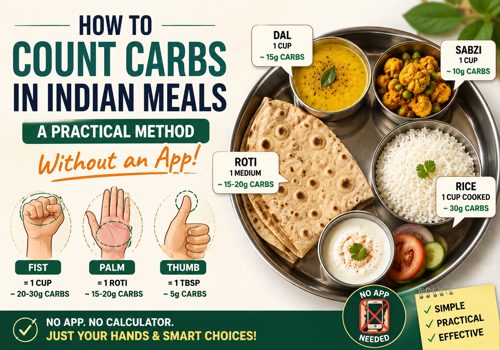
Carb counting in Indian food is the single most practical skill a Type 1 diabetic can learn — yet nobody teaches it in the context of roti, rice, and dal.
Every app assumes you eat sliced bread and canned soup. Your kitchen makes chapati, khichdi, and sambar.
The good news: you do not need an app, a food scale, or a dietitian sitting beside you at every meal. You need three things — your hand, a reference number for each Indian staple, and a simple method that takes 30 seconds.
This guide gives you all three. No guessing. No app required. Lets learn how to count carbs in indian meals.
Why Carb Counting Matters More Than Calorie Counting for Indian T1D Patients
Think of your body as a car. Calories measure how much fuel is in the tank, but carbohydrates are the accelerator pedal that directly revs your blood sugar. For Type 1 Diabetes (T1D) management, tracking calories only helps with weight, but counting carbs is the exact tool needed to calculate insulin doses and stop dangerous blood sugar rollercoasters.
Here is why carb counting is the ultimate superpower for the Indian plate:
- Perfect Insulin Matching: Every gram of carb needs a matching unit of rapid-acting insulin. Using an Insulin-to-Carb Ratio (ICR) removes the dangerous guesswork, letting you dose precisely for what you actually eat.
- The High-Carb Indian Reality: Traditional Indian diets are naturally carb-heavy, often making up approx 60% to 70% of daily calories. Staples like white rice (GI 73) and maida rotis ( GI 85-89 ) act like fast-acting sugar floods. Meticulous carb counting acts as your safety brake.
- Taming “Naked” Carbs: Many regional meals rely heavily on simple, refined starches. Tracking your carbs helps you consciously ensure that at least 70% come from complex, fiber-rich “slow carbs” (like bajra, jowar, or legumes) to keep your energy steady.
- Freedom to Eat Traditional Foods: By using Basic Carbohydrate Counting (BCC) and carb exchanges, you gain absolute food freedom. You can easily swap a bowl of rice for a whole-wheat chapatti or dal while keeping your total carb load—and insulin dose—perfectly balanced.
The Hand Portion Method: Count Carbs in Any Indian Meal Without a Scale or App
Imagine you are at a family wedding or your favorite local restaurant. Pulling out a kitchen scale or typing every ingredient into an app is awkward, stressful, and ruins the joy of eating.
Thankfully, you carry the ultimate carb-counting tool everywhere you go: your own hands.
Because your hand size is proportional to your body, it serves as a highly personalized, permanent visual guide. Clinical guidelines from institutions like the American Diabetes Association and Diabetes UK emphasize that managing diabetes effectively relies heavily on portion sizes and total carbohydrate load. In diabetes care, we use a simple benchmark: one standard “carb choice” or serving equals exactly 15 grams of carbohydrates.
Here is how to turn your hands into a precise medical measuring toolkit for traditional Indian meals.
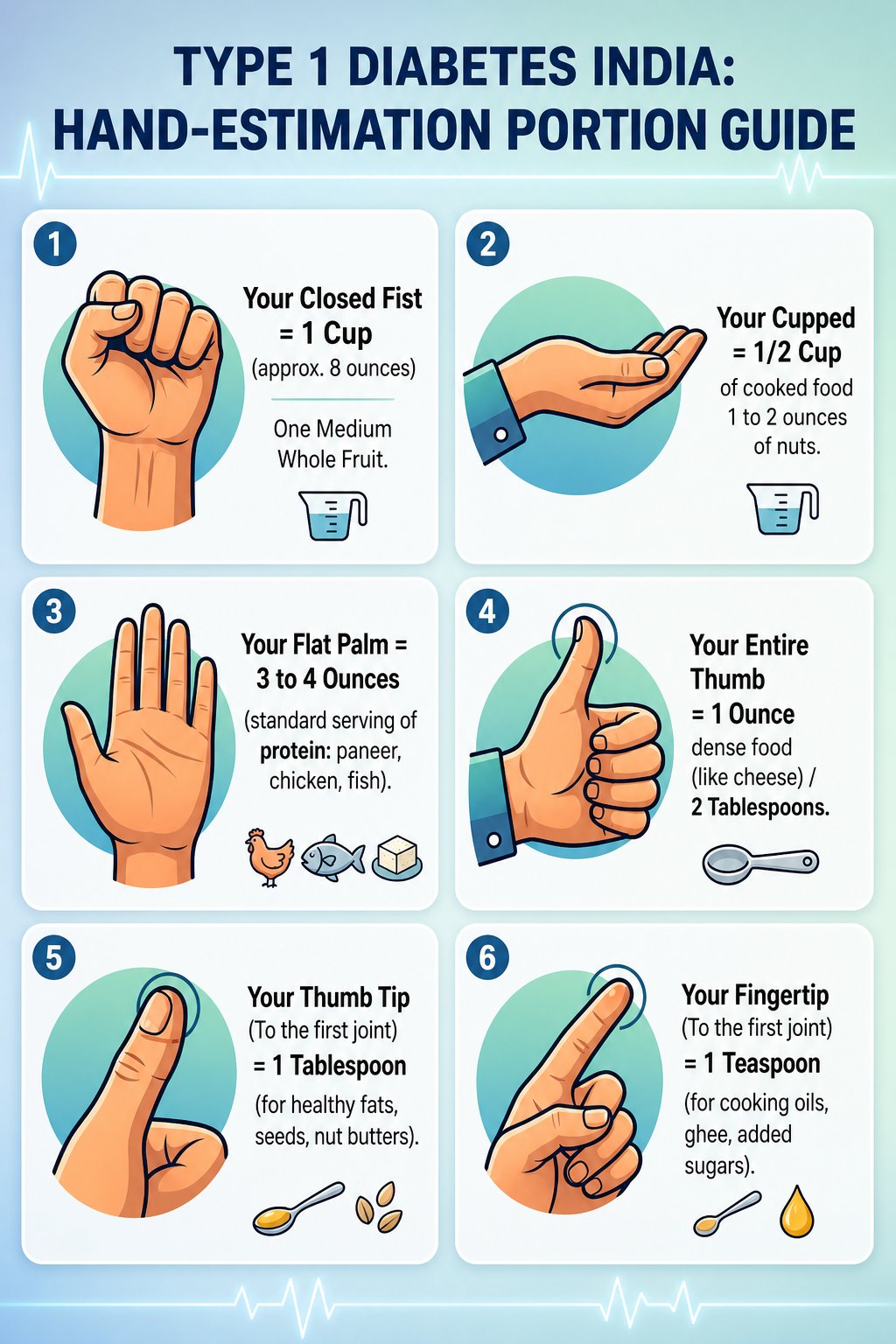
The Hand-to-Measurement Blueprint
Before we look at the plate, let’s calibrate your hands:
- Your Closed Fist = 1 cup : Your fist represents the exact volume of 1 cup of food (roughly 8 ounces) or one medium whole fruit.
- Your Cupped Hand = half cup : Cupping your hand creates a bowl that perfectly holds half cup of cooked food or 1-2 ounces of nuts.
- Your Flat Palm = 3-4 ounces : Your palm (excluding your fingers and thumb) represents a standard serving of clean protein, like paneer, chicken, or fish.
- Your Entire Thumb = 1 ounce or 2 table spoon : Your whole thumb represents about 1 ounce of dense food like cheese.
- Your Thumb Tip (To the first joint) = 1 table spoon: Use this to estimate healthy fats, seeds, or nut butters.
- Your Fingertip (To the first joint) = 1 tea spoon : This is your guide for cooking oils, ghee, or added sugars.
Eyeballing Carbs on an Indian Plate
Now, let’s apply these visual markers to a classic Indian thali to count your carbs instantly:
1. Rice & Grains
A mere 1/3 cup of cooked white or brown rice contains 15 grams of carbs. If you scoop a mound of basmati rice onto your plate that matches the size of your closed fist (1 cup), you are consuming3 carb servings, which equals 45 grams of carbohydrates.
2. Dals, Sambhar, and Legumes
Lentils and beans are dual powerhouses of protein and fiber, but they still contain complex carbs. A cupped hand (1/2 cup) of cooked toor dal, moong dal, rajma, or chole provides roughly 15 grams of carbs.
3. Starchy Vegetables
Non-starchy vegetables like bhindi, palak, or gobi have a negligible impact on blood sugar. However, starchy favorites like aloo sabji (potato) or sweet potato pack a heavier punch. One cupped hand (1/2 cup) of cooked potatoes equals 15 grams of carbs.
4. Traditional Indian Breads
While you cannot measure flatbreads by volume, you can use the span of your hand to eyeball their diameter. One standard 6-inch home-cooked whole-wheat chapatti—which is roughly the width of your outspread fingers—equals 15 grams of carbs. If you prefer grain alternatives like bajra, jowar, or makai rotis, keep in mind that these are typically denser; therefore, just half of a 6 inch millet roti equals 15 grams of carbs.
5. Whole Fruits
Craving a sweet finish? A whole piece of fruit that fits neatly inside your closed fist (like a small apple, pear, orange, or guava) equals 15 grams of carbs.
Carb Count of Every Indian Staple: Roti, Rice, Dal, Sabzi & More
Managing Type 1 Diabetes in an Indian kitchen can feel like navigating a carbohydrate minefield. However, you do not have to abandon your favorite foods; you simply need to understand how they behave on your plate. In clinical diabetes education, we simplify meal planning using “Carbohydrate Choices.” Think of it as a currency system where 1 standard carb choice equals exactly 15 grams of carbohydrates.
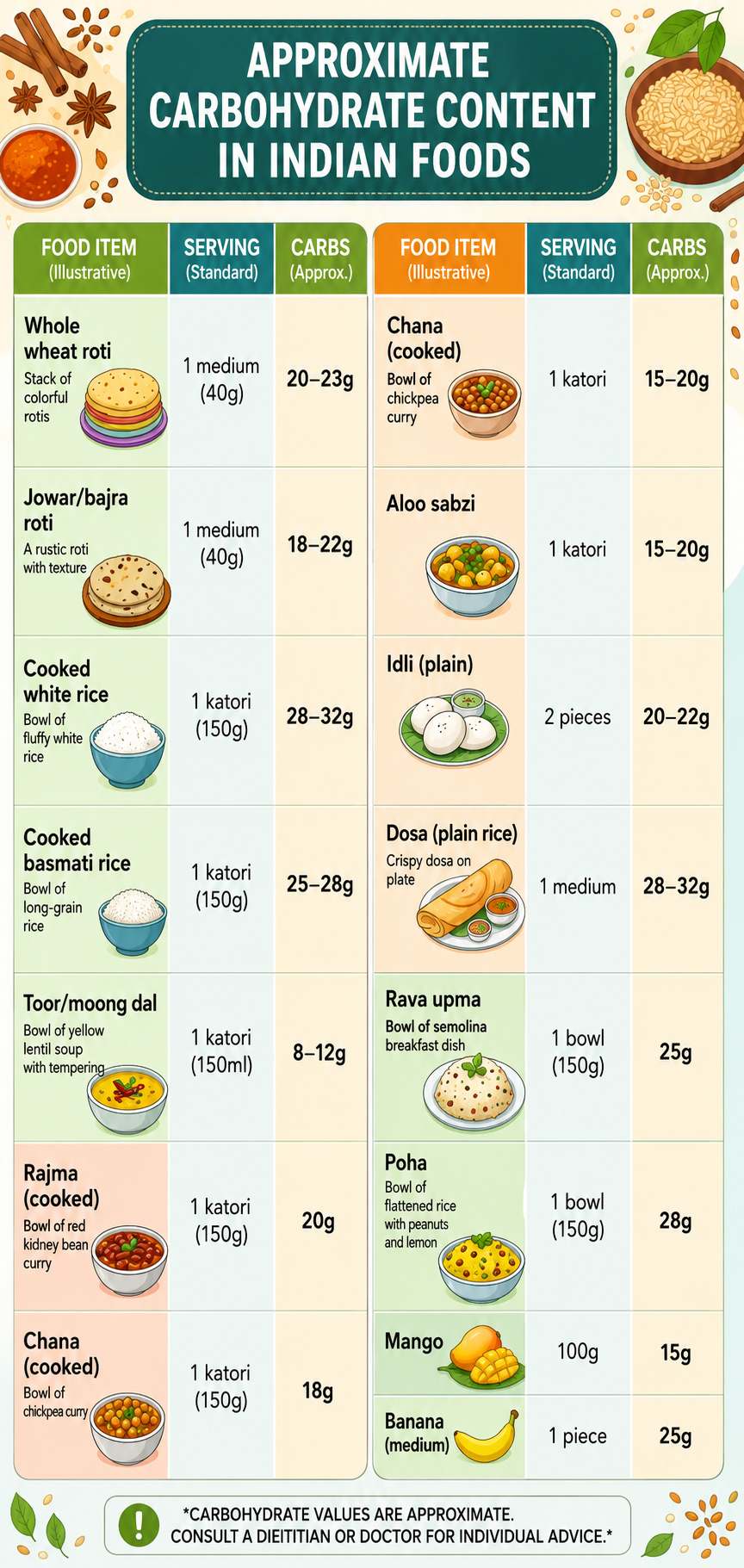
The 15 gram Carbohydrates Cheat Sheet (1 Carb Choice)
1. Indian Breads & Flatbreads
Flour density dictates your portion size. Refined maida options like naan ($GI\text{ }85-89$) lack fiber, causing rapid blood sugar spikes.
- 1 Whole-Wheat Chapatti: (6 inch diameter).
- 1/2 Millet Roti: (Bajra, Jowar, or Makai). Coarse grains are tightly packed.
- 1/2 Paneer Paratha: Paneer acts as a protein brake, but the outer flour shell counts.
- 1/4 Restaurant Naan: Refined white flour floods the bloodstream with glucose quickly.
- 1 Plain Dosa (10 inch) or 1 Standard Idli: Rice-based, but fermentation improves glycemic load.
2. Rice, Grains & Dals
- 1/3 Cup Cooked Rice: (White or Brown). A small fist-sized cup (1 cup) actually equals 45 grams of carbs.
- 1/2 Cup Poha, Upma, or Khichdi: Light but carb-dense breakfast grains.
- 1/2 Cup Thick Dal or Legumes (Rajma/Chole): Lentils feature a low glycemic index (GI 28 for chickpeas), releasing glucose slowly.
- 1 Cup Rasam: Diluted with water, allowing a larger volume.
3. Sabzis, Snacks & Desserts
- Starchy Vegetables (1/2 cup = 15 gram) : Aloo Sabji (potato), sweet corn, and green peas.
- Non-Starchy Vegetables (1/2 cup = 5 g): Bhindi, palak, and cabbage.
The Fiber Bonus: Eating a cup of non-starchy green vegetables before your roti creates an un-digested fiber mesh in your gut, cutting post-meal spikes by up to 40!
- Street Food & Sweets: 3/4 Vegetable Samosa (a whole one contains 21 g), 6 Pani Puris, 1 small Gulab Jamun, or 1/3 cup Gajar Halwa.
⚠️ The Restaurant Tax: Restaurant meals often feature hidden carbs, larger portions, and heavy cream, increasing total carbohydrate loads by 20%-40%. When dining out, round up your carb estimates and pair them with clean protein to protect your time-in-range.
How to Count Carbs in a Mixed Indian Thali Without Measuring Each Dish
Staring at a massive festive thali with multiple katoris (small bowls) can feel incredibly overwhelming when you are trying to manage your blood sugar. You do not need a digital scale to eat safely; instead, turn your thali into a visual map using the Diabetes Plate Method combined with quick hand-estimation tricks.
1. Divide Your Thali Vertically
Mentally slice your 9-inch dinner plate into three simple zones:
- One-Half for Green Safety: Fill 50% of your plate with non-starchy vegetables like palak, bhindi, or fresh salad. These fiber-rich options create an intestinal gel mesh that slows down sugar absorption, meaning you do not need to strictly count them.
- One-Quarter for Power Proteins: Dedicate this section to paneer, chicken, fish, or eggs. Note for vegetarians: While dals, rajma, and chole provide excellent protein, they are dual-purpose foods that contain significant carbohydrates and must be accounted for in your mealtime dose.
- One-Quarter for Carbs: Reserve this final section strictly for your grains and starchy sides, like rice, chapatis, or aloo sabzi.
2. Eyeballs vs. Katoris
Once your carb-heavy foods are grouped into their quarter-section, use these fast, clinical visual anchors to estimate the exact carb load:
- The Hand Span: One standard 6-inch whole-wheat chapatti equals 15 grams of carbs. If it is a thick restaurant naan or paratha, just half of it hits that 15-gram mark.
- The Fist: A mound of rice the size of your closed fist (1 cup) packs roughly 45 grams of carbs. If it fits neatly inside your cupped hand (1/2 cup), count it as 30 grams.
- The Cupped Hand: One standard katori of thick dal, rajma, or aloo sabzi is roughly the size of a cupped hand (1/2 cup) and equals 15 grams of carbs.
- The Yogurt Factor: Dairy contains natural milk sugars. A full 1-cup bowl of plain curd or dahi counts as 12 to 15 grams of carbs.
3. Defeating Thali Traps
Commercial restaurant thalis are designed for maximum flavor, which introduces hidden blood sugar variables. Watch out for these three common traps:
- The Mixed Dish Blur: For complex, mixed dishes like veg biryani, mentally separate the components. Estimate the base rice layer first, then add a small buffer for any starchy vegetables mixed into it.
- The Restaurant Portion Tax: Commercial thali portions are routinely 20 percent to 40 percent larger than home-cooked food. A single serving of restaurant rice can easily pack 3 to 4 standard portions. Always round up your insulin calculations slightly when dining out.
- The Hidden Sugar Flood: Sweetened commercial gravies, sweet tamarind chutneys, and the single gulab jamun sitting at the center of the plate are pure fast-acting sugars. Use your thumb tip (1 tablespoon) to estimate sweet chutneys, and count that single, small decorative sweet as an immediate 15 grams of carbs.
How Food Pairing Changes the Effective Carb Impact of Your Indian Meal
Eating carbohydrates by themselves is like driving a motorcycle at full speed on an empty highway—there are no brakes to stop a sudden blood sugar crash. Clinical data from the Indian Council of Medical Research (ICMR) and Diabetes UK confirms that pairing your carbs with the right ingredients completely rewrites how they behave inside your body.
By mastering the art of food pairing, you can flatten your glucose curves without giving up your favorite traditional meals.
The Ultimate Insulin Brakes: Fiber, Protein, and Fat
When you eat a plain plate of white rice (GI 73) or a white-flour maida naan (GI 85-89), your digestive enzymes convert that starch into blood sugar within minutes. However, adding specific partners turns that fast-acting sugar explosion into a slow, steady release of energy:
- Fiber Acts as a Speed Bump: Soluble fiber from non-starchy green sabzis (like bhindi, palak, or cabbage) forms a thick, protective gel mesh inside your digestive tract. Mayo Clinic research highlights that this physical barrier safely traps glucose molecules, delaying their absorption. Eating a cup of fiber-rich greens before your main grain can cut your post-meal blood sugar spike by up to 40%.
- Fats and Proteins Prolong Digestion: Protein and healthy fats stimulate hormones that slow down gastric emptying (the speed at which food leaves your stomach). Pairing your roti with clean proteins like paneer, chicken, or tofu ensures a highly sustained energy curve. Even simple swaps—like mixing a bowl of white rice with curd—significantly lowers the overall glycemic load of your plate.
- The Cereal-Pulse Synergy: Combining grains and lentils in a precise 3:1 ratio creates a complete, high-quality amino acid profile. This classic pairing satisfies your hunger for up to 5 hours while dramatically improving long-term insulin sensitivity.
⚠️ Beware of the “Delayed Restaurant Spike” Trap
While food pairing is a highly effective clinical strategy, rich restaurant meals introduce a hidden metabolic twist. Heavily oiled dishes like biryani or butter chicken combined with naan contain massive amounts of hidden fats and cream.
Because fat drastically delays stomach emptying, the carbohydrates in these celebratory meals might not hit your bloodstream until 3-5 hours after your final bite. If you use rapid-acting mealtime insulin, this can lead to an immediate low followed by a massive, unexpected spike later in the night.
Never intentionally drown your food in extra ghee or heavy cream just to manipulate the Glycemic Index, as excess saturated fats cause silent tissue inflammation and long-term insulin resistance. Focus on clean, home-cooked pairings to protect your time-in-range naturally.
Common Carb Counting Mistakes Indians Make — And How to Fix Them
Counting carbohydrates in traditional Indian diets can be challenging due to the complexity of the recipes, the heavy reliance on staples, and the use of unstandardized serving bowls.
Here are the most common carb-counting mistakes Indian patients make, along with practical solutions to fix them:
1. Forgetting to Count Dals and Legumes as Carbohydrates
- The Mistake: Because dals (lentils) and legumes (like rajma or chole) are heavily promoted as vegetarian protein sources, many people mistakenly categorize them purely as protein and forget to count their carbohydrate content.
- The Fix: Always remember that pulses and legumes are carb-heavy. A ½ cup serving of cooked dal or legumes contains approximately 15 grams of carbohydrates. When visualizing your meal using the Diabetes Plate Method, dal must be factored into the “carb quarter” of your plate, not just the protein section.
2. Relying on Unstandardized “Katori” and Roti Sizes
- The Mistake: Recipes and meal plans often use a katori (small bowl) as a unit of measurement. However, household katoris can range anywhere from a small 115 ml bowl to a large 360 ml bowl. Similarly, a homemade roti can vary vastly in diameter and thickness depending on who is cooking it.
- The Fix: Standardize your mental measurements. A standard reference katori holds about 150 to 180 ml. For breads, a standard 15g carbohydrate serving is exactly one 6-inch diameter chapati or half of a thicker bajra or makai roti. Practice measuring your usual katoris with a standard measuring cup at home so you know exactly what volume your bowls hold.
3. Underestimating Restaurant Portions and Added Fats
- The Mistake: Assuming a restaurant meal has the same carb and calorie count as a home-cooked meal. Restaurant preparations are typically 20% to 40% higher in calories because they use significantly larger portion sizes (often 250-300 ml per bowl) and much heavier amounts of oil, ghee, and cream.
- The Fix: When dining out, increase your estimated carb and calorie count for the dish. Additionally, be aware of the “delayed spike” trap: the exceptionally high fat content in rich restaurant curries or biryanis slows down carbohydrate absorption, which can cause an unexpected blood sugar spike hours after you finish eating.
4. Falling for the “Sugar-Free” Trap
- The Mistake: Believing that packaged “sugar-free” Indian sweets (like mithai or biscuits) are automatically carbohydrate-free. People often associate these labels with being fully safe for diabetes management.
- The Fix: “Sugar-free” foods can still be loaded with refined cereals (like white flour and starch), fats, and hidden sugar substitutes (such as maltitol or corn syrup), all of which contribute to a high glycemic impact. Always look at the nutrition label for “Total Carbohydrates,” rather than just checking the “Sugars” line. Furthermore, aim to limit added sugars to less than 10% (and preferably less than 5%) of your total daily calories.
5. Getting Confused by Mixed Dishes
- The Mistake: Guessing the total carb count of mixed dishes like khichdi, biryani, bisi bele bhath, or a mixed vegetable curry by just eyeballing the whole plate, which often leads to inaccurate insulin dosing.
- The Fix: Break the mixed dish down into its individual components. For example, if eating a burrito or a complex thali, separate the rice, the lentils/beans, and the flatbread in your mind, calculate the carbs for each individual component using the hand-portion method, and then add them together.
6. Ignoring the “Hidden” Carbs in Condiments
- The Mistake: Generously pouring sweet tamarind chutney on chaat, eating sweetened gravies, or consuming raita with added sugar without tracking them.
- The Fix: Treat sweet chutneys and sauces as significant carb sources. Use the tip of your thumb as a visual guide for 1 tablespoon to estimate the volume of these hidden carbs before you eat.
Reference:
https://www.sciencedirect.com/science/article/abs/pii/S0899900723003465
https://diabetesjournals.org/care/article/48/Supplement_1/S86/157553
https://diabetes.org/food-nutrition/understanding-carbs/eyeball-carbohydrate-servings
https://pubmed.ncbi.nlm.nih.gov/39058316
https://pubmed.ncbi.nlm.nih.gov/28839326
https://www.cdc.gov/diabetes/healthy-eating/diabetes-meal-planning.html
https://diabetes.org/food-nutrition/understanding-carbs/carb-counting-and-diabetes
https://desiutils.in/tools/indian-meal-calories
https://www.cdc.gov/diabetes/healthy-eating/carb-counting-manage-blood-sugar.html
https://pubmed.ncbi.nlm.nih.gov/39058316
About the author
It’s me Mohammad Junaid Rain an MBBS student at GMC Nagpur, passionate about making evidence-based medical information accessible to every Indian. “medstuffs.com” is dedicated to clear, disease education for patients and caregivers.
Disclaimer: This article is for educational purposes only and does not substitute professional medical advice. Please consult your doctor for diagnosis and treatment.