
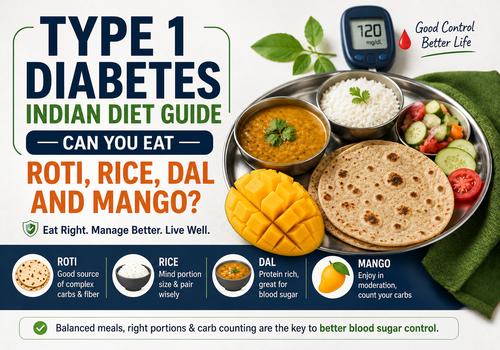
Newly diagnosed patients always ask the same fearful question: “Can I ever eat rice or mango again?” Standard advice says a flat “no.”
But as a medical student, I’m here to tell you that mastering a type 1 diabetes indian diet isn’t about restriction—it’s about precise biochemistry. You do not have to banish roti, rice, dal, or mango. This guide breaks down advanced carbohydrate counting and insulin matching so you can confidently eat the Indian staples you love without the unpredictable blood sugar spikes.
Why Carbohydrates Matter Most for Type 1 Diabetes — Not Sugar Alone?
The most common misconception I see among newly diagnosed Type 1 Diabetes (T1D) patients is focusing solely on “sugar.” The clinical reality is that all carbohydrates dictate your daily survival and insulin needs.
In this article we are going to learn about type 1 diabetes Indian diet guide. Whether it is white table sugar or a starchy plate of rice and roti, your body breaks both down into glucose. Because the pancreas in T1D produces zero insulin, patients must master Carbohydrate Counting—calculating the exact grams of carbs in a meal to precisely match it with a pre-meal injection of rapid-acting insulin.
To execute this safely, we use a personalized Insulin-to-Carbohydrate Ratio (ICR). If your physician sets your ICR at 1:10, you require 1 unit of insulin for every 10 grams of carbohydrates consumed.
Carbohydrate quality also alters this timeline. High-fiber complex carbs (like dal) slow down digestion, creating a gentle glucose curve, whereas liquid sugars trigger rapid, unmanageable spikes. Managing T1D means looking beyond “sugar-free” marketing to calculate the total carbohydrate load.
Glycemic Index of Common Indian Foods: The Complete Chart
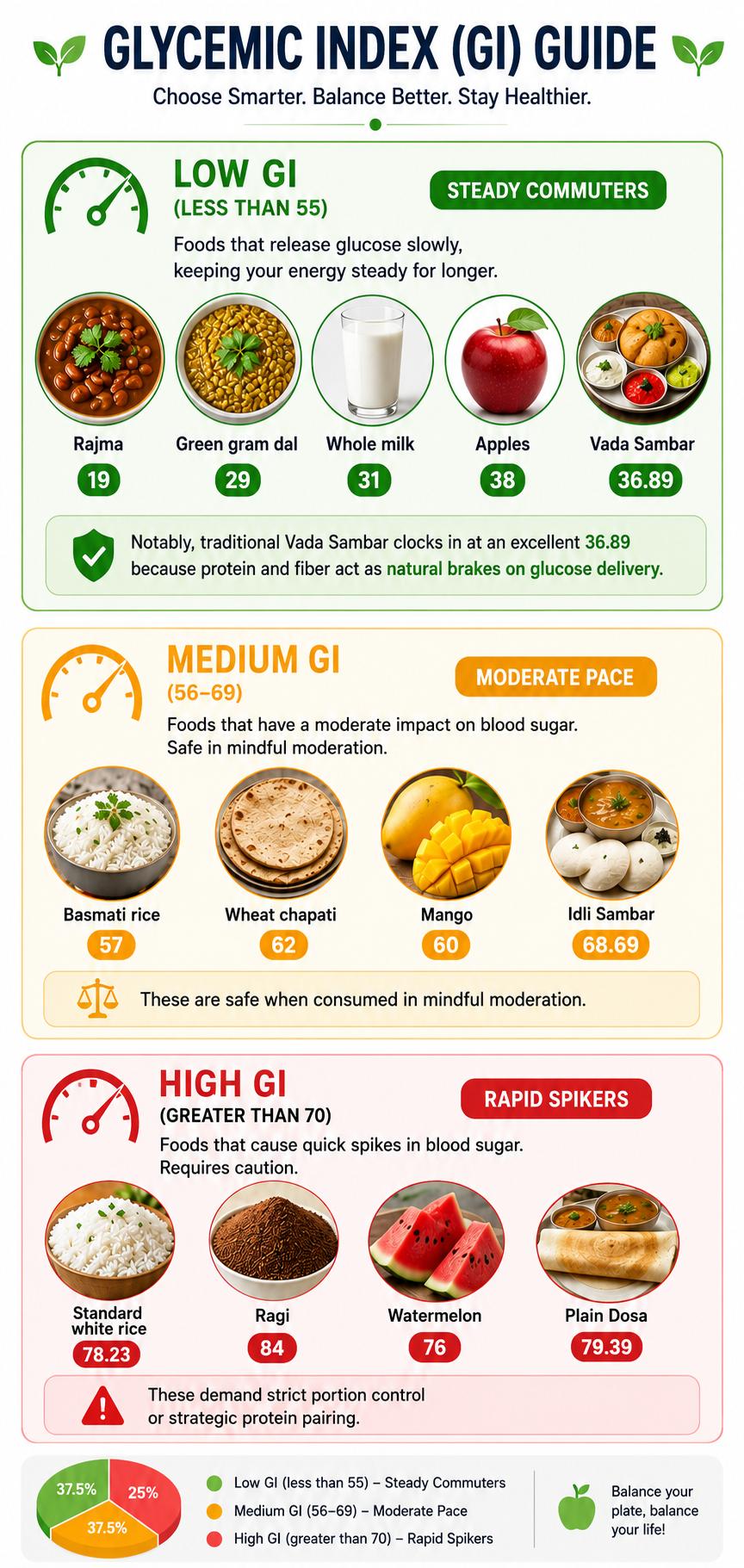
Based on the Indian Council of Medical Research (ICMR) guidelines, Indian foods are classified into three distinct metabolic zones. Shifting your diet to focus on these zones helps transition your diabetes care from restrictive “sugar-free” counting to advanced carbohydrate management.
- 🟢 Low GI (less than 55) – Steady Commuters: Rajma (19), Green gram dal (29), Whole milk (31), and Apples (38). Notably, traditional Vada Sambar clocks in at an excellent 36.89 because protein and fiber act as natural brakes on glucose delivery.
- 🟡 Medium GI (56–69) – Moderate Pace: Basmati rice (57), Wheat chapati (62), Mango (60), and Idli Sambar (68.69). These are safe when consumed in mindful moderation.
- 🔴 High GI (greater than 70) – Rapid Spikers: Standard white rice (78.23), Ragi (84), Watermelon (76), and Plain Dosa (79.39). These demand strict portion control or strategic protein pairing.
The Clinical Catch: Never view GI in isolation. Ice cream has a lower GI (61) because high fat concentrations delay gastric emptying, yet it compromises long-term metabolic health. Always prioritize the Glycemic Load (GL)—multiplying carbohydrate quality (GI) by physical quantity (serving size)—for the truest picture of blood sugar impact.
Can You Eat Roti with Type 1 Diabetes? Wheat, Jowar, Bajra & Multigrain Compared
Yes, you can absolutely eat roti with Type 1 Diabetes (T1D). Since management relies on exogenous insulin, no grain is strictly forbidden; success is all about precise Carbohydrate Counting to match your pre-meal bolus via your Insulin-to-Carbohydrate Ratio (ICR).
As a golden clinical rule: one standard 6-inch wheat chapati contains roughly 15 grams of carbohydrates. However, your choice of flour drastically alters how fast that glucose hits your blood:
- 🟢 Multigrain (Wheat + Chana Dal / Barley): The absolute metabolic winner. This blend drops the GI to an ultra-low 32–39, perfectly matching the timing of your rapid-acting insulin.
- 🟡 Standard Wheat (GI 62–65) & Bajra (GI 67): These are moderate spikers. They require a mandatory “buffer” of protein (dal/paneer) and fiber to slow down absorption.
- 🔴 Jowar (Sorghum – GI 77): A shocker for most patients. Jowar is a high-GI grain that converts to glucose rapidly, frequently outpacing your injected insulin curve.
Clinical Pro-Tip: Roti thickness can easily double your carb count. Weigh your dough balls to keep your ICR calculations precise and stop post-meal spikes before they start.
Rice & Type 1 Diabetes: White Rice vs Brown Rice vs Millets — What’s Safer?
For Type 1 Diabetes (T1D), no grain is strictly off-limits if your carbohydrates are accurately counted and covered with rapid-acting insulin via your personalized Insulin-to-Carbohydrate Ratio (ICR). However, to prevent sharp post-meal glucose spikes, understanding the glycemic timeline of your daily “Chawal” is vital. Let’s look at the real numbers:
- 🔴 The Rapid Spikers: Standard white rice carries a High GI of 78 (GL 49). Shockingly, health-marketed alternatives like Jowar (GI 77) and Ragi (GI 84) break down into glucose even faster, frequently outpacing your bolus insulin.
- 🟡 The Stable Choices: Basmati rice (GI 57) and Brown rice (GI 68) land in the Medium GI zone, offering a much more predictable, manageable blood sugar rise. Bajra (GI 67) behaves similarly.
While guidelines recommend that whole-grain millets make up 20% to 30% of your daily grains for long-term metabolic and gut health, they require tactical management.
The Clinical Safety Protocol: True safety lies in your plate architecture. Never eat these carbs “naked.” Combining your rice or millet with high-fiber vegetables and dense protein (dal, paneer, eggs) delays gastric emptying, smoothing out the glucose peak. Always weigh your grains raw to ensure your carbohydrate counting stays exact.
Can a Type 1 Diabetic Eat Mango, Banana & Other Indian Fruits?
The short answer is a resounding yes. Patients are thrilled to learn that because Type 1 Diabetes (T1D) is managed with precise exogenous insulin, no fruit is completely forbidden. The golden key is accurate carbohydrate counting via your Insulin-to-Carbohydrate Ratio (ICR).
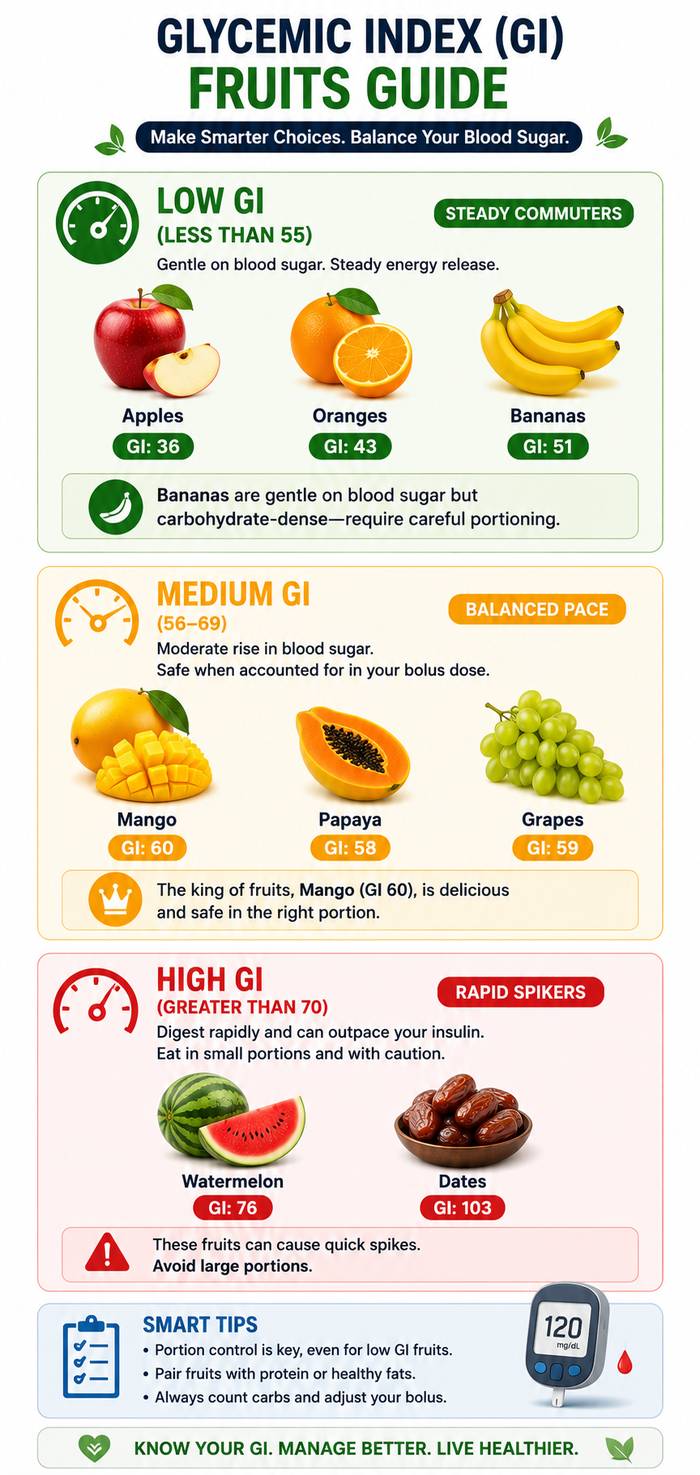
Indian fruits impact your blood sugar timeline based on their Glycemic Index (GI):
- 🟢 Low GI (less than 55) – Steady Commuters: Apples, oranges, and surprisingly, Bananas (GI 51). While gentle on the blood sugar curve, bananas are carbohydrate-dense, requiring careful portioning.
- 🟡 Medium GI (56–69) – Balanced Pace: The king of fruits, Mango (GI 60), alongside papaya and grapes. They cause a moderate rise and are perfectly safe when accounted for in your bolus dose.
- 🔴 High GI (greater than 70) – Rapid Spikers: Watermelon (76) and Dates (103). These digest rapidly and can outpace your insulin if eaten in excess.
Clinical Practice Rules:
- Ditch the Juices: Juicing strips away the dietary fiber “brakes,” turning a safe fruit into an aggressive sugar spike. Always eat whole fruits.
- The 100g Standard: Align with Indian dietary guidelines by eating 100 grams of whole fruit per day (averaging 11 grams of carbohydrates), making your pre-meal insulin matching effortless.
Dal, Rajma, Chana & Lentils: The Best Friends of a Type 1 Diabetic
In my clinical postings at GMC Nagpur, I recommend pulses and legumes as the ultimate blood sugar stabilizers for Type 1 Diabetes (T1D). The hardest part of T1D management is matching your rapid-acting insulin peak with food digestion. Refined grains often trigger rapid spikes, but pulses enter the blood at a perfectly slow crawl.
They sit firmly in the ultra-low GI category ($\le$ 55):
- 🟢 Rajma (Red Kidney Beans): GI 19
- 🟢 Green Gram Dal (Moong): GI 29–42
- 🟢 Bengal Gram (Chana): GI 38
- 🟢 Masoor Dal (Lentils): GI 42
Per 100g raw, pulses deliver 12g of fiber and 22.8g of plant protein. This combination delays gastric emptying, giving your bolus insulin ample time to work.
The Clinical Protocol:
- Never Skip Dosing: Raw pulses pack 49g of carbohydrates per 100g. Accurate carbohydrate counting via your ICR is mandatory to prevent late-onset hyperglycemia.
- The 3:1 Rule: Combine pulses with cereals in a 3:1 ratio to build a complete protein structure containing essential methionine.
- The Flour Hack: Blend chana flour into standard wheat atta to drop your roti’s GI from 65 to an ultra-low 32.
FAQ
what is 10-10-10 rule for diabetics person
Walk for 10 minutes, starting 10 minutes after a major meal, to lower your post-meal blood sugar spike by up to 10% (or more).
what is 80/20 rule?
The 80/20 rule replaces strict restriction with sustainable diabetes control:
80% Foundation: Eat low-GI whole foods, fiber, and lean proteins most of the time to keep baseline blood sugars stable.
20% Flexibility: Allow space for mindful, occasional treats to prevent lifestyle burnout.
what foods reduce HbA1c?
Foods don’t drop HbA1c instantly; they lower your three-month average by flattening daily blood sugar spikes. Focus on:
Fiber Powerhouses: Rajma, chana, moong dal, and psyllium husk trap glucose to slow absorption.
Protein & Fat Buffers: Paneer, almonds, and walnuts delay gastric emptying.
Magnesium-Rich Greens: Spinach and methi improve cell insulin sensitivity.
Smart Staples: Ancient Khapli wheat and low-GI Telangana Sona rice.
About the author
It’s me Mohammad Junaid Rain an MBBS student at GMC Nagpur, passionate about making evidence-based medical information accessible to every Indian. “medstuffs.com” is dedicated to clear, disease education for patients and caregivers.
Disclaimer: This article is for educational purposes only and does not substitute professional medical advice. Please consult your doctor for diagnosis and treatment.
1 thought on “Type 1 Diabetes Indian Diet Guide: Can you Eat Roti, Rice, Dal and Mango?”