
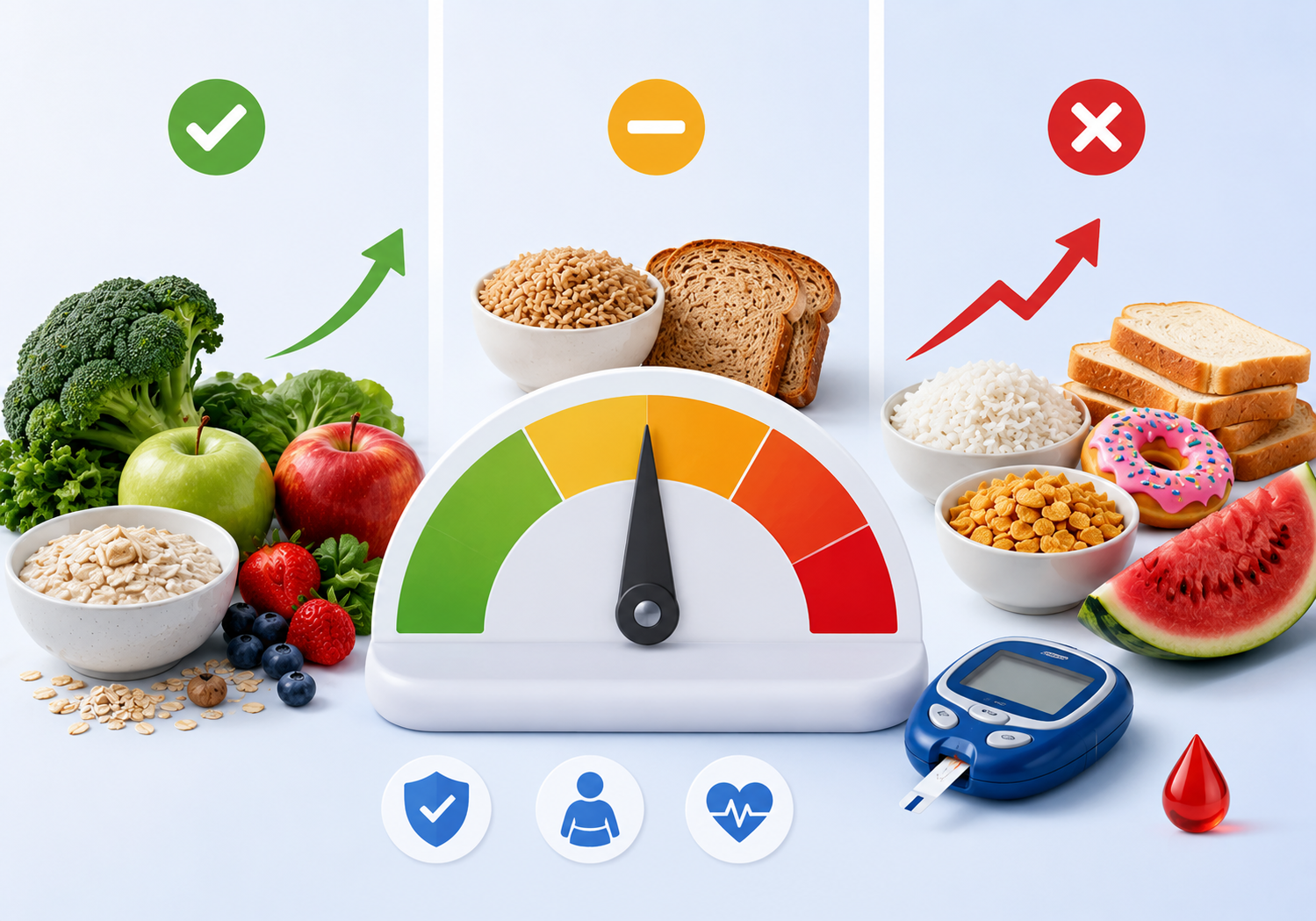
Before starting with glycemic index let me tell you something, if you are living in India or part of the global South Asian diaspora, you have likely been told that rice and roti are your enemies the moment your HbA1c crosses 6.5%.
With India officially recognized as the ”Diabetes Capital of the World”—boasting over 101 million cases according to the latest ICMR data—the standard medical advice has often been a life of ”No.” No rice, no sweets, no comfort.
But as a medical student at GMC Nagpur, I spend my days in the medicine wards seeing the psychological and physical toll this restrictive advice takes on patients. I am here to tell you that the 2026 ADA Standards of Care have undergone a massive shift. The scientific community no longer focuses solely on how many carbohydrates you eat, but on the quality and metabolic impact of those carbohydrates.
The tool that unlocks this dietary freedom is the Glycemic Index(GI). In this blog, we
dismantle the myths, explain the complex physiology through simple analogies, and give you a
data-backed roadmap to managing diabetes that feels like a lifestyle, not a prison sentence.
What is glycemic index
To understand Glycemic index, let’s step out of the biochemistry lab and on to a busy Nagpur highway. Imagine your bloodstream is a road. When you eat carbohydrates—found in your grains, fruits, and starches—they are broken down into glucose (sugar). This glucose enters your ”bloodstream highway.”
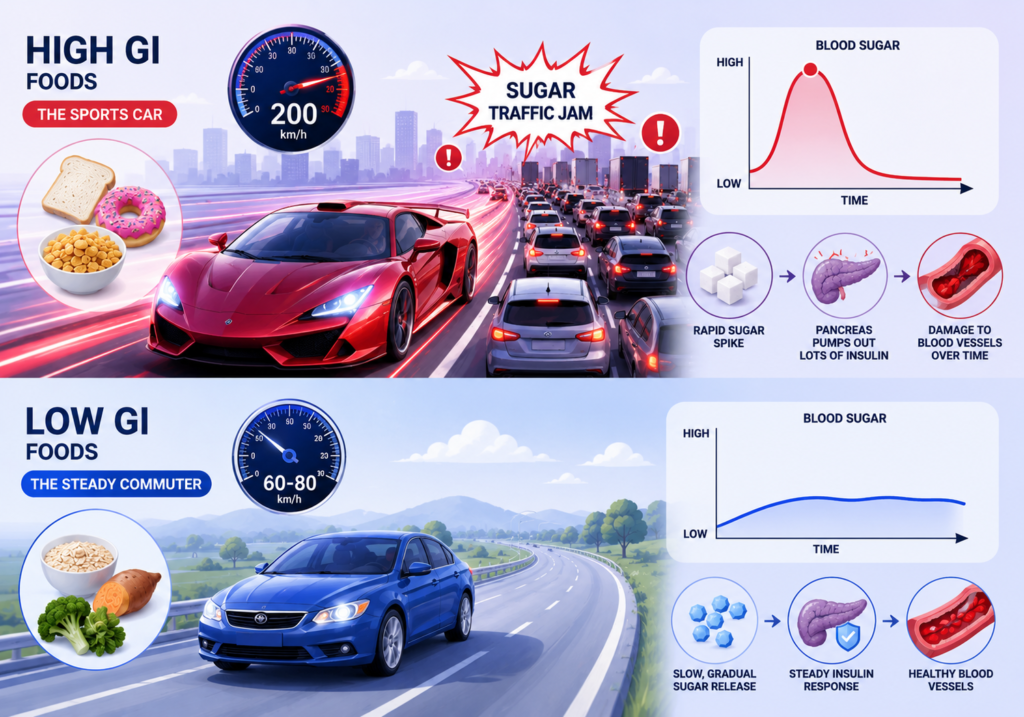
High GI Foods (The Sports Car): Some carbs act like high-speed sports cars. They zoom onto the highway at 200 km/h. This causes a massive ”sugar traffic jam” (a spike). Your pancreas must pump out insulin to clear the road. Over time, these ”crashes” damage the highway itself (your blood vessels).
Low GI Foods (The Steady Commuter): These are like steady, reliable commuters. They
enter the highway slowly and keep a consistent speed. Your blood sugar rises gently and
stays stable.
The Technical Definition: The Glycemic Index (GI) is a numerical ranking (scale of 0 to 100) of carbohydrate-containing foods based on how quickly they raise blood glucose levels after consumption. Pure glucose is the reference standard, assigned a value of 100.
Reference: PubMed- Glycemic Index
The Glycemic Index Scale: Low, Medium, and High Explained
In clinical practice, we use the ”Traffic Light” analogy to help patients make split-second decisions at the grocery store or during meals.
The Glycemic Index Classification
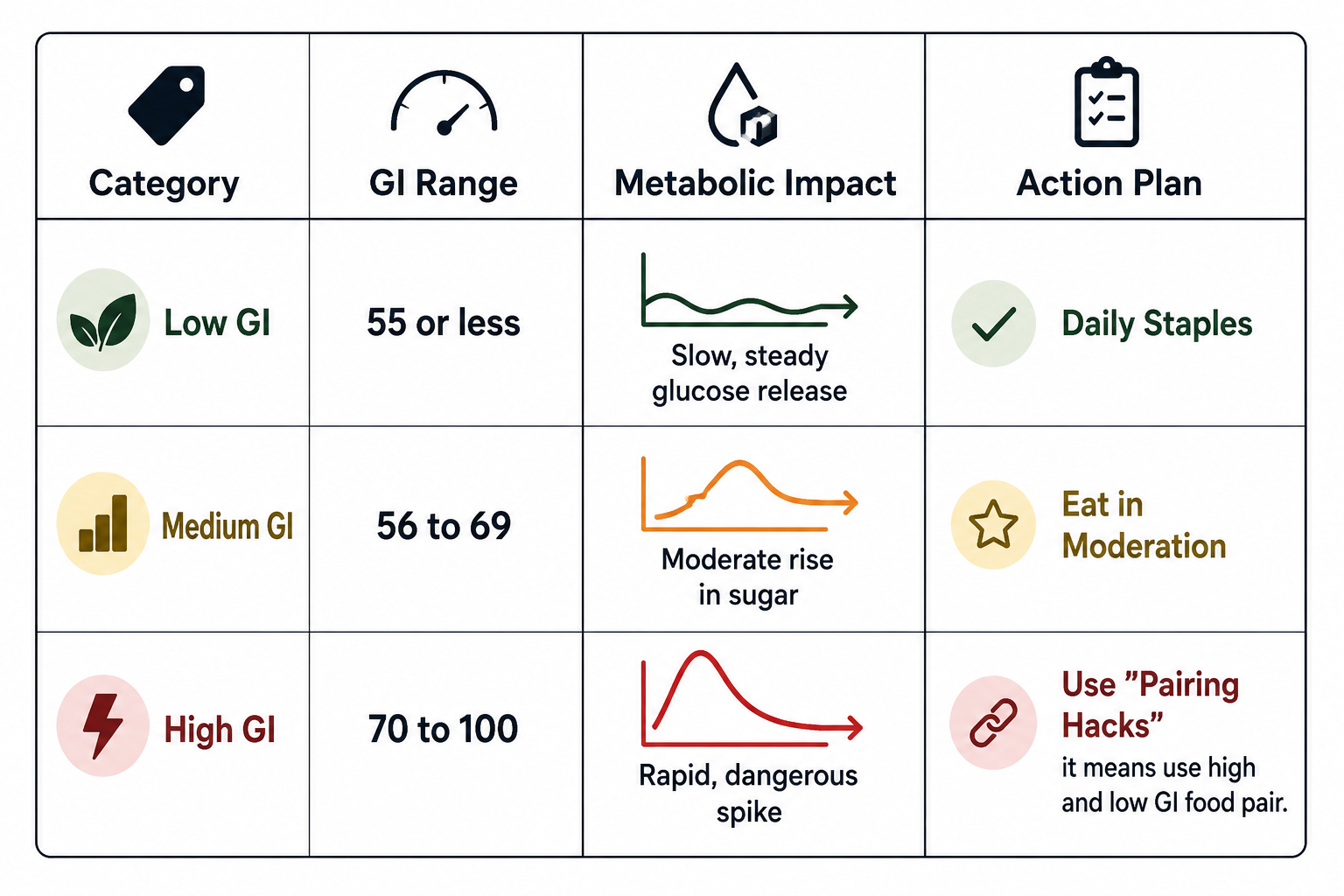
MBBS Clinical Insight: Why do we avoid the ”Red Zone” which is High Glycemic index food? High GI foods trigger Hyperinsulinemia (excess insulin), which is the primary driver of central obesity (belly fat) and worsening insulin resistance. Keeping your insulin ”quiet” is the first step to metabolic health.
Why Glycemic Index Matters Especially If You Have Diabetes
Imagine your body’s cells are houses with locked doors. Glucose is the ”guest” trying to get inside, and Insulin is the ”key.” If you constantly eat High GI foods, you are ”banging” on those doors with sugar spikes. Eventually, the lock gets jammed. This is Insulin Resistance. By switching to a Low GI lifestyle, you are ”knocking gently,” allowing your body to:
- Stabilize HbA1c: Lowering daily ”peaks” naturally lowers your 3-month average.
- Facilitate Weight Loss: Insulin is a storage hormone. Low GI choices keep insulin levels
low, shifting your body into ”fat-burning mode.” - Prevent Microvascular Complications: Stable sugar protects the tiny blood vessels in
your eyes (Retinopathy), kidneys (Nephropathy), and nerves (Neuropathy).
Glycemic Index vs. Glycemic Load: What Is the Difference?
If GI is the Speedometer (speed of rise), then Glycemic Load (GL) is the Fuel Tank (the total
amount of sugar).
- GI(The Quality): Tells you how ”fast” a carb turns into sugar.
- GL(Quantity + Quality): GL = (GI ×Carbs per serving)/100.
The Watermelon Paradox: Watermelon has a High GI (72), but since it is 92% water, its
Glycemic Load is only 5 (Low). Conversely, white rice has a High GI (73) and a High GL (25+),
making it far more impactful.
so give importance to glycemic load also, do not ignore it.
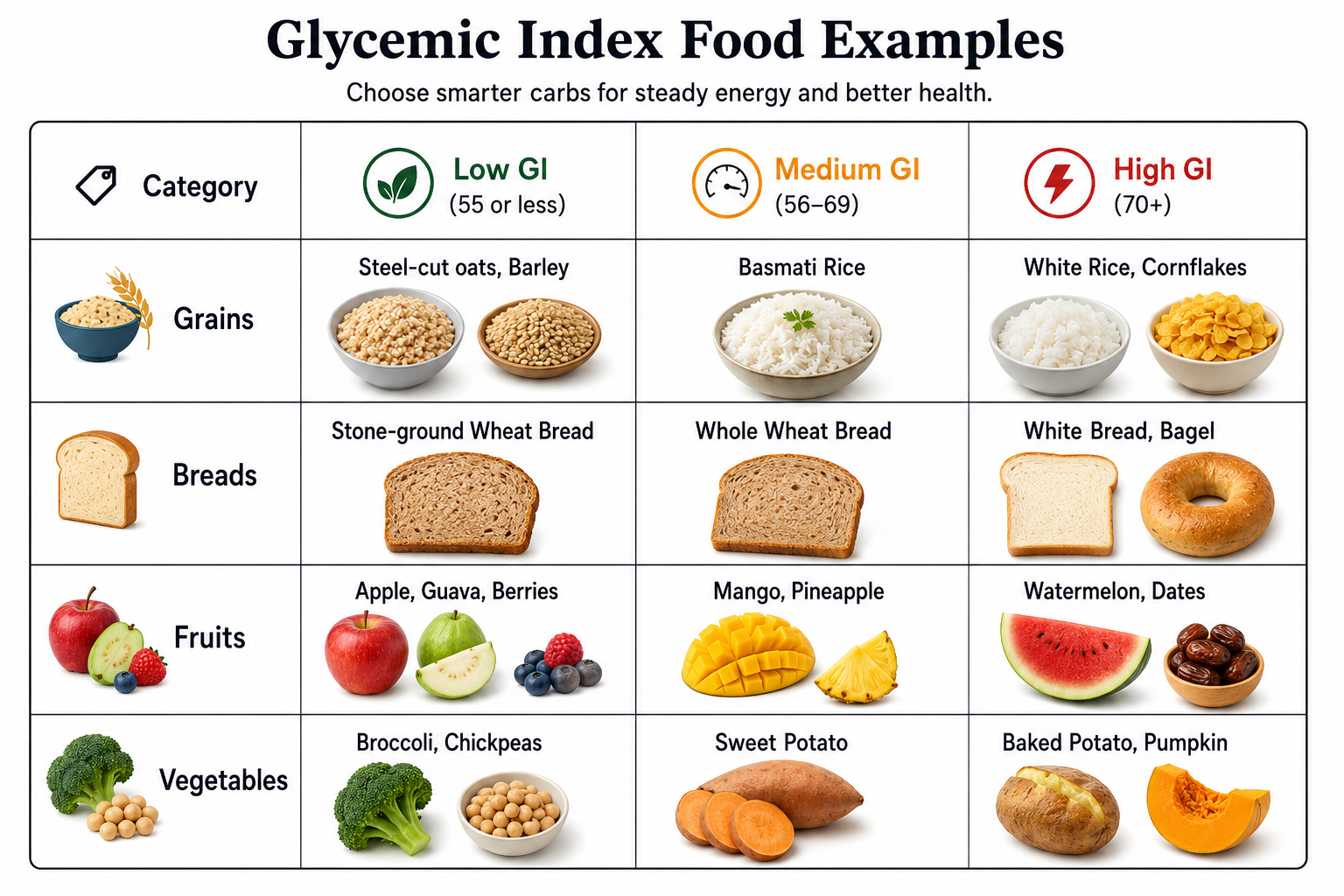
Glycemic Index Chart of Common Foods (Global Staples)
Glycemic Index of Indian Food
Global charts often ignore the ”Diabetes Capital.” Here is the Indian context.
The Rice Revolution: Telangana Sona (RNR 15048)
Rice is the heartbeat of the Indian plate. Traditional white rice (Sona Masuri) has a GI of 75−80. However, researchers at PJTSAU have identified Telangana Sona with a GI of 51. This allows rice lovers to eat their staple without the spike.
The Millet Movement (ICMR2024)
The latest ICMR guidelines emphasize ”Nutri-Cereals” to combat the metabolic epidemic:
- Jowar (Sorghum): GI ≈ 50.
- Bajra (Pearl Millet): GI ≈ 54.
- Ragi (Finger Millet): GI ≈ 54−68 (varies by grind).
What Factors Affect the Glycemic Index of Food?
A food’s GI is not ”fixed.” You can manipulate it through:
- The Cooling Hack: Cooking rice/potatoes and cooling them for 12 hours creates Resistant Starch, lowering GI by ≈ 20%.
- Acidity: Lemon juice or vinegar slows ”Gastric Emptying,” acting as a biological speed bump.
- Processing: A whole apple (Low GI) vs. apple juice (High GI). Fiber is the ”brakes” on the sugar car.
How to Use Glycemic Index in Your Daily Diet (Practical Guide)
Step 1: The ”First Bite” Rule. Order of eating matters. Consume Fiber (Salad) → Protein (Dal/Paneer) → Carbs (Rice/Roti). This creates a ”gel-filter” in the stomach.
Step 2: Smart Swaps. Replace White Rice with Basmati/Telangana Sona. Replace Maida biscuits with Roasted Chana or Makhana.
Step3: The ”Carb Buffer. ”Never eat” Naked Carbs. ”Always pair a carb with fat/protein (e.g., use ghee in roti).
Myth vs Reality
Myth 1: “Sugar-Free” products are always safe for diabetics.
The Reality: Many “sugar-free” biscuits and snacks are made with Maida (Refined Flour). While they don’t have added table sugar, the refined starch in Maida has a very high GI (75+). It turns into sugar in your blood almost instantly.
Don’t just look for “Sugar-Free” on the label; look for the carbohydrate source. If the first ingredient is refined flour, it will cause a “Sports Car” spike in your glucose.
Myth 2: Jaggery (Gur) and Honey are healthy alternatives to White Sugar.
The Reality: This is the most common myth in Indian households. While Jaggery and Honey have minor micronutrients, their Glycemic Index is roughly 58–65, which is very close to table sugar (65).
For your pancreas, sugar is sugar. Both Jaggery and Honey cause significant post-meal spikes. According to the ICMR-NIN 2024 guidelines, they should be treated with the same caution as refined sugar.
Myth 3: Cooking methods don’t change the GI of a food.
The Reality: You can take a Low-GI food and turn it into a High-GI food simply by overcooking it. For example, pasta cooked Al Dente (firm) has a lower GI than soft, mushy pasta.
The Kitchen Hack: Pressure cooking breaks down starch molecules more aggressively, raising the GI. If you are struggling with high sugar levels, try “pot-boiling” your rice and draining the excess starch water to keep the GI lower.
Myth 4: Diabetics should completely avoid “Sweet” fruits like Mango or Grapes.
The Reality: Sweetness does not always equal a high GI. A Mango has a medium GI ( 51–56 ), while a piece of white bread (which isn’t sweet) has a much higher GI (75).
It is about Glycemic Load (GL). You can eat a small portion of mango safely if you pair it with a “buffer” like a few walnuts or eat it after a high-fiber salad.
Myth 5: All “Brown” foods (Brown Bread, Brown Sugar) are Low GI.
The Reality: In many cases, “Brown Bread” is simply white bread with added caramel color and very little actual whole grain. Similarly, brown sugar is just white sugar with molasses.
Always check for “100% Whole Grain” or “Stone-ground” on the label. If it doesn’t say that, it’s likely just a High-GI “Sports Car” in a brown coat.
Myth 6: If a food is Low GI, I can eat as much of it as I want.
The Reality: This is the “Peanut Butter Trap.” While a food might be Low GI (like nuts or fats), it can still be very high in calories.
Weight gain increases Insulin Resistance. If you overeat Low-GI foods and gain weight, your diabetes management will become harder. Quantity (Glycemic Load) still matters just as much as quality (Glycemic Index).
Reference
The glycemic index: physiological significance
About the author
It’s me Mohammad Junaid Rain an MBBS student at GMC Nagpur, passionate about making evidence-based medical information accessible to every Indian. “medstuffs.com” is dedicated to clear, doctor-written disease education for patients and caregivers.
Disclaimer: This article is for educational purposes only and does not substitute professional medical advice. Please consult your doctor for diagnosis and treatment.
10 thoughts on “Glycemic Index: The Complete Guide to GI, Blood Sugar, and Smart Eating in 2026”