
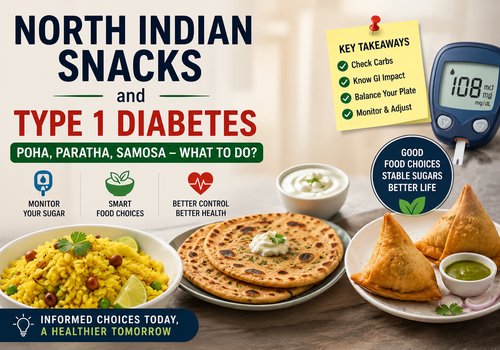
North Indian snacks and Type 1 Diabetes should not be enemies. Yet every morning across India, a parent stands at the stove wondering: “Is it safe to give my child poha today?”
Nobody tells them the answer. The apps do not understand Indian food. The hospital pamphlet says “avoid fried things and sweets” — which helps nobody staring at a plate of aloo paratha at 7am.
Here is the truth: poha, paratha and even samosa are manageable with Type 1 Diabetes. Not avoided. Managed.
The problem was never the food. The problem was never knowing exactly how many carbs are on the plate — and when to give the insulin.
This guide fixes that. One snack at a time.
Poha & Type 1 Diabetes: GI, Carb Count & the Right Way to Eat It
Poha is loved as a light, easy breakfast across Indian households, but for Type 1 Diabetes (T1D), eating it plain is like racing a motorcycle without brakes. Because your pancreas doesn’t produce natural insulin, unbuffered, rapid-digesting starches can hit your bloodstream all at once.
According to research, poha is fundamentally flattened parboiled rice. While its processing under iron rollers lets it retain some minimal fiber, its Glycemic Index and impact vary heavily by variety:
- Thin White Poha: Processing increases its surface area, pushing its GI close to 70 (High).
- Thick/Brown Rice Poha: Less processed flakes slow down digestion, keeping the GI close to 57 (Medium).
- The Carb Burden: One standard bowl (150g cooked) packs roughly 28–32 grams of fast-acting carbohydrates.
How to Build a Metabolic Safety Net
You do not have to banish poha from your thali. You just need to build a structural “net” using these clinical modifications:
- The 50-50 Vegetable Rule: Dilute the heavy starch density. Ensure your bowl is filled with 50% thick poha base and 50% non-starchy, fiber-rich green peas, beans, and carrots.
- Activate the Protein Brake: Toss in plenty of roasted peanuts. The healthy protein and fats in peanuts slow stomach emptying, lowering your sudden insulin demand. Always pair the dish with a side of curd (dahi) or boiled eggs for complete protection.
- Ditch the Aloo: Strictly ban traditional “Batata Poha” (rice plus potatoes) and crispy sev, which create unmanageable double-carb bombs.
- The Lemon Hack: Squeeze fresh lemon juice over the hot flakes. The acidity naturally lowers the meal’s glycemic response, while Vitamin C drastically boosts absorption of the dietary iron left behind by the flattening rollers.
T1D Pro-Tip: To prevent prolonged post-meal highs, count the exact carbohydrate grams in your poha base to calculate your rapid-acting insulin bolus using your specific Insulin-to-Carb Ratio (ICR).
Paratha & Type 1 Diabetes: How Many Carbs, Which Type Is Safer & How to Manage Insulin
Waking up to a piping hot paratha is a classic North Indian tradition, but for a Type 1 warrior, it requires a clear, strategic map. A plain whole wheat paratha has a medium Glycemic Index (GI) of 55–62, with one medium piece (using 50g of dough) carrying 25–30g of carbohydrates. However, trading plain for an aloo paratha introduces a pure starch filling, adding 12–15g of additional carbs and pushing the GI to a medium-high 65–72, totaling 35–42g of carbs per plate.
The real plot twist in your breakfast thali is ghee. While ghee adds comforting flavor, its heavy fat content acts like a metabolic speed bump in your stomach, drastically delaying gastric emptying. This process delays your post-meal peak glucose level by 30–45 minutes. For Type 1 Diabetes, this creates a high-stakes timing challenge: your pre-meal rapid-acting insulin might peak and clear out before the starches ever show up, leading to an early low crash followed by a stubborn, delayed high hours later.
To conquer this mismatch, the ISPAD 2024 guidelines emphasize that high-fat, carbohydrate-dense meals require a delayed insulin approach. If you are eating an aloo paratha glistening with ghee, consider speaking to your doctor about an extended or dual-wave bolus to safely stretch out your insulin delivery. Always pair your paratha with a bowl of curd (raita) or eggs to keep your glucose highway completely smooth and predictable.
Samosa, Kachori & Fried Snacks: Why They Are the Hardest to Manage for T1D
Biting into a crispy samosa or kachori is a double glycemic disaster for anyone managing Type 1 Diabetes (T1D). The golden outer maida wrapper carries a sky-high glycemic index (GI) of 85–90. When stuffed with pure potato starch (GI 70+) and deep-fried, the entire snack hits an estimated GI of 80+. A single medium samosa (75g) packs 25–30g of fast carbohydrates paired with 12–15g of heavy frying fat.
This combination creates a notorious “mismatch trap” for mealtime insulin. Standard rapid-acting insulin (like Novorapid) typically peaks around 60 minutes. However, heavy frying fat significantly delays gastric emptying, pushing your actual blood glucose peak out to 90–120 minutes. If you inject your full insulin dose upfront, your medication peaks and clears while the food is still trapped in your stomach, causing a dangerous early low crash, followed hours later by a massive, stubborn hyperglycemia spike.
This isn’t just a baseline theory; a landmark PubMed 2025 trial (PMID 40256802) proved that fried potatoes caused significantly worse, prolonged postprandial glucose disruptions in T1D youth—even when using advanced automated insulin delivery (AID) systems. Traditional kachoris follow the exact same metabolic trajectory, carrying a high GI of 75–85.
To safely navigate this metabolic highway without unpredictable surges, you must alter your prandial timing. Speak with your healthcare provider about utilizing an extended or split dual-wave bolus strategy to safely stretch your insulin delivery to match the fat-delayed glucose release.
A landmark 2025 meta-analysis published on PubMed (PMC12752844) across 7 clinical trials and 599 patients revealed a striking truth: mastering carbohydrate counting in Type 1 Diabetes lowers HbA1c levels by an average of 0.94%. However, execution is only possible if you have numbers you can actually trust. Global fitness apps and western databases routinely miscalculate traditional, home-cooked North Indian snacks.
To give your insulin matching real precision, this definitive master table has been engineered utilizing the latest Indian Council of Medical Research guidelines (ICMR-NIN 2024) and the validated South Asian carbohydrate counting framework (PubMed 2017).
The North Indian Snack Carb Master Blueprint
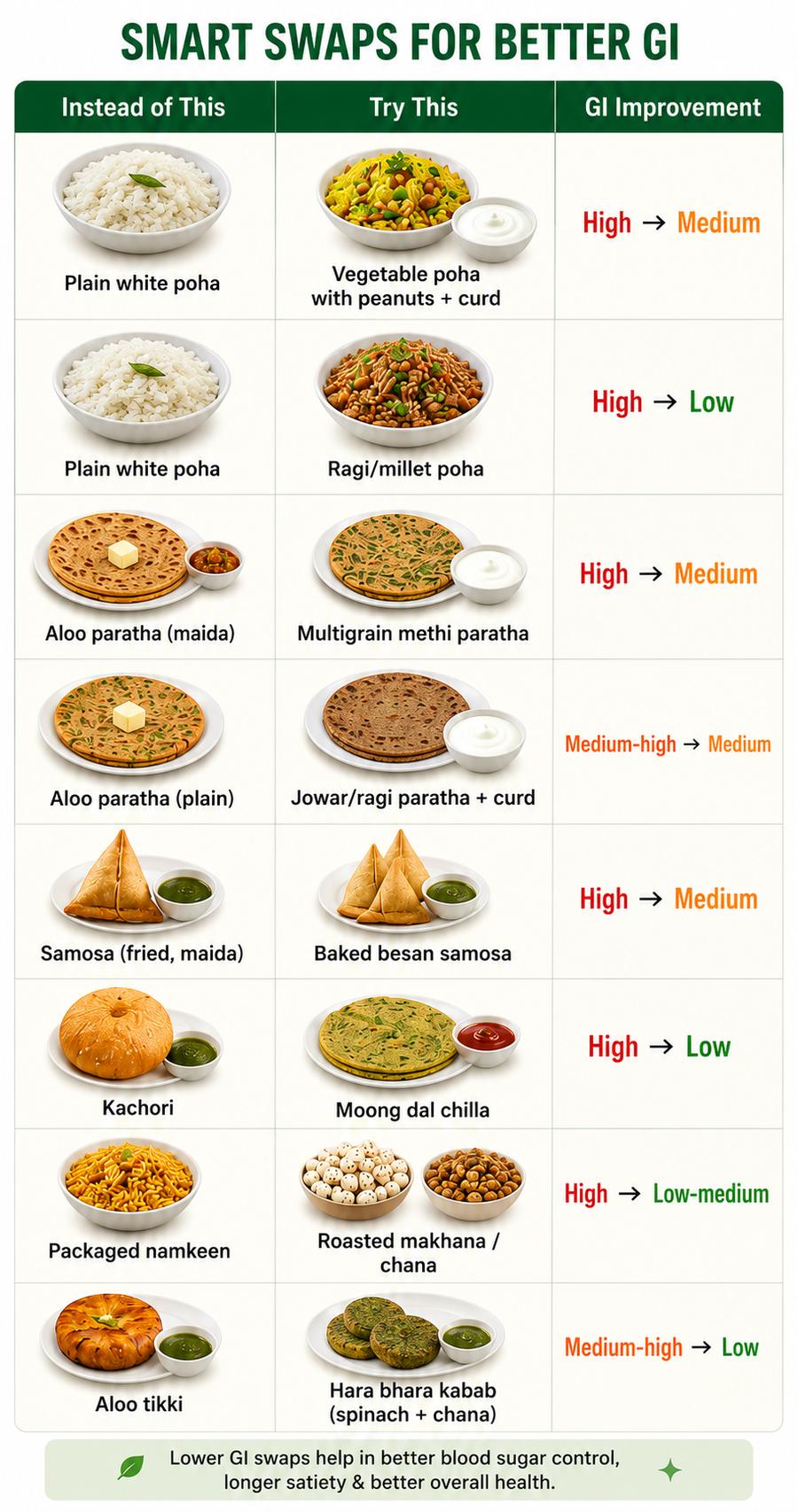
Smarter Swaps & Insulin Timing: How to Enjoy North Indian Snacks Without the Spike
A landmark 24-week randomized controlled trial by the Amrita Institute, Kerala (PMC7019781) proved that a low-GI Indian diet significantly reduces HbA1c (p < 0.05) and truncal obesity. For Type 1 Diabetes, these low-GI swaps are crucial—they directly flatten post-meal glucose excursions and reduce insulin variability. As Dr. Mohan’s Diabetes Centre (2025) notes:
“Traditional Indian foods are already diabetes-friendly—the problem is modern preparation methods.”
To turn your kitchen into a metabolic safe zone, upgrade your thali with these high-yield swaps:
The Secret to Insulin Timing:
Even healthy swaps need a tactical head start. Take your rapid insulin 15 minutes before eating so it peaks exactly when carbohydrates enter your blood. Because traditional snacks contain hidden fats that delay stomach emptying, use a split or dual-wave bolus to catch late glucose surges without early low crashes. Finish with a casual 10-minute walk to force your muscles to soak up extra sugar naturally!
In this article we have covered a North Indian snacks and type 1 diabetes concept clearly. Let me know in comment what you want to more about type 1 diabetes.
Reference:
https://nin.res.in/dietaryguidelines/pdfjs/locale/DGI_2024.pdf
https://tap.health/poha-glycemic-index-is-this-indian-breakfast-good-for-diabetics
https://pubmed.ncbi.nlm.nih.gov/39884261
https://pubmed.ncbi.nlm.nih.gov/28839326
https://www.ncbi.nlm.nih.gov/pmc/articles/PMC5872791
https://pubmed.ncbi.nlm.nih.gov/28839326
https://www.ncbi.nlm.nih.gov/pmc/articles/PMC12752844
https://www.ncbi.nlm.nih.gov/pmc/articles/PMC7019781
https://www.cdc.gov/diabetes/healthy-eating/carb-counting-manage-blood-sugar.html
https://professional.diabetes.org/standards-of-care
About the author
It’s me Mohammad Junaid Rain an MBBS student at GMC Nagpur, passionate about making evidence-based medical information accessible to every Indian. “medstuffs.com” is dedicated to clear, disease education for patients and caregivers.
Disclaimer: This article is for educational purposes only and does not substitute professional medical advice. Please consult your doctor for diagnosis and treatment.