
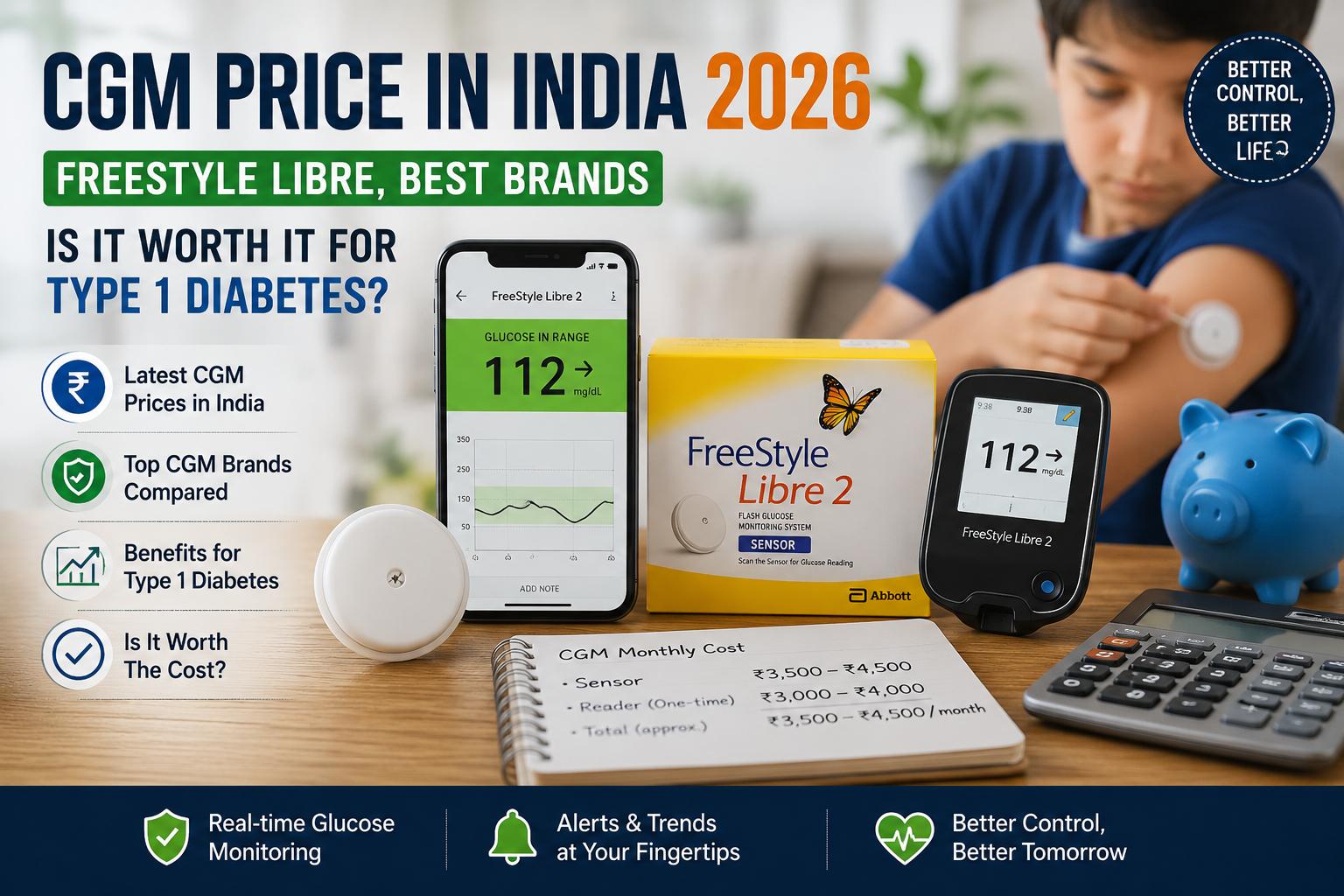
If you are tracking diabetes, searching for the CGM price in India is likely your first step toward ditching painful daily finger-pricks. Managing Type 1 diabetes can often feel like driving a car at night with a foggy windshield—you are constantly guessing your next move based on a single, fleeting snapshot from a traditional glucometer.
A Continuous Glucose Monitor (CGM) changes all of that. Think of it as a live, 24/7 GPS dashboard for your blood sugar, showing you exactly where your levels are heading before a dangerous crash or spike happens.
But let’s be completely honest: this life-altering technology is a major financial commitment for Indian families.
In this patient-first guide, we strip away the heavy medical jargon to give you a transparent, real-world cost breakdown of the FreeStyle Libre, Dexcom, and Medtronic systems. More importantly, we’ll help you run an honest cost-benefit analysis to figure out if it’s truly worth the investment for your health—and your wallet.
What Is a CGM and Why Is It a Game-Changer for Type 1 Diabetes?
A Continuous Glucose Monitor (CGM) is like a live GPS for your blood sugar. Instead of painful finger-pricks that only give a quick snapshot, a CGM uses a tiny under-the-skin sensor to track your glucose 24/7, sending real-time updates straight to your smartphone.
For anyone living with Type 1 diabetes, this technology shifts management from reactive guesswork to proactive control through five key benefits:
- A “Live Movie” vs. a Photo: Traditional meters show your sugar at one exact second. CGMs display trend arrows—showing if your levels are steady, crashing, or spiking—so you can act before a crisis hits.
- Time in Range (TIR) Over HbA1c: While an HbA1c test gives a 3-month average, it hides dangerous daily rollercoasters. TIR tracks the exact percentage of the day you stay in your safe target zone (70–180 mg/dL).
- A Midnight Security Guard: CGMs feature customizable alarms that sound if your sugar drops dangerously low while you sleep, offering vital protection against nighttime hypoglycemia.
- The “Artificial Pancreas” Connection: Advanced CGMs talk directly to smart insulin pumps, automatically adjusting or pausing your insulin doses in real-time based on your body’s needs.
- Ditching the Daily Burden: By replacing up to 10 finger-pricks a day with painless automation, it drastically reduces diabetes burnout and alleviates the constant anxiety of sudden lows.
CGM vs. Glucometer: The 2026 Reality for Indian Families
Choosing between a Continuous Glucose Monitor (CGM) and a traditional glucometer in India comes down to a battle between clinical insight and wallet reality.
Here is how they stack up for Type 1 diabetes management:
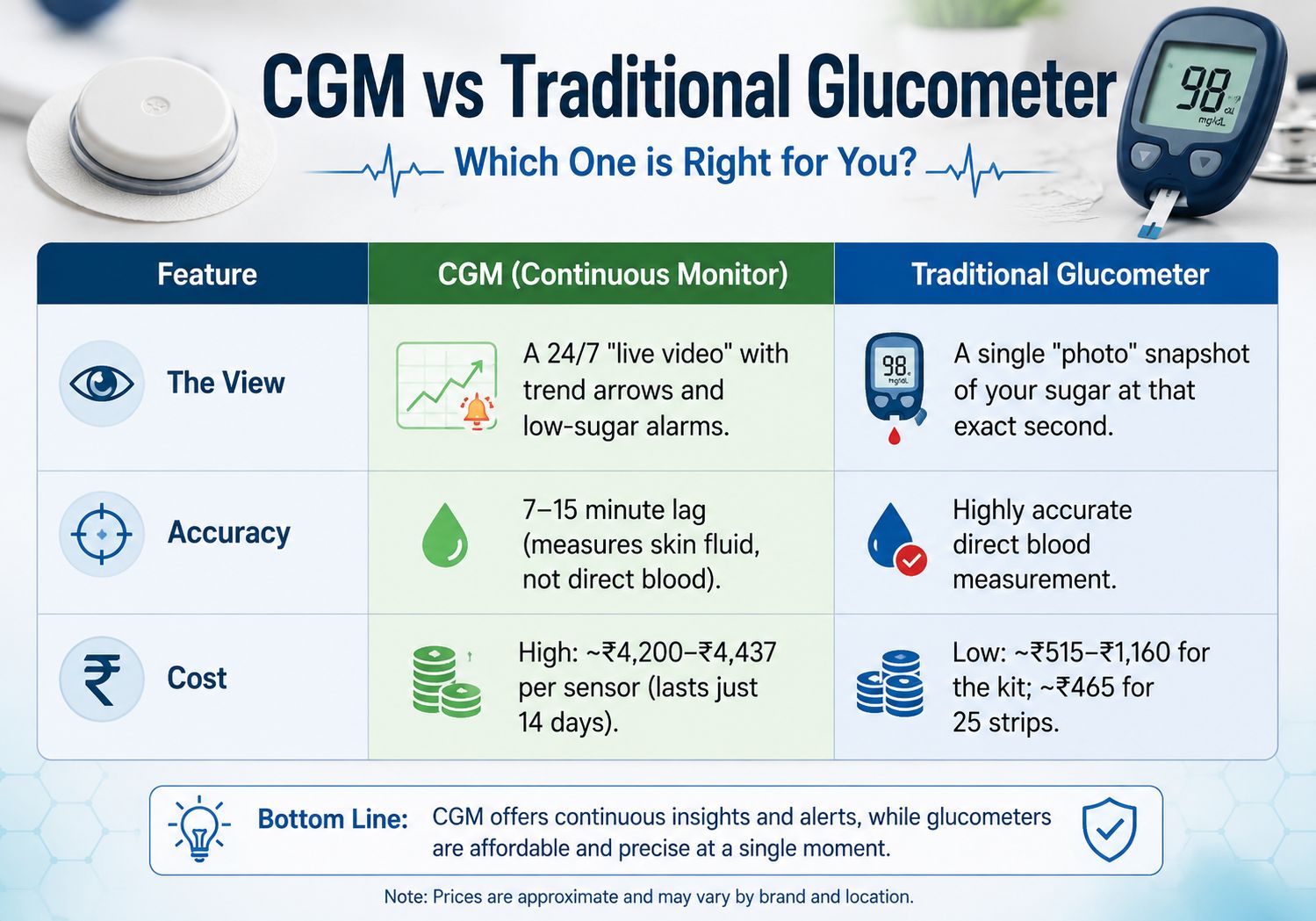
- The Clinical Verdict: CGMs are undeniably superior. They track Time in Range (TIR)—showing the exact percentage of the day you stay safe (70–180 mg/dL)—and catch dangerous midnight crashes before they happen.
- The Indian Reality: The Indian Council of Medical Research (ICMR) emphasizes that financial constraints are a major hurdle. Furthermore, because CGMs can lag during rapid changes or glitch on Day 1, you always need a backup glucometer to double-check a reading before dosing insulin.
The Bottom Line: CGM price in india depends upon the brands that you choosem If budget permits, a CGM is a life-changing investment. But if it doesn’t, do not despair. A high-quality glucometer paired with a disciplined daily injection routine remains a powerful, ICMR-approved shield for managing diabetes effectively.
FreeStyle Libre Price in India: Sensor Cost & Where to Buy
If you are planning to switch to a FreeStyle Libre CGM, your primary concern is likely budgeting for it. Because diabetes management is a long-term commitment, understanding the recurring monthly costs is vital.
Here is a clear, patient-friendly price breakdown in India based on market data:
1. The Sensor Cost (Replaced Every 14 Days)
Because a single sensor lasts for up to 14 days, you will need to budget for roughly two sensors per month.
- Standard FreeStyle Libre Sensor: The CGM price in india for standard freeStyle Libre Sensor is Expect to pay between ₹4,200 and ₹4,437 per sensor. For example, Apollo Pharmacy retails it at around ₹4,437 (discounted from its ₹4,671 MRP), while bulk dealers on IndiaMART list it closer to ₹4,200.
- FreeStyle Libre 2 Plus Sensor: The upgraded version is available through select medical distributors on IndiaMART for approximately ₹4,399.
2. The Reader Cost
Many patients save money by skipping the physical reader entirely and scanning the sensor with a free smartphone app. However, if you prefer a standalone physical Reader, they are listed on IndiaMART under combined categories for around ₹4,200.
Reliable Places to Buy in India
To ensure you receive genuine, temperature-regulated medical devices, stick to verified platforms:
- Apollo Pharmacy & Tata 1mg: Highly trusted online pharmacies offering authentic stock, discounts, and reliable doorstep delivery.
- IndiaMART: A solid option to connect directly with authorized regional medical equipment dealers (such as New Diacare Pharma) if you are looking to negotiate bulk pricing for a 3- or 6-month supply.
FreeStyle Libre vs. Libre Pro: Why One Is Half the Price
If you are browsing online pharmacies in India, you will notice CGM price in india is something confusing: the FreeStyle Libre Pro costs about ₹2,023, while the standard FreeStyle Libre costs between ₹4,200 and ₹4,437.
Why is the “Pro” version half the price? It comes down to who is supposed to read the data. Here is the patient-friendly breakdown:
- Standard FreeStyle Libre (Your Daily Dashboard): This is a personal CGM designed for daily self-management. You scan it with your smartphone for instant, real-time sugar readings and trend arrows. Upgraded models (like the Libre 2 Plus) also feature active alarms to warn you before your sugar crashes. It tells you exactly what to do right now.
- FreeStyle Libre Pro (The Doctor’s Diagnostic Tool): This is a professional tool applied by your doctor in a clinic. Crucially, it is “blinded”—meaning you cannot see your readings or receive alarms during the 14 days you wear it. It quietly records data in the background. After two weeks, your doctor unblinds the data to spot hidden patterns and adjust your overall medical treatment.
The Strategy Verdict: Do not buy the Pro version just to save money. Without the clinic’s specialized software to download the retrospective data, a Pro sensor won’t help you manage daily meals or insulin. For independent, everyday blood sugar control, the standard FreeStyle Libre is your tool.
Medtronic Guardian CGM in India: Features & How to Get It
If the FreeStyle Libre is a personal dashboard, the Medtronic Guardian series is the high-tech, heavy-duty security system of the CGM world. It is uniquely designed for tight control, particularly for those tracking deep trends or using insulin pumps.
Here is what sets this system apart, translated into plain English:
- Twice-Daily “Tuning” (Calibration): Unlike factory-calibrated CGMs, the Guardian Connect requires a traditional finger-prick blood test twice a day. Think of this as calibrating a compass—it ensures the sensor stays highly accurate.
- The Smart Pump Co-Pilot: The Guardian Sensor 3 links directly to Medtronic insulin pumps. If your sugar hits a dangerous low, it can tell your pump to automatically pause insulin delivery, acting as a critical safety net.
- Guardian 4 & Automation: The newer Guardian 4 is a prescription-only device built for advanced automated insulin delivery systems (like the MiniMed 780G pump). It handles the heavy lifting with active alarms that warn you before a spike or crash happens.
- The Paracetamol “Glitch”: A vital safety warning for patients—taking common paracetamol (acetaminophen) or hydroxyurea can trick the Guardian 4 sensor. It may read your blood sugar as falsely high, which could lead to dangerous insulin overdosing if you don’t double-check with a standard glucometer.
Price and How to Buy in India
Because the Medtronic Guardian is a highly specialized, prescription-only clinical device often bundled with automated insulin pumps, official retail prices are not publicly listed on standard online pharmacy apps.
To safely purchase this system and get the required medical training, you must consult your endocrinologist to connect with authorized Medtronic India distributors or specialized diabetes clinics in your region.
CGM for Kids with Type 1 Diabetes in India: Which Is Best?
Managing a child’s Type 1 diabetes without a Continuous Glucose Monitor (CGM) is like driving at night with the headlights off. Both the ICMR and ADA recommend starting a CGM immediately after diagnosis. It acts as a digital safety net, protecting a child’s developing brain from dangerous sugar rollercoasters and easing parental anxiety.
The “best” device depends entirely on your child’s age, daily routine, and family budget:
1. The “Artificial Pancreas” (Best for Insulin Pumps)
- The System: Medtronic MiniMed 780G (Approved for ages 7+ with Guardian 4 sensors).
- Why it’s great for kids: It acts like a smart co-pilot. The CGM communicates directly with the insulin pump, automatically adjusting insulin doses every 5 minutes and pausing delivery if a dangerous nighttime crash is predicted.
2. The Standalone Bodyguards (Best for Daily Injections)
If your child uses insulin pens, you need a standalone CGM with customizable alarms—critical for school-going kids or toddlers who cannot recognize or communicate the symptoms of low blood sugar yet:
- Dexcom G6/G7: Lasts up to 10 days with zero finger-prick calibrations. It instantly alerts parents and school staff via a smartphone app if sugars trend dangerously high or low.
- FreeStyle Libre 2 Plus: Lasts 14 days, is fully waterproof for swimming, and costs roughly ₹4,200 to ₹4,437 per sensor. Ensure you choose upgraded versions featuring active alarms.
The Golden Rule for Parents
CGMs measure glucose in skin fluid, which introduces a 7 to 15-minute lag behind actual blood glucose. Because they can be less accurate on Day 1 or during rapid sugar crashes, always keep a traditional glucometer handy to double-check readings before treating a severe low.
How Accurate Are CGMs for Indian Skin Types & Climate Conditions?
A common question among patients in India is whether our diverse skin types or intense weather conditions affect CGM accuracy. The short answer? Your skin type won’t change how well the device works, but India’s heat and humidity definitely require some extra care.
Here is what you need to know to keep your readings reliable:
- Skin Thickness is Universal: Clinical data shows that average skin thickness (~2.2 mm) does not vary by ethnicity, age, or BMI. The sensor reaches the exact same depth to measure your fluid, regardless of your background.
- The Monsoon & Summer Challenge: While extreme heat and humidity don’t change the internal technology, heavy sweat can loosen the adhesive patch, causing the sensor to fall off. Also, avoid traditional body oils, lotions, or creams near the site, as they directly disrupt sensor accuracy.
- Beating Skin Irritation: The glue or chemicals (like isobornyl acrylate) in the patch can cause itching, redness, or contact dermatitis. If your skin reacts, your doctor can recommend a protective medical barrier spray or cream to apply underneath the adhesive.
- The 3 Universal Accuracy Rules: All CGMs have a 7 to 15-minute physiological lag because they read skin fluid instead of direct blood. They are also notoriously least accurate on Day 1 due to minor local skin inflammation from insertion, and during rapid sugar crashes. Always keep a standard glucometer handy to double-check sudden drops.
Can CGM Costs Be Claimed on Health Insurance in India?
Paying out-of-pocket for a CGM can feel like a heavy monthly subscription for your health. With a single sensor costing roughly ₹4,200 to ₹4,437 and lasting only 14 days, the financial burden is undeniably steep. In fact, the Indian Council of Medical Research (ICMR) explicitly emphasizes that your family’s budget must be a primary factor when designing your diabetes care plan.
So, will insurance help ease this burden? Here is the realistic breakdown:
- Standard Health Insurance: Most traditional policies in India only cover in-patient hospitalization (when you are physically admitted to a hospital). They usually exclude daily outpatient medical consumables or diagnostic devices like CGM sensors, glucometer strips, or insulin pumps.
- The Evolving Exceptions: Thankfully, the insurance landscape is changing. If you hold a specialized diabetes-specific health plan or a premium policy with comprehensive OPD (Out-Patient Department) coverage, you might qualify for partial reimbursement.
Always check your specific policy’s OPD benefits or speak directly with your provider (such as Star Health, Care, Niva Bupa, or ICICI Lombard) to see if you can claim these vital tracking tools.
Understanding CGM Data: Time-in-Range Goals for Indian Type 1 Patients
While an HbA1c test gives a frozen three-month average, Time-in-Range (TIR) reveals your actual daily glucose rollercoaster. Think of TIR as the exact percentage of the day your blood sugar stays in a safe, healthy “sweet spot” rather than spiking or crashing.
The Indian Council of Medical Research (ICMR) notes that while targets must be personalized, using a CGM is incredibly effective for mastering your “time in target” and avoiding dangerous drops. Here is the clinical gold standard for daily TIR goals:
- The Sweet Spot (70–180 mg/dL): Aim to spend at least 70% of your day (about 17 hours) here.
- Keep Lows Low (<70 mg/dL): Restrict time below range to under 4% to prevent severe hypoglycemia.
- Cap the Highs (>180 mg/dL): Keep high spikes under 25% of your daily timeline.
Special Profiles
- High Risk / Older Adults: If you experience frequent hypoglycemia unawareness, safety is your top priority. Your TIR target is safely relaxed to 50%, keeping dangerous lows under 1%.
- Pregnancy: Expecting mothers need much tighter control. The target narrows to 63–140 mg/dL for at least 70% of the day.
The 15-Minute Rule: CGMs read skin fluid, introducing a 7 to 15-minute lag behind actual blood glucose. If your sugar is changing rapidly or crashing, the ICMR recommends a traditional finger-prick to confirm the number before taking corrective insulin or carbs.
CGM + Insulin Pump: The “Artificial Pancreas” in India
Imagine a CGM as a traffic satellite and an insulin pump as a smart car. When they link up, you get an Automated Insulin Delivery (AID) system—essentially a “closed-loop” cruise control for Type 1 diabetes. A smart algorithm reads your real-time glucose levels and automatically adjusts your insulin, taking the non-stop mental burden off your shoulders.
What’s Available in India?
- Medtronic MiniMed 780G: Approved for individuals aged 7 and older. Its “SmartGuard” technology fine-tunes insulin every 5 minutes, automatically corrects spikes if you miscalculate meal carbohydrates, and pauses insulin to prevent dangerous midnight crashes.
- Medtronic MiniMed 670G: An earlier-generation hybrid system that safely automates background (basal) insulin rates and guards against impending lows.
- Open-Source AID (DIY): Tech-savvy patients use community-driven software (like AndroidAPS or Loop) to link compatible commercial pumps and CGMs via smartphone apps for highly customized dosing.
The Cost Reality
While clinically life-changing, the Indian Council of Medical Research (ICMR) highlights that the cost of these pump systems is considerably higher than daily injections.
Beyond the upfront hardware cost, you must factor in recurring monthly expenses: CGM sensors need replacement every 7 to 14 days, and pump infusion sets must be changed every 2 to 3 days. Because of this compounding financial commitment, the ICMR strongly advises having a transparent budget discussion with your endocrinologist before starting pump therapy.
Is a CGM Worth the Cost for Type 1 Diabetes in India? Honest Cost-Benefit Analysis
Deciding to buy a Continuous Glucose Monitor (CGM) is a major financial crossroads. Let’s weigh the life-changing medicine against the heavy Indian price tag.
The Medical Upside: A 24/7 Bodyguard
From a clinical standpoint, a CGM is vastly superior to standard finger-pricks because it offers:
- Live Trend Tracking: Shows exactly where your blood sugar is heading in real-time.
- Time-in-Range (TIR): Captures daily rollercoasters that a standard 3-month HbA1c test completely hides.
- Midnight Security: Predictive alarms ring before you hit a dangerous low, conquering the fear of nighttime hypoglycemia.
The Financial Reality Check
In India, a single sensor costs ₹4,200 to ₹4,437.50 and lasts only 14 days. This forces you to spend ₹8,400 to ₹8,800 monthly, ballooning to over ₹1,00,000 annually just for tracking. The Indian Council of Medical Research (ICMR) explicitly warns that these costs are “exorbitant” for most Indian families, cautioning that crushing financial strain can dangerously push people to skip tests or ration insulin.
The Honest Verdict
- If you have the budget: Absolutely yes. The data and quality of life are worth every rupee.
- If it strains your wallet: No. Never compromise your core insulin supply for a gadget.
You can still achieve excellent health using the ICMR’s cost-effective alternatives:
- Disciplined Glucometer Use: Testing 4 to 6 times a day with standard strips provides great metabolic control.
- Intermittent CGM Use: Wear a sensor for just two weeks every few months. It lets your doctor catch hidden sugar patterns without the year-round financial burden.
FAQ
Which CGM is best in India?
The “best” CGM depends on your specific medical needs and budget. For automated insulin pump integration, the Medtronic MiniMed 780G with Guardian 4 or Simplera Sync sensors is ideal. For standalone, calibration-free monitoring, the FreeStyle Libre (14-day wear) and Dexcom G6 (10-day wear) are excellent, popular options.
How to get a CGM for free?
The sources do not specify how to get a CGM completely for free. To manage expenses, consult your healthcare team regarding financial barriers. You can also check your health insurance for potential coverage, consider intermittent CGM use, or rely on affordable traditional finger-prick glucometers for daily management.
How much does CGM cost?
In India, the cost of a CGM varies. A single FreeStyle Libre sensor costs approximately ₹4,200 to ₹4,437 and lasts up to 14 days. The clinical diagnostic version, FreeStyle Libre Pro, costs around ₹2,023. Advanced automated insulin pump systems paired with CGMs require a significantly larger ongoing financial commitment.
Best CGM device in India price?
The “best” CGM depends on your specific needs. The FreeStyle Libre is the most accessible standalone option in India, with a single sensor costing between ₹4,200 and ₹4,437.50. For automated insulin pump integration, the Medtronic Guardian 4 is ideal, though its exact price in India is not provided.
Dexcom CGM Price India?
Dexcom Continuous Glucose Monitor (CGM) typically ranges from 8000-16000 rupees for a single sensor or box depending on the model
Reference
https://pmc.ncbi.nlm.nih.gov/articles/PMC12432326
https://pmc.ncbi.nlm.nih.gov/articles/PMC13000058
https://www.ncbi.nlm.nih.gov/pmc/articles/PMC10198841
https://pmc.ncbi.nlm.nih.gov/articles/PMC11865750
https://www.apollopharmacy.in/blog/article/continuous-glucose-monitoring-for-diabetics
https://www.1mg.com/otc/freestyle-libre-system-sensor-otc616035
https://pmc.ncbi.nlm.nih.gov/articles/PMC12432326
https://www.1mg.com/categories/health-conditions/diabetes-care/continuous-glucose-monitors-2015
https://www.medtronicdiabetes.com/products/minimed-780g-insulin-pump-system
https://pmc.ncbi.nlm.nih.gov/articles/PMC12432326
https://pmc.ncbi.nlm.nih.gov/articles/PMC13000058
https://pmc.ncbi.nlm.nih.gov/articles/PMC12432326
https://www.ncbi.nlm.nih.gov/pmc/articles/PMC10270742
https://pmc.ncbi.nlm.nih.gov/articles/PMC11865750
https://www.ncbi.nlm.nih.gov/pmc/articles/PMC10305924
https://pmc.ncbi.nlm.nih.gov/articles/PMC12432326
https://my.clevelandclinic.org/health/articles/time-in-range-diabetes
https://www.ncbi.nlm.nih.gov/pmc/articles/PMC12572046
https://www.ncbi.nlm.nih.gov/pmc/articles/PMC10198841
https://pmc.ncbi.nlm.nih.gov/articles/PMC13000058
https://pmc.ncbi.nlm.nih.gov/articles/PMC12432326
https://news.medtronic.com/2025-07-21-Medtronic-secures-CE-Mark-for-MiniMed-TM-780G-System
About the author
It’s me Mohammad Junaid Rain an MBBS student at GMC Nagpur, passionate about making evidence-based medical information accessible to every Indian. “medstuffs.com” is dedicated to clear, disease education for patients and caregivers.
Disclaimer: This article is for educational purposes only and does not substitute professional medical advice. Please consult your doctor for diagnosis and treatment.
1 thought on “CGM Price in India 2026: Freestyle Libre, Best Brands & Is It Worth It for Type 1 Diabetes?”