
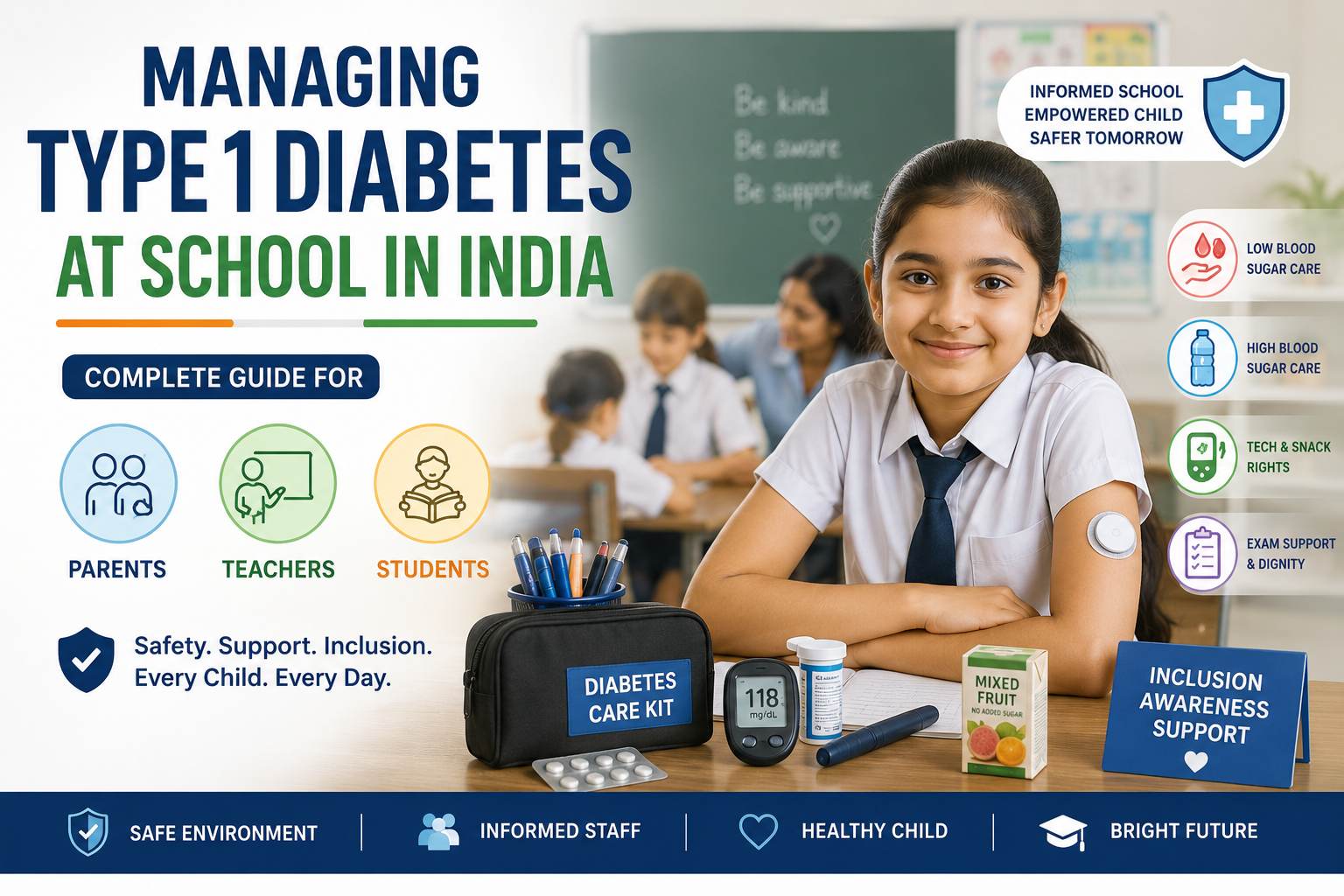
Imagine sending your child to school knowing their safety depends on a series of high-stakes mathematical equations. For thousands of families, navigating type 1 diabetes at school in india is exactly that—a daily balancing act where a simple recess bell can trigger a sudden medical crisis.
Unlike Type 2 diabetes, Type 1 is an autoimmune condition where the body’s immune system mistakenly knocks out the pancreas’s insulin-producing cells. Think of insulin as the metabolic key that unlocks cells for energy. Without it, a student must essentially act as their own manual pancreas—calculating insulin doses while simultaneously trying to focus on history or long division.
From packed school vans and hot classrooms to unsupportive canteen policies, the Indian school environment presents unique metabolic hurdles. However, your child does not have to walk this tightrope alone. Armed with powerful legal protections from the CBSE and NCPCR, this expert-backed clinical guide serves as your ultimate roadmap to turn classrooms into safe, thrive-ready sanctuaries. Let’s protect their health and their future together.
Why Indian Schools Are Often Unprepared for Type 1 Diabetes Emergencies
Managing Type 1 Diabetes (T1D) in Indian schools is a silent uphill battle. While a child’s pancreas completely stops producing insulin, our education system often lacks the medical safety net to support them. Studies reveal a staggering 91% of teachers have zero formal training on T1D, turning predictable blood sugar shifts into preventable crises.
This systemic unpreparedness stems from three major pain points:
- The Infrastructure Gap: Dedicated school nurses are rare. Alarmingly, only about 1 in 5 parents report their child’s school owns a basic glucometer.
- Enforced Secrecy: Deep-rooted societal stigma forces many parents to hide the diagnosis. If a teacher doesn’t know a student has T1D, they cannot recognize or treat sudden hypoglycemia (dangerously low blood sugar).
- Hostile Policies: Many children face active pushback, from being banned from eating life-saving snacks during class to being forced to inject insulin in unhygienic school washrooms.
While the CBSE and NCPCR have issued progressive circulars allowing glucometers and snacks in exams, India still lacks a comprehensive, legally binding national policy. Without real structural mandates, our children remain highly vulnerable between the morning assembly and the final bell.
Your Child’s Legal Rights at School with Type 1 Diabetes in India
Navigating school with Type 1 Diabetes (T1D) can feel like walking a tightrope without a safety net. While India lacks a specific “Diabetes Law” and T1D isn’t officially classified as a physical disability, your child is far from defenseless. Powerful directives from the National Commission for Protection of Child Rights (NCPCR) and major boards like the CBSE act as legal shields under the Right to Education (RTE) Act.
Schools are legally required to provide these vital, life-saving accommodations:
- Therapeutic Snacking: Clear permission to eat mid-class or carry sugar tablets, fruit, and water directly into exam halls to treat sudden “lows” (hypoglycemia).
- Medical Tech Access: The absolute right to carry glucometers, check blood sugar in the classroom, and wear advanced devices like Continuous Glucose Monitors (CGMs) or insulin pumps.
- The Smartphone Exception: Since modern CGMs send readings to a phone, directives allow the phone in class, safely held by a teacher or invigilator to track glucose trends.
- Total Sports Inclusion: Guaranteed access to physical education and school sports, completely guided by your doctor’s advice.
Never let a school tell you these accommodations are “against policy.” These are official mandates designed to keep your child safe, equal, and thriving.
How to Create a Diabetes Management Plan for Your Child’s School
Think of a Diabetes Management Plan (DMP) as your child’s medical blueprint at school. Because Type 1 Diabetes behaves differently in every body, a generic approach fails. A DMP is a personalized, formal document co-created by you and your pediatric endocrinologist, then signed by school authorities. It bridges the gap between clinic and classroom, ensuring staff can act with confidence.
To secure rock-solid safety and clear medical authority, your child’s DMP must outline four critical pillars:
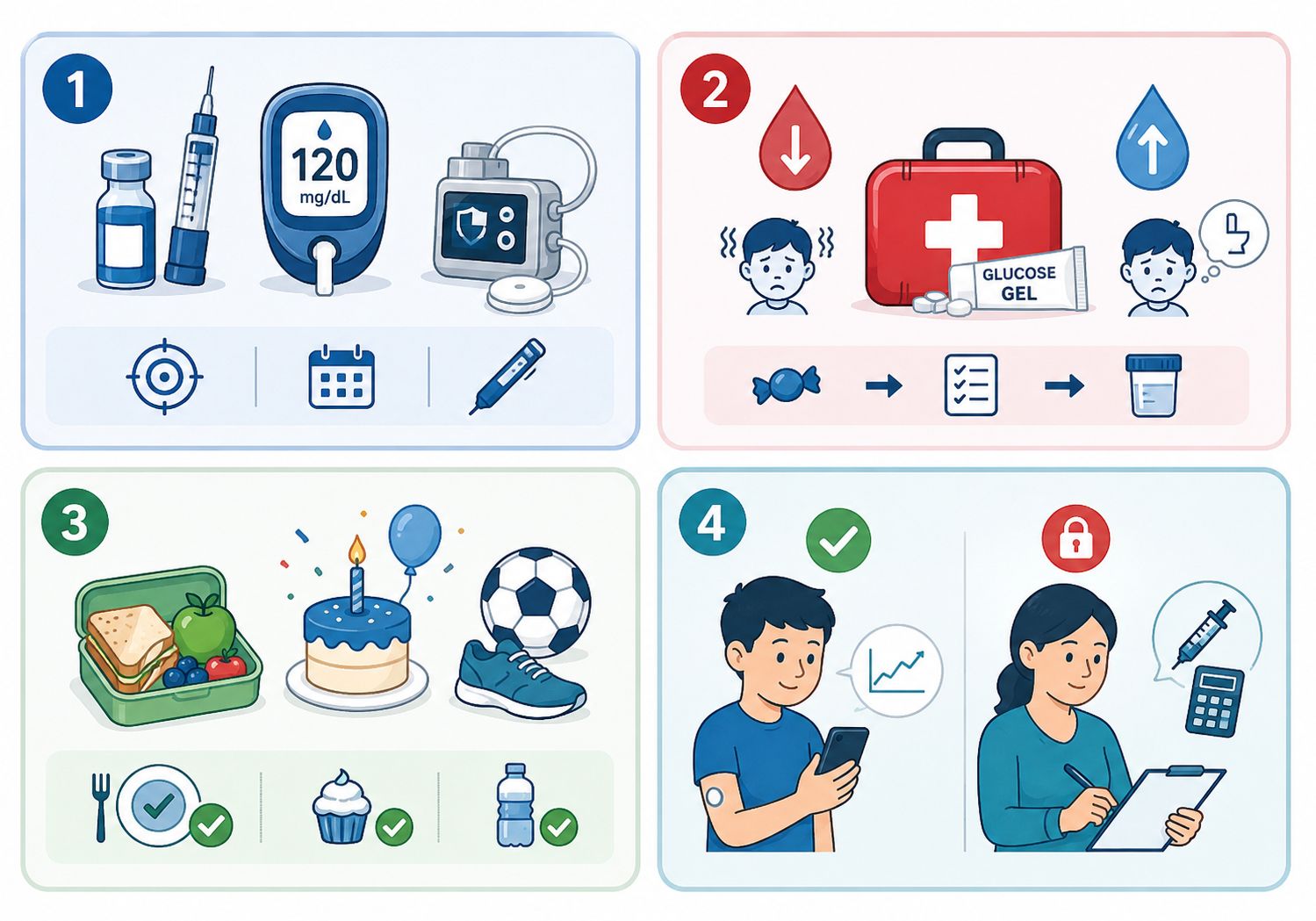
- The Glucose & Insulin Blueprint: This details optimal blood sugar target ranges, specific testing schedules, and precise insulin dosing instructions—whether your child uses a traditional syringe, insulin pen, or an advanced insulin pump.
- The Emergency Rescue Guide: A literal “fire drill” protocol for blood sugar extremes. It lists your child’s unique symptoms for hypoglycemia (low blood sugar) and mandates a classroom “Hypo-Kit” (packed with fast-acting sugar), alongside explicit instructions for treating hyperglycemia (high blood sugar) and testing for dangerous ketones.
- Fuel and Fitness Rules: Practical instructions for managing lunchtime carbohydrates, handling school birthday parties, and adjusting snacks or insulin before physical education (PT) classes to prevent exercise-induced crashes.
- The Independence Scale: Clearly defines what medical tasks your child can do autonomously (like scanning a Continuous Glucose Monitor) versus what requires strict adult supervision (like calculating correction doses).
Strategic Takeaway: Children outgrow their diabetes management settings just like school shoes. Review and update this document with your medical team at the start of every academic year, or the moment your child’s daily routine shifts.
What Teachers Must Know About Type 1 Diabetes: A Quick Guide
As a teacher, you are a student’s primary safety net. Type 1 Diabetes (T1D) isn’t caused by lifestyle or eating too much sugar; it’s an autoimmune condition where the pancreas completely stops producing insulin. Think of insulin as the “key” that unlocks body cells to let energy in. Without it, the body’s metabolism stalls.
To keep your classroom safe, inclusive, and legally compliant, anchor your strategy around these four pillars:
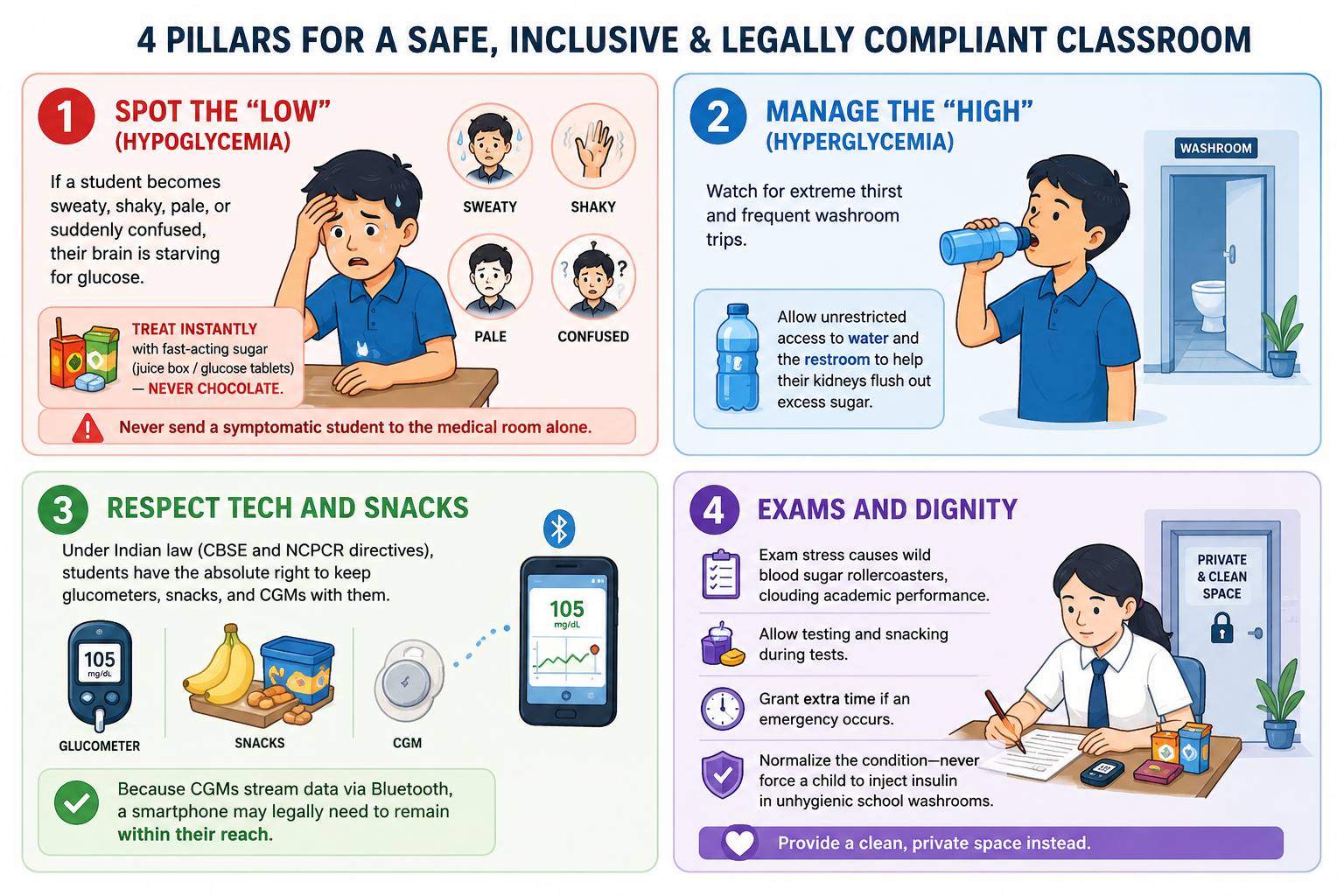
- Spot the “Low” (Hypoglycemia): This is an immediate emergency. If a student becomes sweaty, shaky, pale, or suddenly confused, their brain is starving for glucose. Treat them instantly right at their desk with fast-acting sugar (like a juice box or glucose tablets)—never chocolate, as its fat content slows down sugar absorption. Crucial: Never send a symptomatic student to the medical room alone.
- Manage the “High” (Hyperglycemia): Watch for extreme thirst and frequent washroom trips. Allow unrestricted access to water and the restroom to help their kidneys flush out excess sugar.
- Respect Tech and Snacks: Under Indian law (CBSE and NCPCR directives), students have the absolute right to keep glucometers, snacks, and Continuous Glucose Monitors (CGMs) with them. Because CGMs stream data via Bluetooth, a smartphone may legally need to remain within their reach.
- Exams and Dignity: Exam stress causes wild blood sugar rollercoasters, clouding academic performance. Allow testing and snacking during tests, and grant extra time if an emergency occurs. Lastly, normalize the condition—never force a child to inject insulin in unhygienic school washrooms. Provide a clean, private space instead.
Managing Blood Sugar During CBSE, ICSE & State Board Exams with Type 1 Diabetes
Board exams are a high-stakes pressure cooker. For a student with Type 1 Diabetes (T1D), exam stress releases hormones like cortisol and adrenaline, which act like biological wildcards—causing sudden blood sugar spikes or crashes. Because a brain starved of glucose (hypoglycemia) or flooded with it (hyperglycemia) struggles to recall formulas or focus, blood sugar management is a critical academic tool.
Fortunately, Indian educational boards and the NCPCR provide powerful legal shields:
- The Transparent Pouch Allowance: Under CBSE and state board directives, students can carry fast-acting sugars (glucose tablets, fruit), testing kits, and advanced tech (CGMs/insulin pumps) into the hall in a clear pouch.
- The Smartphone Rule: If a modern CGM streams data to a phone, the invigilator can legally hold the smartphone to monitor live glucose trends without compromising security.
From a clinical standpoint, the International Society for Pediatric and Adolescent Diabetes (ISPAD) advocates for strict emergency safeguards:
- Extra Time Credits: If a student experiences a severe “low” (under 70 mg/dL) or extreme “high” during or just before the exam, they should be granted 30 to 60 minutes of extra time to stabilize and finish.
- Ketone Warning: Severe highs accompanied by ketones indicate a critical medical emergency; the student must be medically excused immediately for treatment.
Action Plan: Register the T1D condition early during LOC (List of Candidates) submission, upload your endocrinologist’s certificate, and visit the exam center superintendent one day before the test to ensure zero friction at the gates.
School Tiffin Ideas for Type 1 Diabetes: Carb-Counted, Indian & Practical
Think of packing a Type 1 Diabetes (T1D) tiffin like fueling a precision engine: you must match the exact amount of fuel (carbohydrates) with the perfect amount of throttle (insulin bolus). To keep blood sugar on a smooth highway rather than a rollercoaster, focus on low-to-medium Glycemic Index (GI) complex carbs that release energy slowly.
To make insulin dosing effortless, clinical guidelines use 15-gram carbohydrate “exchanges.” Here is how to build balanced, familiar Indian meals:
- The Roti & Dal Box (30g–45g Carbs): One 6-inch chapati (15g) paired with ½ cup of low-GI rajma or moong dal (15g). Add non-starchy green sabzis freely; they act as “carb-free” nutritional bonuses.
- The South Indian Twist (30g Carbs): 1 standard dosa or rice idli (15g) with ½ cup sambar (15g). Always pair this with peanut chutney—its healthy fats act like a gentle braking system, slowing down glucose absorption.
- One-Pot Quick Mix (15g–30g Carbs): ½ cup of cooked poha or daliya equals 15g. Mix in ½ cup of protein-rich sprouted moong (+15g) to stabilize the glycemic response.
- The Mid-Day Snack (15g Carbs): 1 small apple or 1 cup of plain curd.
The Essential Classroom “Hypo-Kit”: Always pack a separate, fast-acting 15g carb rescue kit (100ml fruit juice or 4 glucose tablets) to treat sudden low blood sugar. Never use chocolate; its fat content locks up the sugar, dangerously delaying its release into the bloodstream.
My Tip: Take smartphone photos of these measured tiffins. Visual portion guides in your child’s Diabetes Management Plan give hesitant teachers instant confidence to verify that food intake perfectly matches the pre-meal insulin dose.
You can also read this article for to understand 7 day meal plan for type 1 diabetes
Handling a Hypoglycemia Emergency at School: Step-by-Step Protocol
Hypoglycemia (low blood sugar) is a medical code-red. Think of it as a child’s brain rapidly running out of battery—action must be instant to prevent a total system crash.
1.Recognize and Escort:Immediate.
Watch for shakiness, sweating, dizziness, or sudden behavioral changes. Never leave the child unattended. If a glucometer is not immediately available, skip the test, assume it is a “low,” and treat it right away.
2.Apply the Rule of 15:Minutes 1 to 15.
If the child is conscious and can swallow, give 15 grams of fast-acting sugar (100 ml fruit juice or 4 glucose tablets). For younger children under 50 kg, dose precisely at 0.3 grams per kilogram. Wait 15 minutes and retest; if blood sugar is still below 70 mg/dL, repeat the dose.
3.Stabilize the Fuel Tank:Post-Recovery.
Once blood sugar climbs back into a safe range, have the student eat a snack with complex carbohydrates (like a slice of bread or milk) to lock in stability and prevent a secondary crash.
4.Execute Severe Protocol:Critical Emergency.
If the child is unconscious or seizing, never force food or liquids down their throat due to a severe choking hazard. Turn them onto their side into the recovery position, call an ambulance immediately, and administer Glucagon if a trained staff member is present. If Glucagon is unavailable, carefully rub honey or glucose paste inside their cheek.
Sports & PE Safety: Management of Type 1 Diabetes at School in India
When coordinating the management of type 1 diabetes at school in india, physical education (PE) coaches must understand that exercise acts like a biological wildcard on blood sugar. Different activities pull different metabolic levers. Continuous aerobic sports (like football or cycling) act like a steady fuel drain, causing glucose levels to drop rapidly. Conversely, short, explosive anaerobic bursts (like sprinting or heavy lifting) trigger stress hormones like adrenaline, which temporarily dump stored sugar into the system, causing spikes.
To maintain rock-solid field safety, PE teachers should enforce these precise clinical guardrails:
- The Pre-Game Check: Test blood sugar before the whistle blows. If glucose is less than 90 mg/dL, the student must consume fast-acting carbs and wait for it to rise before playing. If it is greater than 250 mg/dL, check for ketones; if positive, bench the student immediately to prevent dangerous Diabetic Ketoacidosis (DKA).
- Sideline Rescue: Always keep a “Hypo-Kit” (juice or glucose tablets) directly on the field. For any physical activity lasting longer than 30 minutes, mid-game carbohydrate refueling is essential.
- The “Delayed Crash” Window: Physical exertion increases insulin sensitivity for 7 to 11 hours post-exercise, creating a high risk for dangerous, delayed drops overnight. To counteract this, the child’s pre-exercise insulin dose or pump basal rate requires a calculated, doctor-approved reduction.
Equip every PT teacher and sports coach with a copy of the child’s personalized Diabetes Management Plan, turning them into proactive field allies.
Type 1 Diabetes in College & University in India: Hostel, Mess Food & New Freedom
While the management of type 1 diabetes at school in india relies on a protective net of parents and teachers, entering college flips the script into total autonomy. In this phase of “emerging adulthood,” you suddenly become your own full-time endocrinologist while navigating the wild frontier of campus life.
To conquer this new freedom without burning out, you must master three campus realities:
- The Hostel Hurdle: No parents means no built-in alarms for glucose checks. Storage is a classic pain point—unrefrigerated insulin spoils fast in Indian summers. Secure a mini-fridge permission slip from university authorities early, and explicitly train your roommates on your emergency protocol. They are your new first responders.
- The Mess Food Minefield: University mess halls are notoriously heavy on high-glycemic carbohydrates (think endless white rice, maida rotis, and starchy potatoes). Since mess menus change daily, treat meals as a live experiment: test before and after eating, and aggressively hunt for proteins and green vegetables to blunt those sharp post-meal spikes.
- The Social Trap: Peer pressure and late-night parties introduce major metabolic risks. The Indian Council of Medical Research (ICMR) notes that alcohol actively blocks your liver from releasing emergency glucose, setting a dangerous trap for severe, delayed nighttime hypoglycemia. If you choose to drink, never do it alone and always pair it with complex carbohydrates.
Transitioning from a cozy pediatric clinic to adult care can feel overwhelming. Proactively introduce yourself to the campus medical clinic, outline your medical history, and look for local T1D peer support networks. Independence doesn’t mean doing it all alone.
How to Talk to Classmates, Friends & Extended Family About Type 1 Diabetes
Navigating the social landscape of Type 1 Diabetes (T1D) is a delicate balancing act between medical safety and personal privacy. Because daily care routines must happen in public view, cultivating an empathetic social circle is an absolute cornerstone of the successful management of type 1 diabetes at school in india. You don’t need to tell the whole world, but you do need “social armor.”
Deploy these three expert-backed communication strategies to protect your peace and your health:
- The 30-Second Clarifier: Crush societal blame instantly. Explain that T1D is an autoimmune condition—like an internal biological glitch where the body’s security system mistakenly misidentifies and attacks its own insulin-producing cells. It has zero connection to sugar intake, lifestyle, or parenting choices.
- The Trusted Inner Circle: Hand-pick a small group of close friends. Show them exactly where your “Hypo-Kit” is kept and teach them to spot your unique warning signs of a low (like sudden sweating, shakiness, or confusion) so they can step in as immediate safety allies during recess.
- Firm Family Boundaries: Extended relatives often dramatize the condition or offer unscientific advice out of ignorance. Politely but firmly remind them that T1D is a manageable biological reality, not a tragedy. With your calculated medical regimen, you can safely play sports, study, and thrive just like any other student.
If constantly explaining your diagnosis feels emotionally draining, lean into local Indian T1D youth support groups. Connecting with peers who walk the exact same daily mathematical path provides unparalleled emotional relief and practical survival hacks.
CBSE’s 2025 Sugar Board Initiative: What It Means for Diabetic Students in India
In mid-2025, the CBSE launched a bold directive requiring over 24,000 schools to install “Sugar Boards” on campus. Endorsed by the FSSAI and NCPCR, these visual displays expose hidden sugars in canteen snacks to combat the alarming rise of childhood obesity and Type 2 diabetes across the country.
While this massive push for food literacy benefits the student body at large, it introduces a critical medical paradox into the everyday management of type 1 diabetes at school in india:
- The Hypoglycemia Paradox: While campuses are actively campaigning against sugar, a child with Type 1 Diabetes (T1D) requires fast-acting sugar (like fruit juice or glucose tablets) as an immediate, life-saving rescue medicine to treat sudden low blood sugar.
- The Crucial Training Gap: Teachers and administrators must be thoroughly educated on this distinction. A student with T1D should never face disciplinary action, confusion, or public shaming for consuming sugar at their desk during a blood sugar crash.
- Normalizing Carb Awareness: On a positive note, putting sugar counts in the spotlight helps normalize label-reading and dietary tracking, reducing the isolation T1D students often experience when calculating their insulin doses.
Coupled with recent CBSE rules allowing insulin pumps and continuous glucose monitors (CGMs) into board exam halls, this initiative marks a massive cultural shift. Indian campuses are moving away from treating chronic conditions as private secrets, paving the way for a safer, healthier school ecosystem.
FAQ
Can a child with type 1 diabetes go to school?
Yes, children with Type 1 diabetes can absolutely go to school. Medical guidelines emphasize they must be given the exact same educational and extracurricular opportunities as their peers. With a personalized diabetes management plan and supportive accommodations from school personnel, they can safely participate in all aspects of school life.
What foods reduce HbA1c?
To help reduce HbA1c, focus on non-starchy vegetables, whole fruits, legumes, nuts, seeds, whole grains, and low-fat dairy. High-fiber and low-glycemic index (GI) foods, along with Mediterranean or low-carbohydrate diets, effectively lower A1C levels. Conversely, avoid ultra-processed foods, refined grains, and sugar-sweetened beverages.
How do students with type 1 diabetes manage their condition during the school day?
Students manage Type 1 diabetes at school by following a personalized Diabetes Management Plan. This involves regularly checking blood glucose using glucometers or continuous monitors and administering insulin via injections or pumps before meals. They count carbohydrates for their food intake and keep fast-acting sugars nearby to immediately treat any hypoglycemic episodes.
What are reasonable adjustments for children with T1D?
Reasonable adjustments for children with T1D include school personnel providing support with prescribed insulin or glucagon administration during school hours. They also involve understanding and assisting with diabetes technologies, such as continuous glucose monitors and insulin pumps, to ensure equal educational participation.
References
https://pubmed.ncbi.nlm.nih.gov/25941655
https://www.health.ny.gov/publications/0944.pdf
https://www.breakthrought1d.org/t1d-resources/school
https://www.diabeteswise.org/en/exercise/guidelines-for-exercise
https://pmc.ncbi.nlm.nih.gov/articles/PMC5793337
https://www.sciencedirect.com/science/article/abs/pii/S0899900723003465
https://diabetes.org/living-with-diabetes/hypoglycemia-low-blood-glucose/symptoms-treatment
https://pmc.ncbi.nlm.nih.gov/articles/PMC4333753
https://pmc.ncbi.nlm.nih.gov/articles/PMC10107219
https://pmc.ncbi.nlm.nih.gov/articles/PMC11039824
https://cbseacademic.nic.in/web_material/Circulars/2025/26_Circular_2025.pdf
About the author
It’s me Mohammad Junaid Rain an MBBS student at GMC Nagpur, passionate about making evidence-based medical information accessible to every Indian. “medstuffs.com” is dedicated to clear, disease education for patients and caregivers.
Disclaimer: This article is for educational purposes only and does not substitute professional medical advice. Please consult your doctor for diagnosis and treatment.