
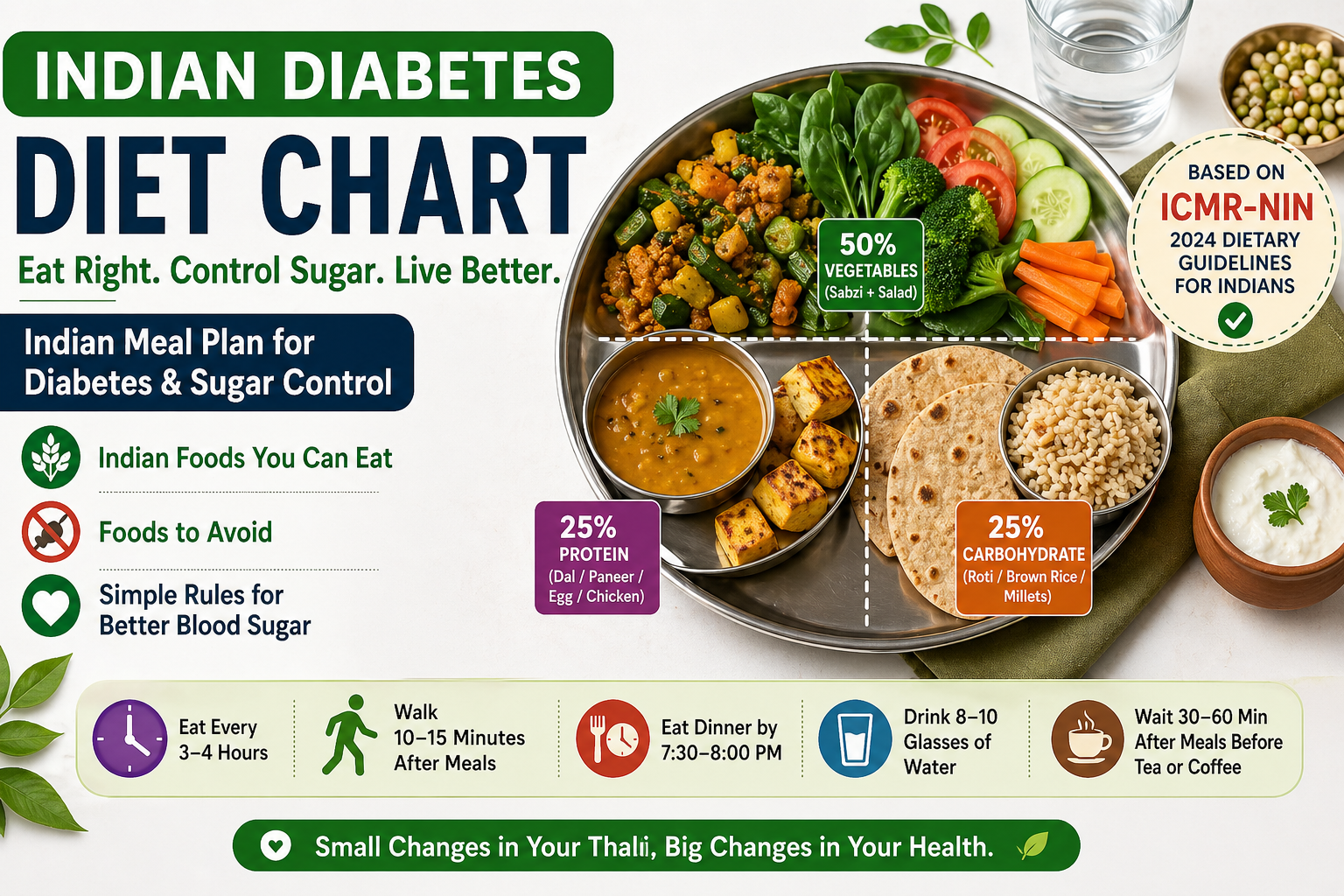
A Indian diabetes diet chart should fill half the plate with vegetables, one quarter with protein (dal/paneer/eggs), and one quarter with low-GI carbs (millets or whole wheat roti). Eat every 3–4 hours, avoid maida and sugary drinks, and include dals at every meal
Why India Needs Its Own Diabetes Diet chart
Most diabetes diet guides online are written for Western audiences — focusing on bread, pasta, and processed foods that most Indians rarely eat. A diabetes diet chart designed specifically for Indians must account for roti, rice, dal, sabzi, and the unique way Indian bodies process carbohydrates.
India’s Diabetes Numbers Are Alarming
India now has over 101 million (10.1 crore) people living with diabetes — a number confirmed by the landmark ICMR-INDIAB national study published in The Lancet Diabetes & Endocrinology in 2023. That makes India the country with the highest absolute number of diabetics in the world.
An additional 136 million Indians have prediabetes, meaning their blood sugar is already elevated but has not yet crossed the diabetes threshold. The majority of these people don’t know their status.
Here is what makes this genuinely important: according to ICMR-NIN’s own 2024 Dietary Guidelines for Indians, a healthy diet combined with regular physical activity can prevent up to 80% of Type 2 diabetes cases. This is not a fringe claim — it is official government guidance, updated in May 2024 after a 13-year gap.
Your kitchen has more power than you think.
Why Indians get diabetes differently
Here is something most diet guides skip entirely, but it may be the most important thing you read today:
Indians develop diabetes at a lower BMI than people in Western countries. A person in India with a BMI of 22 or 23 can already be at high metabolic risk — a BMI level that would be considered completely “normal” under Western guidelines.
The reason is a phenomenon researchers call “thin-fat syndrome” or the “Asian Indian phenotype.” Indians tend to store more fat around the abdomen and organs (called visceral fat) even when they appear slim. This belly fat is directly responsible for insulin resistance — the process that leads to Type 2 diabetes.
This matters practically because:
Even if your weight appears normal, your diet still matters enormously.
Portion sizes are more important for Indians than other populations.
The type of carbohydrate you eat has outsized effects on Indian metabolisms.
Understanding the Basics Before You See the Chart
What Actually Happens When You Eat
When you eat food, your body breaks down the carbohydrates into glucose (sugar), which enters your bloodstream. Your pancreas then releases insulin to move this glucose from the blood into your cells, where it becomes energy.
In diabetes, this system is broken:
In Type 2 diabetes (90–95% of Indian cases), the cells stop responding properly to insulin — this is called insulin resistance. The pancreas tries to compensate by producing more insulin, but eventually cannot keep up.
In Type 1 diabetes, the pancreas barely produces any insulin at all.
The result in both cases: blood sugar stays high for too long. Over years, this damages blood vessels, nerves, kidneys, eyes, and the heart.
Diet helps by reducing how much glucose enters the blood, and how fast.
The Glycemic Index — Explained With Indian Foods
The Glycemic Index (GI) measures how fast a food raises your blood sugar compared to pure glucose.
food with low GI will raise the blood sugar slowly, compare to food with high GI.
High GI (above 70): Blood sugar rises fast — like a rocket
Medium GI (56–69): Moderate rise
Low GI (below 55): Blood sugar rises slowly and steadily — this is what we want
Here’s what this looks like with actual Indian foods:
| Food | GI | Effect |
| White bread/ Maida | 75+ | Very fast spike |
| Plain white rice | 72 | Fast spike |
| Jalebi | 65 | Fast spike |
| Whole wheat roti | 54 | slow rise |
| Brown rice | 55 | slow rise |
| Ragi (finger millet) roti | 54 | slow rise |
| Jowar (sorghum) roti | 50 | slow rise |
| Moong dal (cooked) | 38 | very slow |
| Rajma (kidney beans) | 29 | very slow |
| Chickpeas (chhole) | 33 | very slow |
| Spinach / cucumber | <15 | Barely moves |
Important: GI is not the only thing that matters. How much you eat (portion size) and what you eat it with (food combinations) both change the actual blood sugar effect. Eating rice with dal and vegetables is very effective than from eating plain rice alone.
The 3 Nutrients That Matter Most
Carbohydrates: The main driver of blood sugar. Not all carbs are equal — complex carbs from whole grains and legumes release glucose slowly; refined carbs spike it fast.
Protein: Does not raise blood sugar. Keeps you full, reduces cravings, preserves muscle, and slows the absorption of carbs eaten at the same meal.
Fibre: Found in vegetables, legumes, and whole grains. Slows glucose absorption dramatically. ICMR-NIN 2024 guidelines specifically highlight that most Indians are fibre-deficient.
The Diabetes Thali Method
Forget tracking calories or weighing food. Think in a thali — because that is how India actually eats.
Here is the rule for every meal
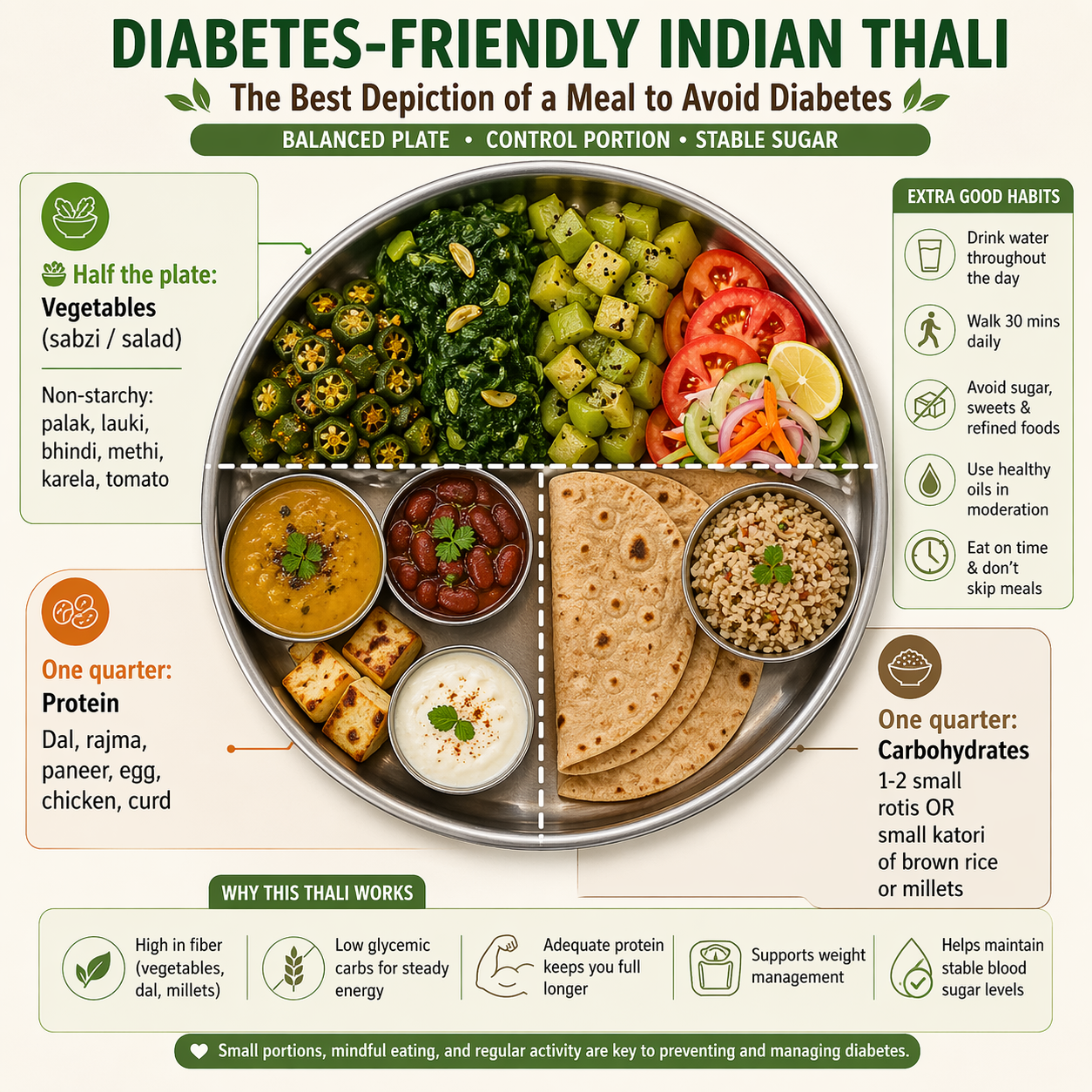
This “Diabetes Thali” is directly aligned with ICMR-NIN 2024 guidelines, which state that vegetables, fruits, and greens should constitute at least half the plate at every meal, while cereals and millets form the other major portion alongside pulses.
The key insight: most Indians already have the right ingredients in their kitchen. The problem is usually proportions — too much roti/rice, not enough dal and vegetables.
Indian diabetes diet chart
Important notes before reading:
This chart is designed for a adult with Type 2 diabetes
Calorie range: approximately 1,400–1,800 kcal/day
Adjust portion sizes based on your doctor’s or dietician’s advice
This is a general guide, not a substitute for personalised medical advice
This diet chart will help you to manage your daily food intake.
You can follow this chart
Golden Rules for Following This Chart
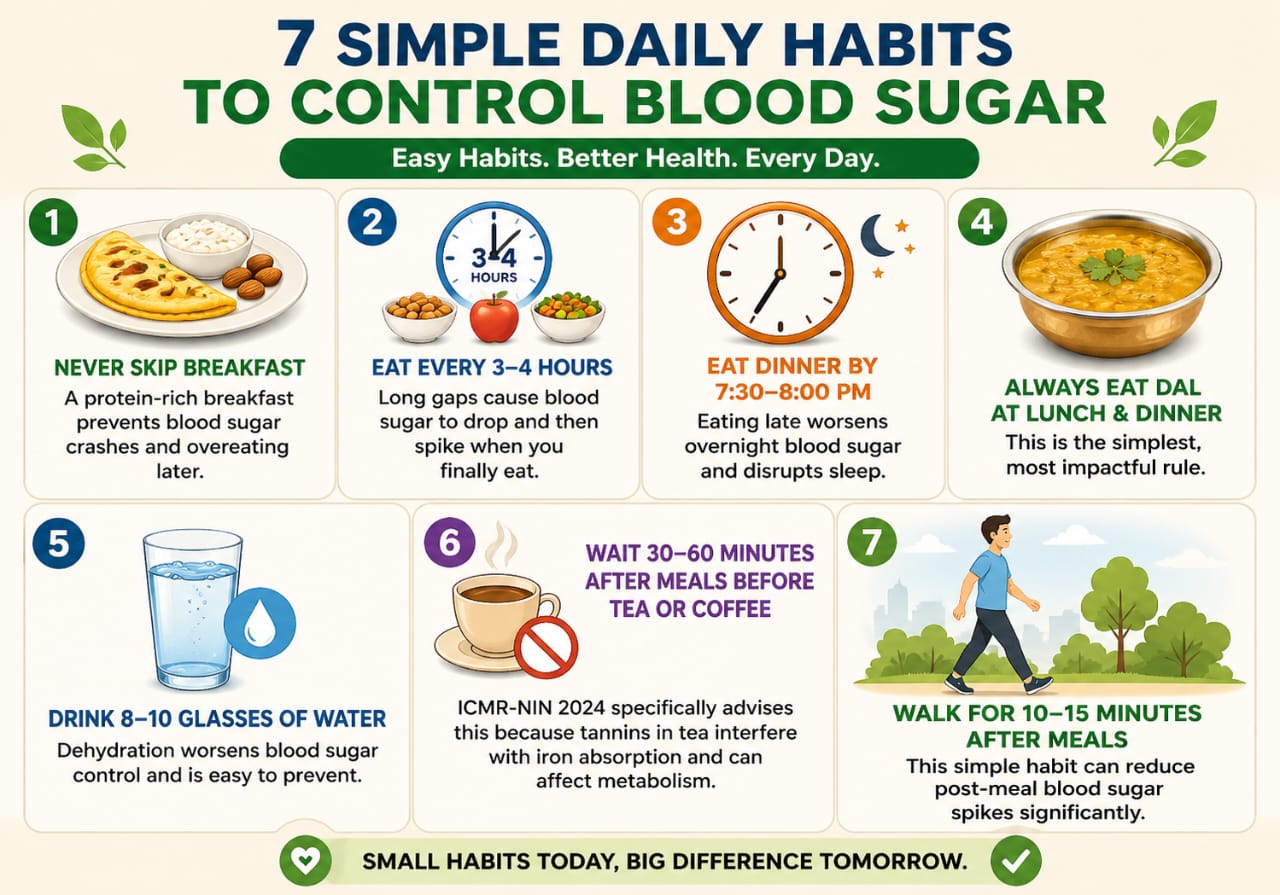
Never skip breakfast — a protein-rich breakfast prevents blood sugar crashes and overeating later.
Eat every 3–4 hours — long gaps cause blood sugar to drop and then spike when you finally eat.
Eat dinner by 7:30–8:00 PM — eating late worsens overnight blood sugar and disrupts sleep.
Always eat dal at lunch and dinner — this is the simplest, most impactful rule
Drink 8–10 glasses of water — dehydration worsens blood sugar control and is easy to prevent
Wait 30–60 minutes after meals before tea or coffee — ICMR-NIN 2024 specifically advises this because tannins in tea interfere with iron absorption and can affect metabolism
Walk for 10–15 minutes after meals — this simple habit can reduce post-meal blood sugar spikes significantly
Special Situations Every Indian Diabetic Faces
Diwali, Holi & Festive Season
The festive season does not have to mean chaos for your blood sugar. Here is how to navigate it:
- Eat before you go.
- Have a small protein-rich snack (curd, nuts, a chilla) before attending a party. You will be less hungry when surrounded by mithai.
- Choose wisely from what’s available. Dry fruits (2–3 pieces of kajú, 1–2 dates) are better choices than barfi or jalebi.
- If eating mithai, take the smallest possible piece and eat it with a meal, never on an empty stomach.
- Dry fruit barfi without refined sugar is available in many sweet shops today.
- Do not “diet for punishment” after the festival.
Skipping meals post-Diwali causes more blood sugar fluctuation, not less. Return to your normal chart immediately.
Eating at Restaurants & Dhabas
- Start with a soup or salad. A bowl of dal soup, clear vegetable soup, or a small salad before the main course slows overall carbohydrate absorption.
- Order wisely: Dal tadka over paneer makhani. Roti over naan. Grilled fish over fish fry. Raita over creamy sauces.
- Control your portion of rice. Ask for a half plate, or eat rice only with plenty of dal and curry.
- At South Indian restaurants: Idli and plain dosa with sambar are much better choices than rava dosa, set dosa, or dishes with extra butter/ghee. Add extra sambar for protein.
- At dhabas on the highway: Stick to dal, roti, and a simple sabzi. Avoid the deep-fried and cream-heavy specials.
Ramzan / Roza
Managing diabetes during Roza requires extra attention. Always consult your doctor before fasting, especially if you are on insulin or certain medications that can cause hypoglycaemia during fasting hours.
Sehri (pre-dawn meal): This is the most important meal of the day during Ramzan. Include complex carbs (roti, daliya, oats), protein (eggs, dahi, paneer, dal), and plenty of water. Avoid salty and spicy food that will increase thirst.
Iftar (breaking fast): Break the fast with 1–2 dates + water (as Sunnah and medically sensible — dates provide fast glucose to prevent hypoglycaemia). Then wait 10–15 minutes before eating a full meal. Avoid making Iftar a feast of fried foods. A bowl of soup, a roti with sabzi, and dal is ideal.
During fasting hours: Monitor blood sugar if you have a glucometer. Symptoms of low blood sugar (shakiness, sweating, confusion) should prompt breaking the fast.
Travelling & Office Lunches
- Pack snacks from home. Roasted chana, almonds, a small tiffin of sprouts, or a roti with dal will prevent you from making bad choices at airports, train stations, or canteens.
- Stay hydrated. Carry a water bottle. Airports and AC environments cause dehydration, which worsens blood sugar.
- At office canteens: Choose sabzi + roti over fast food. Ask for less oil. Have an extra serving of dal if available. Skip the dessert or replace with a small cup of curd.
Five Common Indian Myths About Diabetes Diet — Busted
You Must Give Up Rice Completely.
Not true. White rice has a higher GI than brown rice or millets — that part is correct. But the solution is not elimination; it is portion control and food pairing.
Eating a small katori of white rice with plenty of dal, vegetables, and curd is metabolically very different from eating a full plate of plain rice. The protein and fibre in the other foods slow glucose absorption significantly.
A better goal than zero rice: switch to brown rice, use a smaller portion, and always pair it with dal and sabzi.
Jaggery (Gur) Is Safe Because It’s Natural
False. Jaggery and sugar both raise blood glucose at nearly the same rate. Jaggery does contain small amounts of iron and minerals that refined sugar lacks, which makes it marginally more nutritious — but from a blood sugar perspective, they are essentially equivalent.
This myth is particularly dangerous because people sometimes consume jaggery in large quantities believing it is “safe,” causing major blood sugar spikes.
Sugar-Free Products Are Always Safe to Eat
Misleading. Many sugar-free biscuits, cookies, and mithai are made with maida (refined flour) and unhealthy fats. The GI can still be high even with zero sugar. They can also cause weight gain, which worsens insulin resistance.
The rule: Always read the ingredient list, not just the front of the package. If it lists maida, vanaspati, or multiple types of starch — it is not appropriate regardless of the “sugar-free” claim.
Eating Fruits Will Spike My Blood Sugar
Incorrect for most fruits when eaten correctly. The science consistently shows that whole fruit consumption is associated with better diabetes management, not worse. The fibre in whole fruit buffers the sugar.
The problem is fruit juice — not fruit. One glass of orange juice (3–4 oranges juiced) has roughly the same sugar content as a Coke, with the fibre removed.
Eat the fruit. Skip the juice.
Once I’m on Medication, My Diet Doesn’t Matter
Dangerously false. Diabetes medication — whether metformin, insulin, or other drugs — works with your diet to maintain blood sugar control. It does not override poor eating.
Moreover, some medications (like insulin and sulfonylureas) can cause hypoglycaemia if you eat too little or at wrong times. Poor diet also accelerates complications that medication cannot reverse.
Think of medicine as the foundation and diet as the structure built on it. You need both.
When to See a Doctor or Dietician
This guide is based on official Indian dietary research and is designed for general guidance. Please see a qualified doctor or registered dietician if:
- You have been newly diagnosed with diabetes or prediabetes
- Your fasting blood sugar remains above 130 mg/dL or HbA1c above 7% despite dietary changes
- You are pregnant or planning pregnancy (gestational diabetes requires specific, supervised guidance)
- You have kidney disease (diabetic nephropathy requires protein restriction — some high-protein recommendations here may not apply)
- You are on insulin, sulfonylureas, or multiple medications (meal timing must align with your drug schedule)
- You have heart disease alongside diabetes (fat recommendations need more careful personalisation)
- You experience frequent hypoglycaemic episodes (low blood sugar) or unexplained fatigue
Frequently asked questions
Can a diabetic eat rice?
Yes, in moderation. Brown rice is preferred over white rice. The key is portion size (half katori, not a full plate) and always pairing it with dal and vegetables. Eating rice alone or in large portions is the problem, not rice itself.
What is the best breakfast for a diabetic Indian?
A moong dal chilla, methi thepla with plain curd, ragi dosa with sambar, or oats upma are all excellent options. The ideal breakfast has protein, complex carbs, and fibre — and avoids refined flour (maida) and sugar.
Is banana good for diabetics?
In small portions, yes. Eat half a medium banana, preferably slightly underripe (lower GI), and pair it with a handful of nuts or curd for protein. A whole ripe banana on an empty stomach is not ideal.
Can I eat mango if I have diabetes?
Yes, in very small portions and not daily. 4–5 small pieces (not a whole mango) eaten with a meal (not alone) is generally acceptable for most Type 2 diabetics with reasonably controlled blood sugar. Monitor your post-meal sugar to see how your body specifically responds.
What time should I eat dinner if I have diabetes?
Ideally between 7:00 PM and 8:00 PM. Eating late (after 9 PM) increases the time blood sugar remains elevated during sleep and is associated with worse overnight glucose readings. If work makes early dinner impossible, eat a light snack at 7 PM and have a very light dinner later.
Is coconut good or bad for diabetics?
Fresh coconut in moderate amounts is acceptable — it contains medium-chain fats and fibre. Coconut oil is fine as a cooking fat in small quantities, particularly in South Indian cuisine. The concern is sweetened coconut products (coconut ladoo, coconut barfi) which are high in sugar.
Can I drink chai (tea)?
Yes, with adjustments. Use no more than 1/4 teaspoon of sugar per cup, or use stevia. Avoid waiting to drink tea right after meals — ICMR recommends at least 30–60 minutes gap as tannins in tea interfere with iron absorption. Green tea and herbal teas without sugar are better choices.
Reference
- Dietary information for diabetes patient
- ICMR-NIN Expert Committee, Dietary Guidelines for Indians-2024
- Dietary guidelines across different countries & comparisons to dietary guidelines for Indians
- A good guide to good carbs: The glycemic index
- Burden of non-communicable diseases in India: Findings from the ICMR-INDIAB study
- Standards of Care in Diabetes- ADA
About the author
Mohammad Junaid Rain is a 2nd-year MBBS student focused on simplifying diabetes care for Indian families. He creates evidence-based health content using medical textbooks, ADA guidance, ICMR resources, research papers, and clinical exposure. His goal is to make diabetes management practical and easy to understand for Indians.