
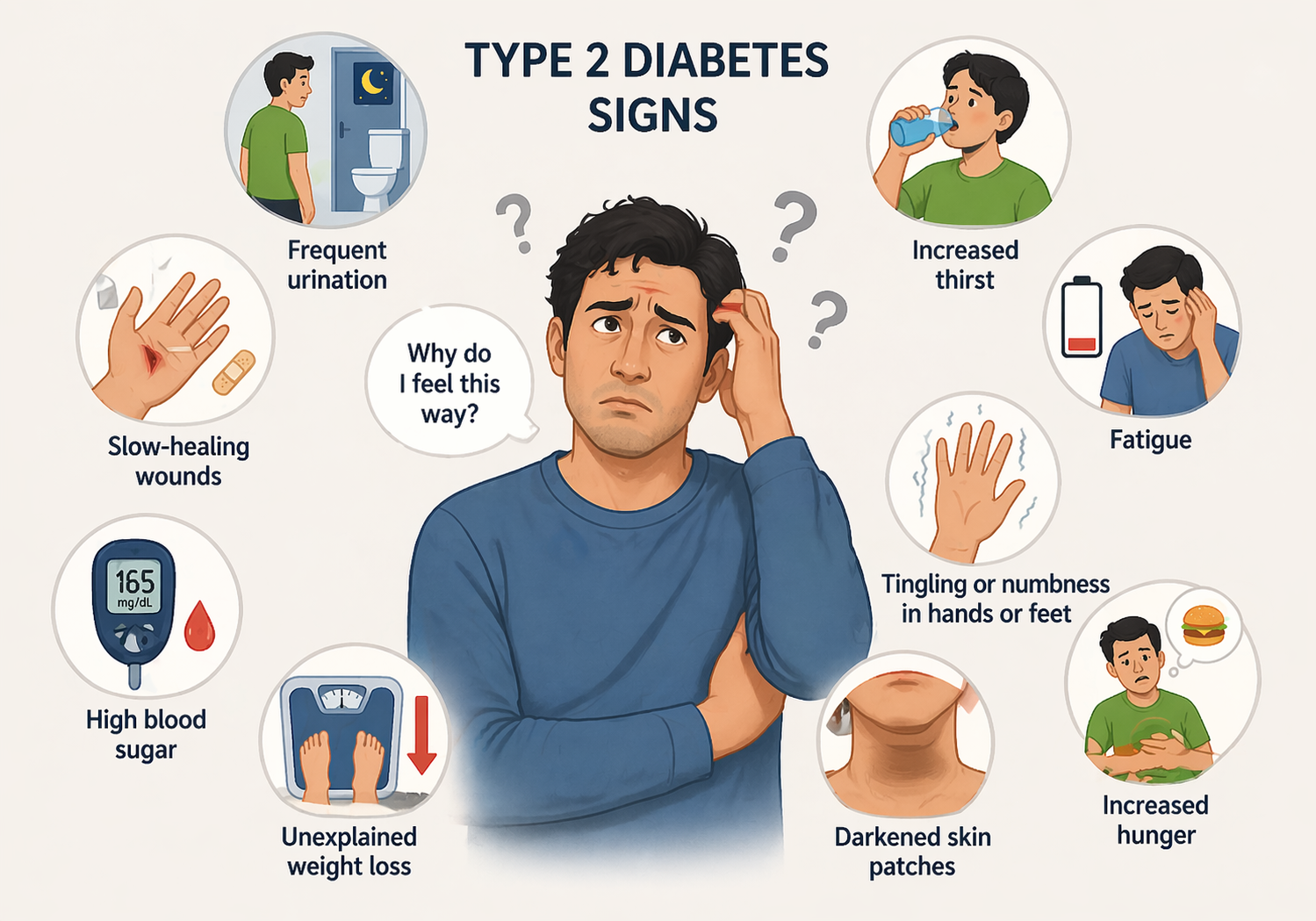
Before discussing early signs of type 2 diabetes let me tell you something, Most people often imagine diabetes comes with obvious warning signs — a dramatic moment where your body suddenly breaks down and a doctor delivers the news. The reality is far quieter, and far more dangerous.
Type 2 diabetes doesn’t announce itself. It whispers. It hides behind everyday complaints you’d never think twice about — feeling a little tired, needing an extra glass of water, a cut that’s taking longer to heal than usual. By the time most people get diagnosed, the condition has already been quietly progressing for years.
That’s the part that catches people off guard.
According to the CDC, over 8 million Americans have type 2 diabetes and don’t even know it. In India, the numbers are just as alarming — millions are living with undetected high blood sugar right now, going about their daily lives completely unaware.
So why does this happen? Why do so many people miss the signs?
Because the early symptoms of type 2 diabetes are easy to explain away. Fatigue? “I’ve been busy.” Frequent urination? “I’ve been drinking more water.” Blurry vision? “I need new glasses.”
That’s exactly what makes this disease so dangerous — and exactly why understanding the early warning signs could genuinely change, or even save, your life.
If you haven’t already, start with our foundational guide — What Is Type 2 Diabetes? Everything You Need to Know — to understand how and why this condition develops in the first place. Then come back here, because what follows might be the most important checklist you read this year.
Why Type 2 Diabetes Is the “Silent Disease”
Here’s something that surprises most people: type 2 diabetes doesn’t hurt. At least not at first.
Unlike a broken bone or a chest infection, there’s no sharp pain telling you something is wrong. Your blood sugar can be elevated for months or even years before your body sends signals loud enough to notice. This is precisely why the medical community calls it a silent disease — and why the World Health Organization estimates that a significant portion of people with type 2 diabetes remain undiagnosed globally.
The silence happens because your body is incredibly adaptive. In the early stages of insulin resistance, your pancreas simply works harder — pumping out more insulin to compensate for cells that are becoming less responsive. From the outside, everything seems fine. Blood sugar stays relatively controlled. Symptoms stay buried.
But this compensation can only last so long.
As research published in The Lancet has shown, by the time type 2 diabetes is formally diagnosed, many patients have already lost a significant portion of their beta cell function — the only cells in the pancreas responsible for making insulin. The damage has been happening quietly, long before the diagnosis.
This is why waiting for dramatic symptoms is a dangerous game. The window to catch type 2 diabetes early — at the prediabetes stage, where the condition is often reversible — is real, but this window closes if care is not taken. And most people don’t even know the window exists.
Understanding the early signs isn’t about being anxious or self-diagnosing. It’s about being informed. Your body does send signals — they’re just easy to mistake for something else. The sections ahead will walk you through exactly what to look for. So keep your seatbelt tie we are now entering into understanding Early Signs and Symptoms of Type 2 Diabetes Most People Miss.
The 10 Early Warning Signs of Type 2 Diabetes
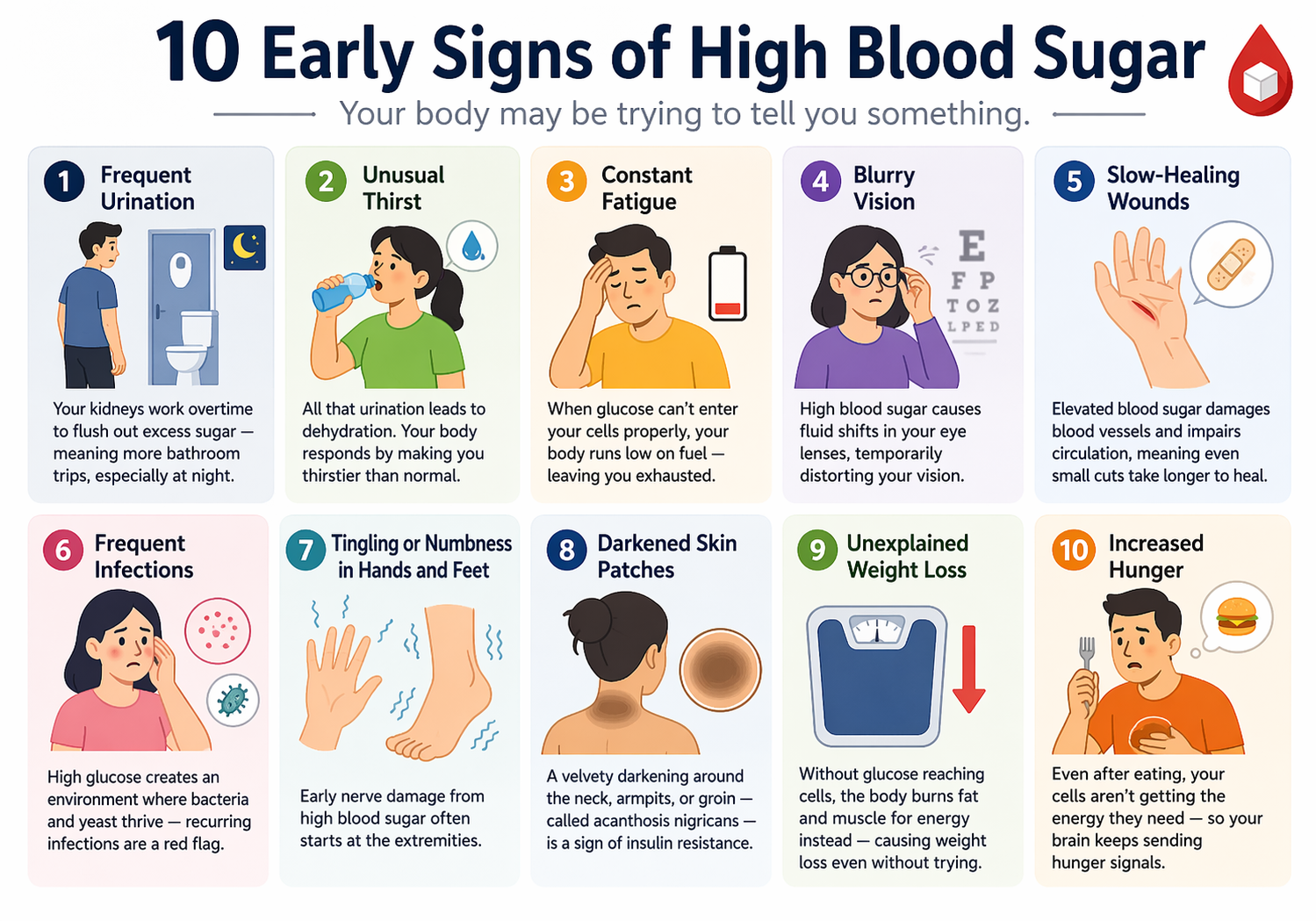
Now lets discuss the early signs of type 2 diabetes. Most of these signs are easy to dismiss. That’s exactly the problem. Here’s what your body might actually be telling you:
- Frequent Urination: Your kidneys work overtime to flush out excess sugar — meaning more bathroom trips, especially at night.
- Unusual Thirst: All that urination leads to dehydration. Your body responds by making you thirstier than normal, creating a frustrating cycle.
- Constant Fatigue: When glucose can’t enter your cells properly, your body runs low on fuel — leaving you exhausted even after a full night’s sleep. So even after the good diet and good sleep if you stay fatigue then it simply means glucose is not use by the body means chances of insulin resistance or no insulin at all.
- Blurry Vision: High blood sugar causes fluid shifts in your eye lenses, temporarily distorting your vision. Many people blame aging or screen time.
- Slow-Healing Wounds: Elevated blood sugar damages blood vessels and impairs circulation, meaning even small cuts or bruises take unusually long to heal.
- Frequent Infections: High glucose creates an environment where bacteria and yeast thrive — recurring skin, urinary, or gum infections are a quiet red flag.
- Tingling or Numbness in Hands and Feet: Early nerve damage from high blood sugar often starts at the extremities. Many people write this off as “poor circulation.”
- Darkened Skin Patches: A velvety darkening around the neck, armpits, or groin — called acanthosis nigricans — is a visible sign of insulin resistance.
- Unexplained Weight Loss: Without glucose reaching cells, the body burns fat and muscle for energy instead — causing weight loss even without trying.
- Increased Hunger: Even after eating, your cells aren’t getting the energy they need — so your brain keeps sending hunger signals.
Noticing more than two or three of these? Don’t wait. A simple fasting blood sugar test can tell you a lot — and early action makes all the difference. Learn how type 2 diabetes is diagnosed in our complete guide.
Signs Specific to Women vs Men
Type 2 diabetes shares many symptoms across the board — but your biology can shape how and where those signs show up. Here’s what to watch for based on your gender:
In women
Frequent Yeast Infections: High blood sugar feeds yeast growth. Women with undiagnosed type 2 diabetes often experience recurring vaginal yeast or urinary tract infections that keep coming back despite treatment.
Polycystic Ovary Syndrome (PCOS): PCOS and insulin resistance are deeply connected. According to the Office on Women’s Health, women with PCOS have a significantly higher risk of developing type 2 diabetes — and the hormonal imbalance itself can mask early symptoms.
Hormonal Fluctuations Masking Symptoms: Fatigue, mood shifts, and irregular cycles are often blamed on hormones — making it easy to overlook blood sugar as the real culprit.
Greater Risk of Heart Complications: Research shows that women with type 2 diabetes face a disproportionately higher risk of cardiovascular disease compared to men with the same condition.
In men
Reduced Testosterone & Low Libido: Insulin resistance directly disrupts testosterone production. Men may notice reduced sex drive, fatigue, or difficulty building muscle — symptoms rarely linked to blood sugar at first glance.
Erectile Dysfunction: One of the earliest and most overlooked male-specific signs. Damaged blood vessels and nerves from high blood sugar affect circulation long before a formal diagnosis. The American Diabetes Association confirms the strong link between type 2 diabetes and erectile dysfunction.
Muscle Loss: Men tend to lose lean muscle mass earlier in the progression of type 2 diabetes, often mistaking it for normal aging.
Whether you’re a man or a woman, subtle hormonal or sexual health changes deserve attention — they’re often your body’s earliest distress signal.
Prediabetes Symptoms — What Comes Before Type 2 Diabetes
Think of prediabetes as the last exit on the highway before a point of no return.
Your blood sugar is higher than normal — but not yet high enough to be classified as type 2 diabetes. This stage is critical, because here’s the thing most people don’t realize: prediabetes is largely reversible. Type 2 diabetes, once fully developed, is not.
According to the CDC, over 98 million American adults have prediabetes — and more than 80% of them have no idea. In India, the numbers are equally alarming, with millions sitting in this danger zone completely unaware.
So what does prediabetes actually feel like?
I can honestly tell you based on my studies and learnings prediabetes has very few symptoms and that’s the problem. Most people with prediabetes experience no clear symptoms at all. But some do notice subtle, easy-to-dismiss signals:
- Mild fatigue after meals — your cells are already struggling to absorb glucose efficiently.
- Slightly increased thirst or urination — not dramatic, just a quiet shift from your normal.
- Darkened skin patches — particularly around the neck or armpits, signalling underlying insulin resistance.
- Brain fog — difficulty concentrating, especially after carbohydrate-heavy meals.
- Unexplained weight gain around the belly — visceral fat directly worsens insulin resistance, accelerating the progression.
The challenge is that these signs are so ordinary that most people shrug them off for months or years. But if we take preventive measure at this point then it can be easily reversed back to the normal.
This is exactly why routine blood sugar testing matters — especially if you carry any of the known risk factors like family history, excess weight, or a sedentary lifestyle. A simple HbA1c test can catch prediabetes before it silently becomes something harder to manage.
Key takeaway: No symptoms doesn’t mean no problem. Prediabetes is your window — don’t miss it.
When to see Doctor
Here’s a simple rule: don’t wait until something feels seriously wrong. With type 2 diabetes, by the time symptoms become impossible to ignore, the condition has usually been progressing for years.
Use this checklist as your guide. If any of the following apply to you — it’s time to book that appointment.
- Frequent urination: especially waking up multiple times at night to use the bathroom.
- Unusual thirst: that doesn’t go away no matter how much you drink.
- Fatigue that won’t quit: feeling drained even after proper sleep and rest.
- Blurry vision: even occasional or mild episodes that come and go.
- Slow-healing cuts, wounds, or bruises: anything taking longer than it should.
- Recurring infections: yeast infections, UTIs, or gum problems that keep coming back.
- Tingling, numbness, or burning in your hands or feet.
- Darkened skin patches around your neck, armpits, or groin.
See a Doctor Immediately If You Have Risk Factors Like:
- A parent or sibling with type 2 diabetes.
- You are overweight, especially with belly fat.
- You’ve been diagnosed with prediabetes before and haven’t followed up.
- You had gestational diabetes during pregnancy.
- You are over 35 with a sedentary lifestyle.
The Test You Need to Ask For:
A simple fasting blood glucose test or HbA1c test is all it takes. According to the American Diabetes Association, adults with risk factors should be screened every 1–3 years — even with zero symptoms.
Early detection is not just smart — it’s life-changing. Understand the full picture of type 2 diabetes risk factors in our complete guide before your next doctor’s visit.
What Tests Confirm Type 2 Diabetes?
Suspecting diabetes is one thing. Confirming it is simple, quick, and can be done with a routine blood test. Here are the four tests your doctor may use:
1. Fasting Blood Sugar Test
You skip food and drink for at least 8 hours, then a blood sample is taken. It’s the most common first step.
| Result | What It Means |
|---|---|
| Below 100 mg/dL | Normal |
| 100–125 mg/dL | Prediabetes |
| 126 mg/dL or above | Diabetes |
2. HbA1c Test (Glycated Haemoglobin)
This is the gold standard. It measures your average blood sugar over the past 2–3 months — no fasting required.
| Result | What It Means |
|---|---|
| Below 5.7% | Normal |
| 5.7% – 6.4% | Prediabetes |
| 6.5% or above | Diabetes |
According to the American Diabetes Association, the HbA1c test is preferred for diagnosis because it reflects long-term blood sugar patterns — not just a single-day snapshot.
3. Oral Glucose Tolerance Test (OGTT)
You drink a sugary solution and your blood sugar is tested 2 hours later. Commonly used during pregnancy screening but also effective for general diagnosis. It tells how effectively your body is maintaining the blood glucose level.
4. Random Blood Sugar Test
A blood sample taken at any time of day — no fasting needed. A result of 200 mg/dL or higher alongside symptoms strongly suggests diabetes.
One important note: A single abnormal result is rarely enough. Most doctors confirm a diabetes diagnosis with two separate tests on different days — unless symptoms are severe. Learn more about the full diagnostic process in our complete type 2 diabetes guide.
Reference
https://diabetes.org/about-diabetes/diagnosis
https://www.cdc.gov/diabetes/php/data-research/index.html
https://womenshealth.gov/a-z-topics/diabetes
https://pmc.ncbi.nlm.nih.gov/articles/PMC12764642
About the author
It’s me Mohammad Junaid Rain an MBBS student at GMC Nagpur, passionate about making evidence-based medical information accessible to every. “medstuffs.com” is dedicated to clear, doctor-written disease education for patients and caregivers.
Disclaimer: This article is for educational purposes only and does not substitute professional medical advice. Please consult your doctor for diagnosis and treatment.