
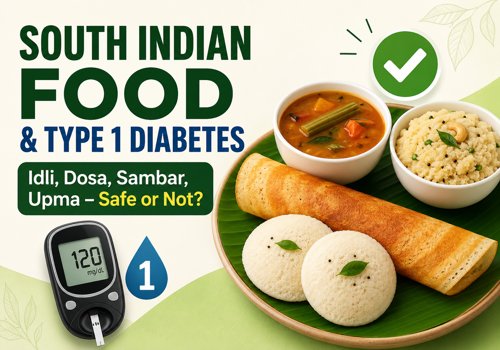
In the medicine wards of GMC Nagpur, I frequently meet Type 1 Diabetes patients who have completely banished their favorite breakfasts out of pure fear. Conventional advice dictates that fermented white rice staples like idli and plain dosa are a direct ticket to dangerous blood sugar spikes. So, it becomes important to understand the south indian food and type 1 diabetes.
The clinical reality is entirely different, Managing South Indian food with Type 1 Diabetes isn’t about abandoning your culinary heritage—it’s about mastering insulin biochemistry. This practical guide breaks down the true Glycemic Index scores of idli, dosa, sambar, and upma, giving you the precise carbohydrate-counting rules and pre-bolus hacks you need to enjoy these staples while keeping your blood sugar completely stable.
Why South Indian Breakfast Is Different for Type 1 Diabetes?
In my clinical postings at GMC Nagpur, South Indian breakfasts are famously tricky for Type 1 Diabetes (T1D). While dishes like idli and dosa are nutrient-dense, their high white rice base and fermentation make them rapidly absorbable. Fermentation essentially “pre-digests” the starches, causing them to flood the bloodstream and outpace rapid-acting insulin if unmatched.
The South Indian menu spans the entire Glycemic Index (GI) spectrum:
- 🔴 High GI (more than 70): Plain Dosa (79) and Onion Dosa (80) cause rapid, sharp glucose excursions.
- 🟡 Medium GI (56–69): Idli with Sambar (69) and Pesarattu (Moong dal dosa, 61) offer a more predictable, moderate rise.
- 🟢 Low GI (less than 55): Vada Sambar (37) scores low only because deep-frying introduces heavy fats that delay gastric emptying, though excessive fried items compromise long-term metabolic health.
The Rava (Semolina) Paradox:
Cooking methods drastically alter a food’s biochemistry. Steaming semolina for Rava Idli maintains a favorable Low GI of 55, but dry-roasting it as an Upma base spikes the GI to 76! Adding a cup of mixed vegetables or dals to your upma can drop that GI back down to 55.
Clinical Blueprint for T1D:
- The Sambar Shield: Never eat idlis “naked.” Pairing your carbs with lentil-rich Sambar or peanut chutney adds fiber, fat, and protein, blunting the glucose peak by 15% to 20%.
- Standardize Your Ladle: Dosa batter is highly carbohydrate-dense. Consistently measuring your portions with a standard-sized ladle ensures your pre-meal insulin matching via your ICR remains flawless.
Idli & Type 1 Diabetes: GI, Fermentation Science & How Many Is Safe
Yes, you can absolutely enjoy idli with Type 1 Diabetes (T1D). Because your management relies on exogenous insulin, there is no universal “safe number”—safety depends entirely on carbohydrate counting and matching your insulin dose via your personalized ICR.
However, idli comes with a unique metabolic twist: Fermentation Science. While fermentation enhances nutrient absorption, it also “pre-digests” the starches. This means the carbohydrates break down and flood your bloodstream rapidly, requiring precise bolus timing.
Let’s look at the numbers per 15-gram carbohydrate exchange:
- 🔴 Standard Rice Idli: Paired with sambar, it carries a Medium GI of 68.69 and a high Glycemic Load (GL 34.34). One small rice idli equals 15g of carbs.
- 🟢 Rava (Semolina) Idli: A superior structural swap. Steaming semolina drops the GI to a favorable 55. Two small rava idlis equal 15g of carbs, giving you double the food volume for the exact same glycemic impact.
Clinical Cheat Sheet: Always inject your rapid-acting insulin 20 to 30 minutes before eating to give your insulin a head start against the fast-absorbing fermented rice. Always pair your idlis with vegetable-dense sambar to add protein and fiber, smoothing out the glucose curve.
Dosa & Type 1 Diabetes: Plain, Masala, Onion & Millet Dosa — Which Is Safest?
No dosa is strictly forbidden in Type 1 Diabetes (T1D), but fermentation means the starches are “pre-digested,” causing rapid glucose spikes. Choosing your batter and filling wisely makes or breaks your post-meal time-in-range:
- 🔴 The Fast Spikers: Plain (GI 79.4) and Onion Dosa (GI 79.7) flood the bloodstream instantly due to a lack of fiber. They demand strict pre-bolusing.
- 🟡 The Stable Upgrades: Vegetable Dosa (GI 64) and Paneer Dosa (GI 71.5). The protein from paneer and fiber from veggies act as functional speed bumps, delaying glucose absorption.
- 🟢 The Metabolic Winners: Pesarattu (Moong dal dosa – GI 60.7) and millet-based dosas. Swapping white rice for whole lentils or complex millets provides a slow, predictable glucose release that matches your insulin curve.
Clinical Pro-Tips: Never eat a dosa “naked”—always pair it with lentil-rich sambar. Watch out for hidden cooking fats; while ghee delays immediate carbohydrate absorption, excessive saturated fat complicates next-day insulin sensitivity. Always measure your batter using a standardized ladle to keep your carbohydrate counting and ICR exact.
Sambar: The Secret Weapon That Lowers the GI of Every South Indian Meal
Fermented white rice staples like plain dosa can be absolute nightmares for Type 1 Diabetes (T1D) because they digest instantly. Sambar is your ultimate metabolic buffer against these sharp glucose spikes. Ladling this lentil stew over your breakfast transforms its glycemic profile through three distinct mechanisms:
- The Pulse Advantage: Primarily made from low-GI toor dal (GI ~43), pairing sambar with fast-acting carbs can drop the entire meal’s overall Glycemic Index by 15% to 20%.
- The Fiber Barrier: Packed with drumsticks, gourds, and carrots, sambar delivers a massive infusion of dietary fiber that physically retards glucose absorption in your gut.
- Protein Synergy: Combining the rice in idli/dosa with the dal in sambar forms a high-quality “complete” protein. This structure takes much longer to digest, significantly delaying gastric emptying.
The “sambar effect” is clinically proven: a plain dosa alone has a High GI of 79.39, but pairing idli with sambar drops the GI to a manageable 68.69.
The Clinical Rule: Sambar is powerful, but it isn’t “free.” The dal and veggies contribute to your total carbohydrate load. Always count its carbs alongside your main dish to calculate your precise pre-meal bolus.
Upma & Rava: How to Eat It Safely with Type 1 Diabetes
Raw rava (semolina/suji) has a moderate Glycemic Index of 66, but your cooking method alters its biochemistry. Dry-roasting rava for upma pushes its GI to a soaring 76, causing rapid post-meal spikes. Conversely, steaming it (like rava idli) retains a manageable GI of 55.
To safely enjoy upma without outpacing your rapid-acting insulin, implement these clinical modifications:
- Load the Veggies: Add a full cup of carrots, peas, and beans. This dense fiber injection drops the upma’s GI back to 55. Aim for a plate structure of ½ vegetables, ¼ protein, and ¼ semolina.
- The Pulse Partner: Mix in moong dal (like a semolina-dal khichdi) to slash the overall Glycemic Index by 15% to 20% and anchor the Glycemic Load to a stable 10.
- Add Metabolic Speed Bumps: Incorporating fenugreek seeds or oats cuts the glycemic impact by another 15% to 20%.
Portion Protocol: Dry rava is exceptionally carbohydrate-dense (73g carbs per 100g). Always weigh your portions raw and cap it at 25–30 grams (¼ cup) for a predictable 15–20g carbohydrate exchange. Enjoy upma for breakfast or lunch to avoid volatile overnight blood sugar fluctuations.
Practical Guide: Carb Counts, Insulin Timing & Safer Swaps for South Indian T1D Meals
Managing Type 1 Diabetes (T1D) while enjoying South Indian cuisine requires moving past guesswork into tactical dosing. Use this clinical cheat sheet to match your insulin perfectly to traditional favorites.
1. Carbohydrate Counting Basics (15g Carb Exchanges)
To apply your Insulin-to-Carbohydrate Ratio (ICR), use these standard 15-gram carbohydrate benchmarks:
- 1 Small Rice Idli or 2 Small Rava Idlis
- 1 Standard Plain Dosa * ¼ Cup Dry Rava (25–30g raw upma base)
- 1 Standard 6-inch Chapati (or ¾ Millet Roti)
- Clinical Math: Estimate your rapid-acting ICR by dividing 500 by your Total Daily Dose (TDD) of insulin.
2. Dosing & Timing Strategy
- The Pre-Bolus (Fermented Foods): Fermented rice batters flood the bloodstream instantly. Always inject rapid-acting insulin 20 to 30 minutes before eating to give your insulin a head start against the spike.
- The Split-Bolus (High-Fat Meals): Deep-fried medu vada or heavy ghee dosas delay gastric emptying, causing early hypoglycemia followed by a late-onset surge. Use a split or extended bolus to distribute coverage over 2–3 hours.
- Correction Factor: Use the 1800 Rule (1800 / TDD) to determine your Insulin Sensitivity Factor (ISF) for correcting pre-meal hyperglycemia.
3. High-Yield Smart Swaps
Optimize your plate architecture to naturally depress the Glycemic Index (GI):
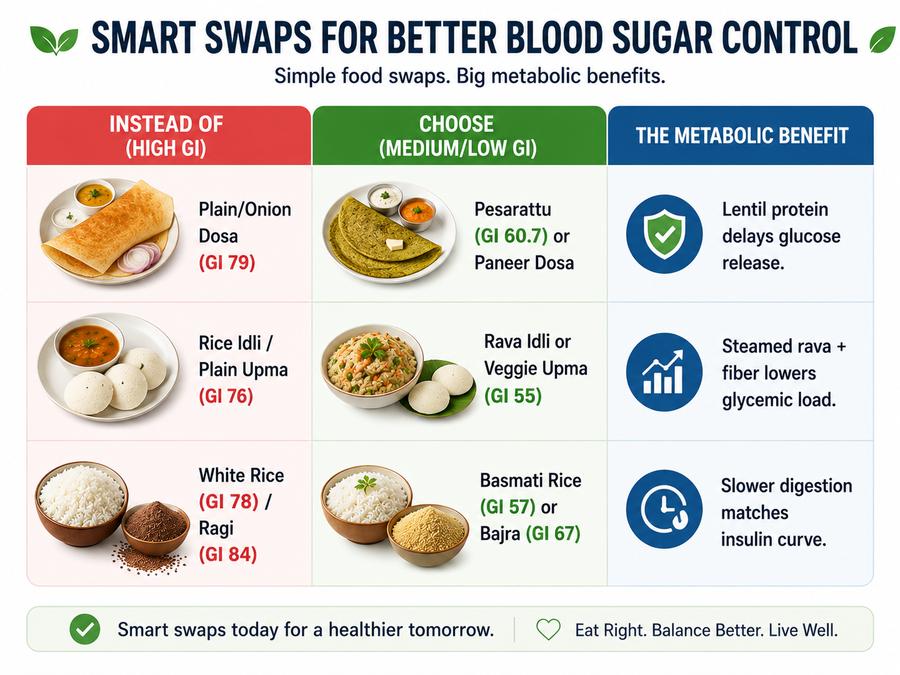
Never eat carbs “naked.” Generously ladling vegetable-heavy, lentil-based sambar reduces a meal’s net GI by 15% to 20%, creating a physical fiber barrier that smooths out glucose peaks.
Reference:
https://pmc.ncbi.nlm.nih.gov/articles/PMC9304465
https://pmc.ncbi.nlm.nih.gov/articles/PMC9304465
https://pmc.ncbi.nlm.nih.gov/articles/PMC6683079
https://pmc.ncbi.nlm.nih.gov/articles/PMC9304465
https://pmc.ncbi.nlm.nih.gov/articles/PMC5393082
https://pmc.ncbi.nlm.nih.gov/articles/PMC9304465
https://professional.diabetes.org/standards-of-care
https://pmc.ncbi.nlm.nih.gov/articles/PMC7539032
https://nin.res.in/dietaryguidelines/pdfjs/locale/DGI_2024.pdf
About the author
It’s me Mohammad Junaid Rain an MBBS student at GMC Nagpur, passionate about making evidence-based medical information accessible to every Indian. “medstuffs.com” is dedicated to clear, disease education for patients and caregivers.
Disclaimer: This article is for educational purposes only and does not substitute professional medical advice. Please consult your doctor for diagnosis and treatment.