
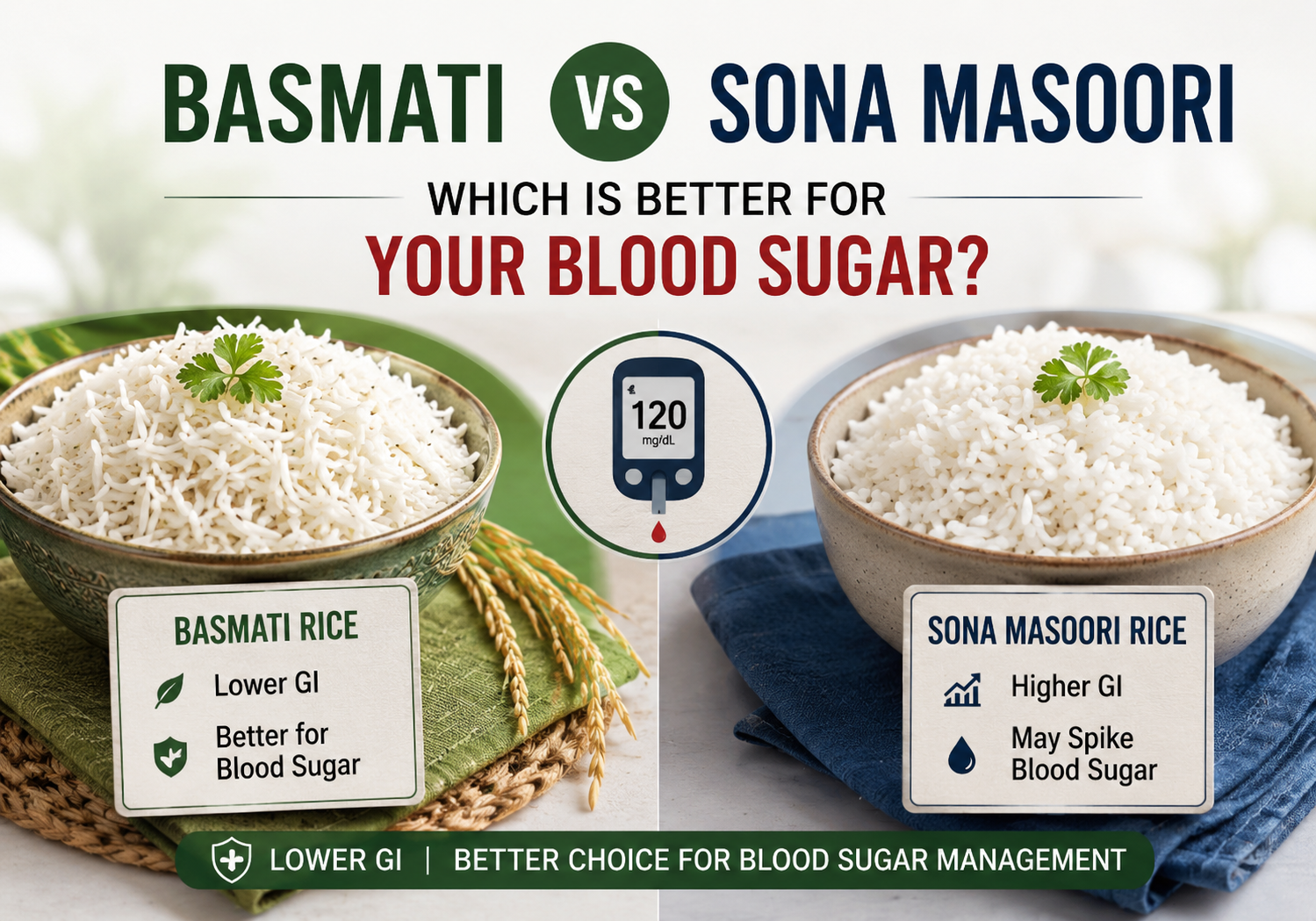
Every Indian family asks the same question at the dinner table: which rice is safer for diabetes, basmati or sona masoori? The answer is not what most people expect.
Basmati vs Sona Masoori rice: which rice is actually better for your blood sugar?
Rice is not the enemy. But the type of rice you choose and how you cook it can make a real difference to your blood sugar levels after every meal. In the basmati vs sona masoori debate, the science gives us a clear winner for diabetics. And the reason why comes down to a single word: amylose.
Basmati rice has a glycemic index of 50–58, low to medium range. Sona Masoori, tested in the Indian Journal of Medical Research, scores 72, firmly in high-GI territory. In this article, we explain what these numbers mean for your daily plate, why basmati behaves differently in your body, and four simple cooking methods that lower the blood sugar impact of any rice right in your own kitchen.
What Is the Glycemic Index of Basmati Rice? (And Why It Is Lower Than You Think) ?
If you are managing diabetes or insulin resistance, you do not have to banish rice from your kitchen. Biochemically, premium Basmati rice ranks surprisingly well on the Glycemic Index (GI) scale compared to standard white rice:
- White Basmati Rice: GI of 50 to 58 (Low to Moderate)
- Aged Basmati Rice: GI of 50 to 55 (Safe, Low)
- Brown Basmati Rice: GI of 45 to 52 (Fiber-rich, Low)
- Parboiled Basmati Rice: GI of 40 to 45 (Lowest impact)
The Clinical Science: Why Basmati Prevents Sugar Spikes
The secret behind these numbers isn’t magic—it is basic kitchen chemistry driven by three distinct physiological factors:
- The Amylose Advantage: Rice starch contains amylopectin (which digests instantly) and amylose (which resists breakdown). Basmati is naturally packed with 25% to 30% amylose. Think of amylose as a tightly knotted rope; your digestive enzymes take much longer to untie it. This is why Basmati grains stay separate and fluffy when cooked, releasing glucose as a steady, safe drip rather than a sudden spike.
- Intact Long-Grain Structure: High-quality premium Basmati uses advanced milling to reject broken grains. Because the physical structure remains completely intact, your stomach requires more metabolic energy to process it, actively delaying glucose absorption.
- Natural Resistant Starch: Basmati contains unique prebiotic carbohydrates that bypass the small intestine entirely, avoiding rapid glucose conversion and fermenting safely in the large intestine.
Hack for Blood Sugar Control
You can lower this GI even further using the cooling hack. Cooking your Basmati and chilling it in the refrigerator for 12 to 24 hours restructures the starches into “resistant starch.” When reheated, it behaves exactly like dietary fiber in your gut.
Always practice smart portion control—keep it to half a cup—and create a nutritional “speed breaker” by pairing your rice with high-fiber vegetables and lean proteins like dal or chicken to keep your blood sugar perfectly flat.
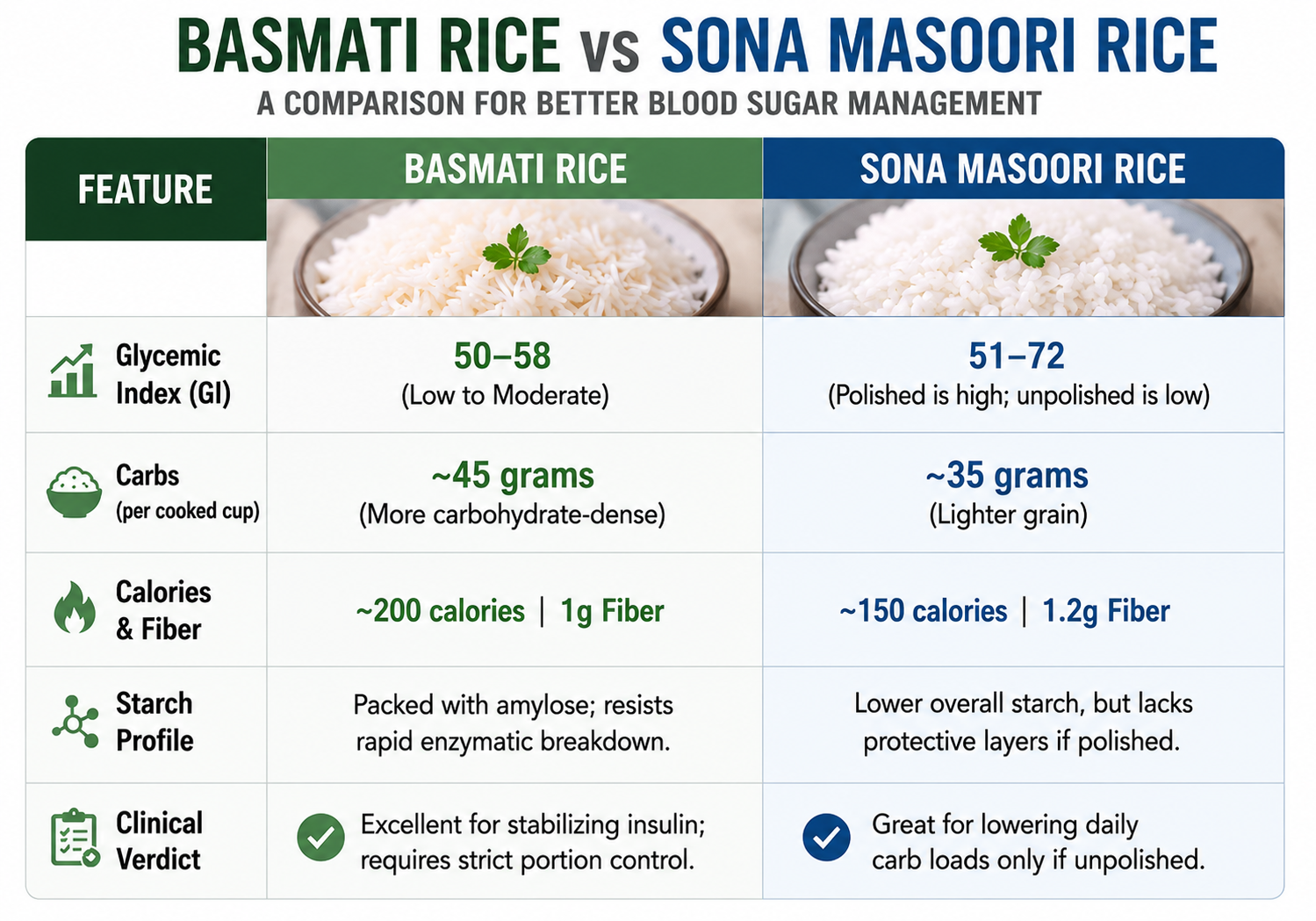
Basmati vs Sona Masoori for Diabetes: The Ultimate GI Comparison Table
When managing diabetes, choosing between Basmati and Sona Masoori is one of the most critical decisions for your daily plate. While one offers a superior starch structure that delays glucose release, the other naturally contains fewer total carbohydrates per cup.
Here is the clinical breakdown to help you make an informed, evidence-based choice for your metabolic health:
The Metabolic Insight: Glycemic Index vs. Glycemic Load
Sona Masoori is often praised as the “healthier” choice because it is physically lighter and lower in calories. However, standard, highly polished supermarket Sona Masoori carries a high GI of up to 72. Without its protective bran layer, it acts like a racecar in your bloodstream, forcing a sharp insulin spike that can worsen insulin resistance over time.
The Medical Prescription: If you prefer the soft texture of Sona Masoori for daily meals, look for unpolished versions or clinically tested, moderate-GI alternatives like Samba Masuri (BPT 5204). If you want reliable, built-in blood sugar protection right out of the bag, Basmati is your physiological winner—just measure your portions to account for the extra calorie density.
Why Basmati Rice Has a Lower Glycemic Index: The Amylose Science Explained
Not all carbohydrates behave the same way in the human body. The reason premium Basmati rice stabilizes blood sugar while standard white rice causes aggressive spikes lies entirely within the biochemical architecture of its starch molecules.
Rice starch is composed of two distinct molecules that dictate its digestibility and subsequent impact on your pancreas:
- Amylopectin (The Rapid Spiker): This molecule has a highly branched, open structure. Picture it as a loose, tangled ball of yarn that digestive enzymes can easily shred. It gelatinizes rapidly during cooking, making rice sticky and clumpy. Because your metabolism breaks it down effortlessly, it rapidly floods your bloodstream with glucose, causing sharp insulin spikes.
- Amylose (The Slow Releaser): Amylose consists of long, linear, tightly packed chains of glucose. Imagine it as a thick, tightly knotted climbing rope. It physically resists enzymatic breakdown and prevents the grain from clumping during cooking, keeping the rice light, separate, and fluffy.
The Basmati Metabolic Advantage
Basmati rice is uniquely metabolically protective because it naturally contains an exceptionally high concentration of digestion-resistant amylose—typically 25% to 30%.
Because of this specific molecular blueprint, your body is forced to process the grain through a prolonged digestive timeline. Instead of a sudden glycemic surge, Basmati delivers a slow, safe, and metered drip of glucose into your bloodstream. By understanding this kitchen chemistry, you can utilize high-amylose grains to actively protect your metabolic health without completely eliminating rice from your life.
Can Diabetics Eat Basmati Rice Daily? What Clinical Research Says
Yes, clinical research confirms that individuals with Type 2 diabetes can eat high-quality Basmati rice daily, provided it is managed through precise portion control and strategic food pairing. Because Basmati naturally sits in a low-to-moderate Glycemic Index (GI) range of 50 to 58, it interacts with your metabolism far more safely than standard sticky white rice.
Why Research Supports Basmati
- The Amylose Anchor: Its high amylose content resists rapid enzymatic breakdown, ensuring a slow, metered release of glucose into your bloodstream rather than a sharp spike.
- Magnesium and Micronutrients: Basmati contains essential trace minerals like magnesium, a vital cofactor that actively improves cellular insulin sensitivity and blood sugar regulation.
- Prebiotic Satiety: Its natural resistant starches nourish beneficial gut microbiota, enhancing metabolic health and reducing biochemical cravings for sugar between meals.
The Clinical Protocol for Daily Consumption
If your HbA1c levels are stable, you can safely integrate Basmati into your daily routine by adhering to three non-negotiable rules:
- Optimize the Clock: Consume your daily rice portion at lunch when your daytime metabolic rate and insulin sensitivity are naturally higher. Avoid heavy carbohydrate loads within two hours of sleeping.
- Enforce Portion Caps: Limit your serving strictly to ½ to 1 cup of cooked rice. Excess volume increases the total glycemic load, neutralizing the grain’s inherent low-GI advantage.
- Transition to Brown Basmati: For daily consumption, wholegrain brown Basmati is medically superior. Its intact bran layer delivers dense dietary fiber, significantly delaying gastric emptying.
My advice: Never eat your rice “naked.” Always pair it with high-fiber vegetables (like spinach or bhindi) and lean proteins (like dal, paneer, or chicken). This creates a physical “speed breaker” in your digestive tract, keeping your post-meal blood sugar curve perfectly flat.
How to Cook Basmati and Sona Masoori to Keep GI as Low as Possible
How you handle rice in your kitchen directly alters its cellular structure and glycemic impact. By utilizing basic food chemistry, you can actively manipulate these starches to keep their Glycemic Index (GI) as low as possible.
Follow this step-by-step clinical cooking protocol to master your blood sugar:
- The Pre-Wash and Soak: Rinse your rice until the water runs completely clear to strip away loose surface starch. Soaking Basmati for 30 minutes further reduces starch density before heat is applied.
- Ditch the Pressure Cooker: Pressure cooking traps gelatinized starches inside the grain. Instead, boil your Basmati or Sona Masoori in an open pot with excess water, then drain the cloudy, starchy water completely to remove free sugars.
- Cook to “Al Dente”: Overcooking breaks down the grain’s protective carbohydrate barriers, forcing the GI to climb. Keep the rice firm. This is critical for Sona Masoori, which easily over-gelatinizes due to its shorter grain structure.
- The 24-Hour Cooling Hack: Refrigerate cooked rice for 12 to 24 hours. This chilling process forces starches to crystallize into Resistant Starch Type 3, which passes through the small intestine undigested like dietary fiber—blunting glucose spikes even after reheating.
- Buffer with Healthy Fats: Incorporating a teaspoon of pure ghee or coconut oil delays gastric emptying, which naturally slows the release of glucose into your bloodstream.
- The Acid Hack: Squeeze fresh lemon juice over your plate. The acidity lowers the meal’s pH, slowing down the salivary amylase enzymes responsible for rapidly breaking down carbohydrates.
The Clinical Protocol: Never eat your rice “naked.” Limit daily portions to ½ cup and pair them with high-fiber vegetables (like bhindi or palak) and lean protein (like dal, paneer, or chicken) to build an unbreakable metabolic barrier. for detail read this article
FAQ
What is the top 5 healthiest rice?
As a metabolic health strategist, here are the top 5 healthiest low-GI rice varieties for stabilizing your blood sugar:
Black Rice: A metabolic superfood with a GI of 42.3, packed with disease-fighting antioxidants.
Kerala Matta (Red Rice): Scores a highly safe GI of 45–52 and is loaded with digestion-slowing fiber.
Brown Basmati: Boasts a GI of 45-52, brilliantly combining high-amylose starch with an intact, protective bran layer.
Telangana Sona (RNR 15048): A breakthrough white rice with a clinically proven GI of 51.0.
Wild Rice: A nutrient-dense, high-protein grain with a moderate GI of 57.
Is basmati rice better than Sona Masoori rice?
Health warriors, the answer depends on your metabolic goal! For strict blood sugar control, Basmati rice is the clear winner. Its high amylose content provides a low Glycemic Index (GI 50-58), preventing rapid insulin spikes.
Conversely, Sona Masoori contains fewer calories and total carbohydrates, making it great for weight management. However, standard polished Sona Masoori has a high GI, so you must choose unpolished varieties to safely protect your blood glucose.
so winner for this question is Basmati rice.
Which rice is better than basmati?
To beat Basmati, upgrade to pigmented indigenous varieties! Black rice is a metabolic superstar with an ultra-low Glycemic Index of 42.3 and rich antioxidants. Kerala Matta (Red Rice) is another superior choice, scoring a safe 45 to 52 while delivering digestion-slowing fiber.
Basmati rice vs sona masoori rice which is better for weight loss?
For pure weight loss, Sona Masoori is the winner! It naturally contains fewer calories and carbohydrates per cup compared to the denser Basmati. However, because standard Sona Masoori has a high Glycemic Index, always choose the unpolished variety to keep insulin steady and effectively burn fat.
About the author
It’s me Mohammad Junaid Rain an MBBS student at GMC Nagpur, passionate about making evidence-based medical information accessible to every Indian. “medstuffs.com” is dedicated to clear, disease education for patients and caregivers.
Disclaimer: This article is for educational purposes only and does not substitute professional medical advice. Please consult your doctor for diagnosis and treatment.