
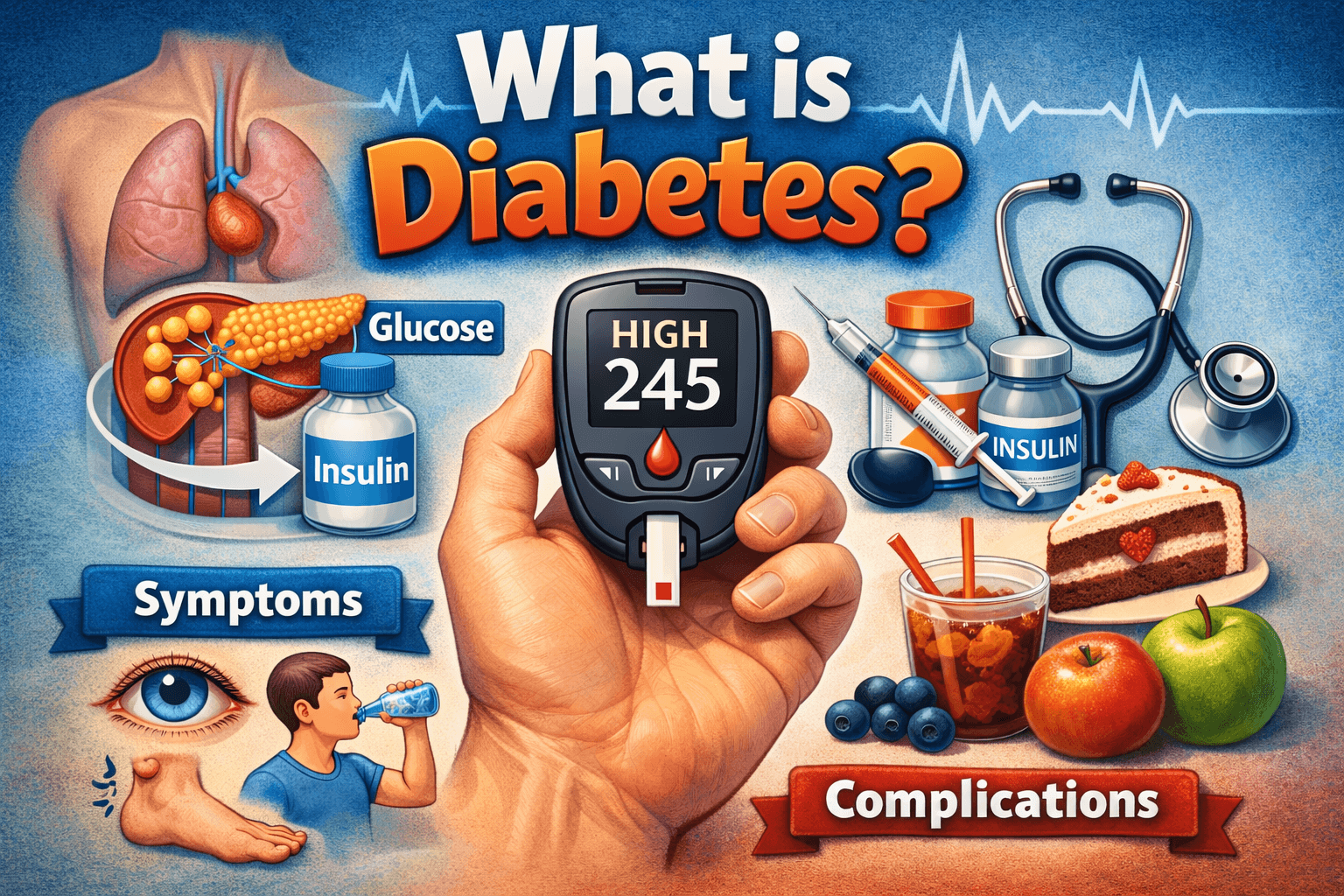
Before explaining what is diabetes, let me ask you something. You eat food every day to get energy? But what if your body is unable to use that food properly?
If you often feel tired after meals, feel unusually thirsty, or go to the washroom frequently — your body might be trying to tell you something important.
This is where diabetes begins.
In this article, you’ll understand what diabetes really is — in the simplest way possible.
What is Diabetes?
Diabetes is a condition where the level of sugar (glucose) in your blood becomes too high.
But the real problem is not just high sugar.
The real problem is that your body is unable to use that sugar for energy. This leads to a buildup of glucose in the blood while your body cells remain energy-deprived.
How Diabetes Happens in the Body
To understand diabetes clearly, you need to understand what happens after you eat food.
- Food is broken down into glucose (sugar)
- This glucose enters your bloodstream
- Your body needs to move this glucose into cells for energy
For this process, your body uses a hormone called insulin, which is released from the pancreas.
Think of insulin as a key, and your body cells as locked doors.
- Insulin unlocks the cells
- Glucose enters the cells
- Energy is produced
What happens in diabetes?
- Either the body does not produce enough insulin
- Or the body cannot use insulin properly (insulin resistance)
As a result:
- Glucose cannot enter the cells
- It remains in the bloodstream
- Blood sugar levels rise
What Actually Goes Wrong in Diabetes
Because glucose cannot enter the cells:
- Blood sugar levels increase
- Cells do not receive enough energy
This creates a double problem:
- Too much sugar in the blood
- Too little energy inside the cells
This imbalance is the core reason behind all symptoms and complications of diabetes.
Symptoms of Diabetes
so far till here we understand what is diabetes now lets Understand symptoms
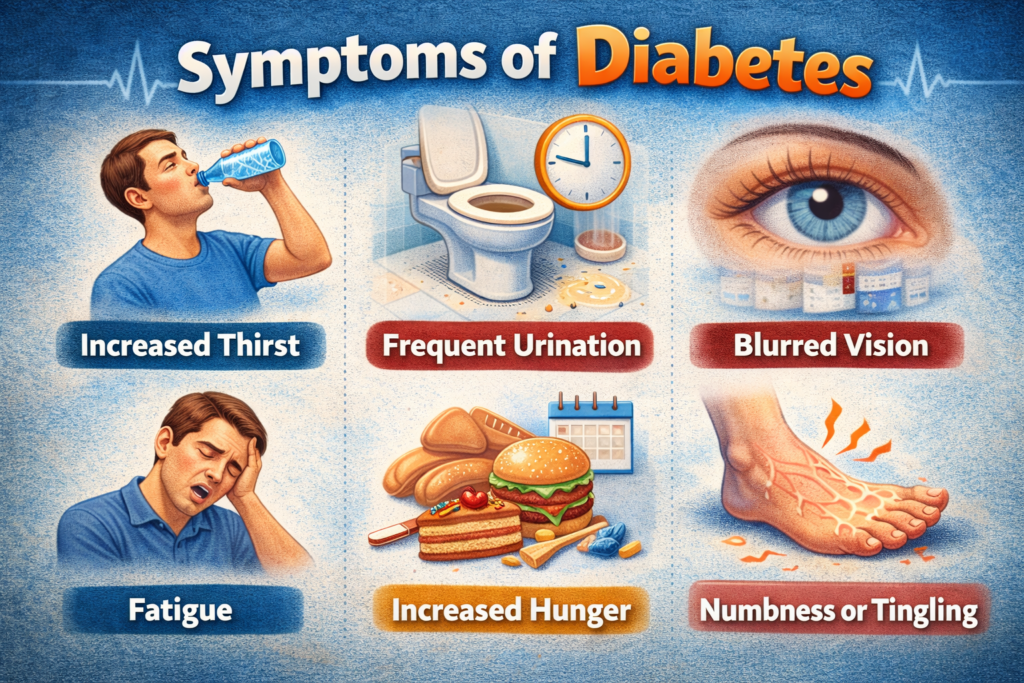
🔹 Frequent urination
To maintain normal blood sugar levels, your body tries to remove excess sugar through urine.
🔹 Excessive thirst
Frequent urination leads to loss of water, causing dehydration and increased thirst.
🔹 Fatigue (tiredness)
Cells are not receiving enough glucose for energy, making you feel tired.
🔹 Unexplained weight loss
The body starts breaking down fat and muscle for energy when glucose cannot be used properly.
🔹 Blurred vision (important early sign)
High blood sugar affects fluid balance in the eyes.
Common Myths About Diabetes
❌ Myth 1: Eating sugar directly causes diabetes
✅ Truth: Diabetes depends on how your body processes sugar, not just how much sugar you eat.
❌ Myth 2: Only older people get diabetes
✅ Truth: In India, diabetes is increasingly seen in people in their 20s and 30s.
❌ Myth 3: Diabetes always requires insulin injections
✅ Truth: Many people manage diabetes with diet, exercise, and medications.
❌ Myth 4: If you feel fine, you don’t have diabetes
✅ Truth: Diabetes can remain silent for years without noticeable symptoms.
Why Diabetes is Increasing in India
In India many people don’t understand what is diabetes. Unawareness makes India as one of the largest populations of people with diabetes globally, often leading it to be described as the “diabetes capital of the world.”
According to global and national estimates, over 77 million people in India are living with diabetes, and recent studies suggest this number may exceed 100 million. More than half of affected individuals remain undiagnosed.
The rising burden of diabetes in India is driven by multiple factors, including high carbohydrate diets, sedentary lifestyles, increased abdominal fat, and genetic susceptibility.
This makes early awareness and lifestyle modification extremely important.
Types of Diabetes
🔹 Type 1 Diabetes
The body does not produce insulin. It usually starts at a younger age. Because of less insulin level in the body, blood glucose level rises above the normal level. To maintain a normal life external source of insulin has to be taken which will be life-long.
🔹 Type 2 Diabetes (Most Common)
The body does not use insulin effectively (insulin resistance). This is strongly linked to lifestyle factors. type 2 diabetes can be reversed by lifestyle modification, taking proper medication.
🔹 Gestational Diabetes
Occurs during pregnancy and may increase future risk of Type 2 diabetes.
It is very important to understand type1 vs type 2 diabetes difference
What is Prediabetes? (Early Warning Stage)
Now single question which is what is diabetes is not alone to worry, there is one more term which is prediabetes. Prediabetes is a condition where blood sugar levels are higher than normal but not high enough to be classified as diabetes.
Think of it as a warning sign.
- Your body is starting to lose control over blood sugar
- But the condition is still reversible
Why it matters:
If ignored, prediabetes can progress to Type 2 diabetes.
The good news:
With proper lifestyle changes such as healthy eating, weight control, and regular exercise, prediabetes can often be reversed.
When Should You See a Doctor?

Now you well understand what is diabetes, so You should consult a doctor if you notice:
- Frequent urination
- Excessive thirst
- Persistent fatigue
- Unexplained weight loss
- Blurred vision
You should also get tested if you:
- Are overweight
- Are physically inactive
- Are above 30 years of age
- Have a family history of diabetes
Early diagnosis can prevent long-term complications.
Why Diabetes is Dangerous
If left uncontrolled, diabetes can affect multiple organs:
- Heart (heart disease)
- Brain (stroke)
- Eyes (vision loss)
- Kidneys (kidney damage)
However, with early detection and proper management, these complications can be prevented.
Conclusion
so now we understand that what is diabetes. It is not just about high sugar levels.
It is a condition where your body fails to properly use glucose for energy.
Once you understand what is happening inside your body, you can take control early, make better lifestyle choices, and prevent complications.
“Awareness is the first step toward prevention“.
Frequently Asked Questions (FAQs About Diabetes)
- Is diabetes a disease?
Yes, diabetes is a disease. More specifically, it is a metabolic disorder in which the body is unable to properly regulate blood sugar (glucose) levels.
It occurs either because:
- The body does not produce enough insulin
- Or the body cannot use insulin effectively
- What is the main cause of diabetes?
The main cause of diabetes depends on the type, but the most common form — Type 2 diabetes — is mainly caused by:
- Insulin resistance (body not responding properly to insulin)
- Unhealthy lifestyle (poor diet, lack of physical activity)
- Excess body fat, especially abdominal fat
- Genetic predisposition
In simple terms:
The body cannot properly use sugar for energy.
- What is Type 2 diabetes?
Type 2 diabetes is the most common type of diabetes.
In this condition:
- The body produces insulin
- But the cells do not respond to it properly (insulin resistance)
As a result, glucose builds up in the blood instead of entering the cells.
It is strongly linked to lifestyle factors such as diet, physical inactivity, and obesity.
- Is diabetes a chronic disease?
Yes, diabetes is a chronic (long-term) disease.
This means:
- It usually develops slowly
- It requires long-term management
- It cannot be completely cured in most cases
However, it can be effectively controlled with proper lifestyle changes and medical care.
- What is the WHO definition of diabetes?
According to the World Health Organization (WHO), diabetes is a chronic disease that occurs when the pancreas does not produce enough insulin or when the body cannot effectively use the insulin it produces, leading to increased blood glucose levels.
- What is gestational diabetes?
Gestational diabetes is a type of diabetes that develops during pregnancy.
- It usually occurs in the second or third trimester
- It affects how the body uses insulin
- Blood sugar levels become higher than normal
Although it often resolves after delivery, it increases the risk of developing Type 2 diabetes later in life for both the mother and the child.
- Can diabetes be reversed?
Type 1 diabetes cannot be reversed because the body does not produce insulin.
However, Type 2 diabetes and prediabetes can often be managed and even reversed in early stages through:
- Healthy diet
- Regular exercise
- Weight loss
- Lifestyle changes
Early action is key.
- What are the early signs of diabetes?
Early signs of diabetes may include:
- Frequent urination
- Increased thirst
- Unusual fatigue
- Blurred vision
- Slow healing of wounds
Some people may not have any symptoms, especially in early stages.
- What is normal blood sugar level?
Normal blood sugar levels are generally:
- Fasting: 70–99 mg/dL
- After meals: Less than 140 mg/dL
Values above this range may indicate prediabetes or diabetes.
- How is diabetes diagnosed?
Diabetes is diagnosed using blood tests such as:
- Fasting blood sugar test
- HbA1c test
- Oral glucose tolerance test
A doctor will interpret these results to confirm diagnosis.
Resources
- https://www.who.int/news-room/fact-sheets/detail/diabetes
- https://diabetesjournals.org/care/search-results?page=1&q=diabetes&fl_SiteID=1000003
About the author
Mohammad Junaid Rain is an MBBS student at GMC Nagpur, passionate about making evidence-based medical information accessible to every Indian. “medstuffs.com” is dedicated to clear, doctor-written disease education for patients and caregivers.
Disclaimer: This article is for educational purposes only and does not substitute professional medical advice. Please consult your doctor for diagnosis and treatment.