
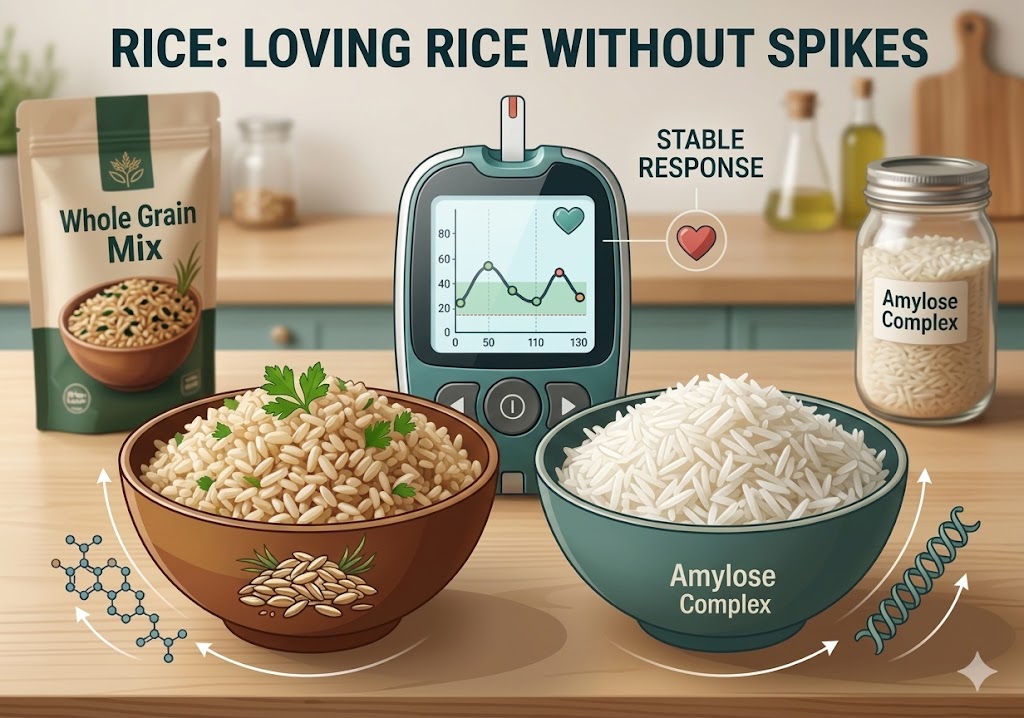
For many of us, a meal doesn’t feel “complete” without a portion of warm, fluffy rice. But if you are living with diabetes or pre-diabetes, that plate of rice often comes with a side of guilt and fear. You’ve likely been told by well-meaning relatives or even doctors that rice is the “enemy” of stable blood sugar. So it becomes important to understand the glycemic index of rice.
Here is the truth: You don’t have to divorce rice to manage your diabetes.
According to the latest 2024 ICMR-NIN (National Institute of Nutrition) Guidelines, carbohydrates still make up nearly 50-60% of the Indian diet. The secret to health isn’t in total elimination; it’s in understanding the Glycemic Index (GI). In simple terms, the GI is a “speed limit” for your food. It tells us how fast a specific type of rice turns into sugar in your bloodstream.
While typical white rice is often a “high-speed” food (causing those sharp, exhausting sugar spikes), new clinical research—including the breakthrough studies on Telangana Sona (RNR 15048) rice—proves that there are low-GI varieties that behave more like “slow-burn” fuel.
In this guide, we are bridging the gap between traditional Indian dining and modern medical science. Supported by the ADA (American Diabetes Association) 2026 Standards of Care, we will show you how to identify low-GI rice varieties, how “resistant starch” can lower a grain’s impact, and how the right “food pairing” can help you enjoy your favorite pulao or dal-chawal without the 2-hour post-meal spike.
Let’s redefine your relationship with rice—one grain at a time.
What is Glycemic index of Rice
One of the biggest misconceptions in diabetes management is that “rice is just rice.” In reality, the Glycemic Index (GI) of rice isn’t a fixed number; it’s a moving target. It depends heavily on the specific variety of the seed and how much of its “protective shield” (the bran and germ) was removed during milling.
Think of the GI scale (0 to 100) as a speedometer. Our goal is to stay in the “slow lane” (Low GI: 55 or less) to avoid the metabolic “car crash” of a sugar spike.
According to clinical data and the 2024 ICMR-NIN Food Exchange lists, here is how your favorite rice varieties rank:
- Standard White Rice (The “High-Speed” Grain): With a GI of 70 to 87, polished varieties like traditional Sona Masuri are the metabolic equivalent of eating pure sugar. Because the fiber-rich outer layer is stripped away, your body digests these grains almost instantly, leading to an aggressive and exhausting blood sugar spike.
- Brown Rice (The “Fiber-Locked” Grain): Steamed brown rice usually sits comfortably in the Low GI range (50 to 55). It retains its fibrous outer bran layer, which acts as a physical barrier. This forces your digestive enzymes to work harder and slower, releasing energy gradually.
- White Basmati Rice (The “Naturally Balanced” Grain): Surprisingly, not all white rice is off-limits. Basmati, particularly the long-grain varieties, has a Low to Moderate GI (50 to 58). This is due to its high “amylose” content—a type of sturdy starch that resists rapid breakdown.
- Telangana Sona / RNR 15048 (The “Clinical Breakthrough”): This is a game-changer for the Indian plate. Developed by PJTSAU and verified in the Journal of Rice Research, this specific variety has a clinically proven GI of 51.0. It offers the fluffy texture of white rice with the blood sugar safety of brown rice.
- Red and Black Rice (The “Antioxidant Powerhouses”): Indigenous varieties like Kerala Matta or Black “Forbidden” rice range from 42.3 to 52 on the GI scale. These are packed with anthocyanins (antioxidants) and minerals, making them a premium choice for long-term heart and metabolic health.
The “Fridge Factor”: A Smart Kitchen Hack to Lower GI
What if I told you that you could lower the GI of any rice variety—including white rice—just by changing how you store it?
Medical science reveals a fascinating process called Starch Retrogradation. When you cook rice and then cool it in the refrigerator for 12 to 24 hours, the structure of the starch molecules changes. They turn into something called “Resistant Starch.”
As the name suggests, this starch resists digestion. Instead of turning into sugar in your small intestine, it travels to your large intestine where it acts like a prebiotic fiber. Studies show that reheating “day-old” rice can significantly lower the post-meal glucose response compared to eating it fresh off the stove. This is a powerful, science-backed way to enjoy your traditional meals with much higher confidence.
Brown Rice & Basmati — The Safer Choices Comparison table
If you want to master your blood sugar without giving up your favorite staples, you do not need to banish rice from your diet. Both steamed brown rice and white basmati rice are excellent, evidence-based alternatives to standard polished white rice.
While they look and taste different, they both work toward the same goal: preventing the “roller-coaster” effect of sugar spikes and crashes. According to the 2024 ICMR-NIN guidelines, choosing grains with more fiber and complex structures is the most sustainable way to manage Type 2 diabetes.
Here is your ultimate comparison table breaking down why these two grains are the safer choices for your metabolic health:
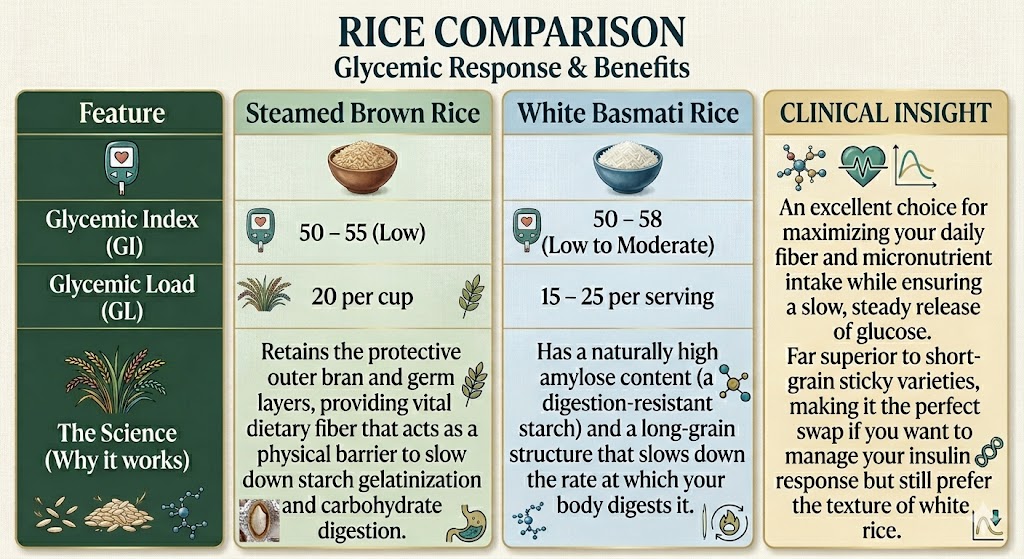
Most people are shocked to see a “white” rice in the safety zone. Medical science explains this through Amylose content. Most short-grain white rices (like Jasmine or Sona Masuri) are high in amylopectin, which dissolves quickly in your saliva. Basmati is high in amylose, a long, complex molecule that takes much longer for your digestive enzymes to “unlock.”
I always tell patients: Don’t overcook your rice. The longer you boil rice until it becomes soft and mushy, the more you “pre-digest” the starch. This actually raises the Glycemic Index! To keep your Basmati or Brown rice in the low-GI safety zone, cook it until it is just tender (firm to the bite). This keeps the starch structure intact, ensuring a slower release of glucose into your bloodstream.
GI of Indian Rice Varieties
One of the most frequent questions I receive is: “Does rice need to be completely banished from my diet?” The short answer is: Absolutely not! You just need to choose the right variety.
Because rice is the primary source of calories for over half of India’s population, clinical researchers (including experts at ICMR-NIN) have extensively tested both traditional and newly developed grains to see how they impact our blood sugar. Think of this list as your “Metabolic Compass”—it shows you which grains lead to a steady energy flow and which ones lead to a sugar crash.
The “Slow Burners” (Low GI: 55 and Below)
If you are actively managing prediabetes, Type 2 diabetes, or insulin resistance, these are your absolute best choices. These grains behave like “slow-release fuel,” providing energy without overwhelming your pancreas.
- Black Rice (Kavuni Arisi): GI 42.3. This indigenous powerhouse has an exceptionally low GI. Its dark color comes from anthocyanins—powerful antioxidants that also help improve insulin sensitivity.
- Kerala Matta (Red Rice): GI 45–52. A native favorite from South India. Because it is only partially hulled, it retains a massive amount of fiber that creates a “speed bump” for sugar absorption.
- Telangana Sona (RNR 15048): GI 51.0. This is the “Medical Breakthrough” grain. Developed by researchers at PJTSAU, it looks and tastes like super-fine white rice but has been clinically proven to be low-GI. It is a game-changer for those who miss the texture of white rice.
- White Basmati (Aged): GI 50–58. As we discussed, its long-grain structure and high amylose content make it a safe, moderate choice compared to short-grain white rice.
- Sampada (GI 51) & Lalat (GI 53.17): These are lesser-known varieties often found in Central and Eastern India that perform exceptionally well in clinical tests.
How Cooking Changes GI
One of the biggest secrets in the world of diabetes management and weight loss is this: A food’s Glycemic Index (GI) is not a permanent number. How you prepare, cook, and even store your meals literally alters their cellular structure. This means you have the power to “re-engineer” your rice to change how quickly it spikes your blood sugar. If you want to master your metabolic health, you need to understand this “Kitchen Chemistry.”
According to the ADA 2026 Standards of Care, individualized meal preparation is key to glycemic control. Here is exactly how your cooking methods shift the GI, broken down with practical, everyday examples:
1. The Overcooking Trap: Why “Mushy” Means a Sugar Spike
Heat physically breaks down the protective cellular walls of your rice. The longer you boil your rice—especially if you cook it until it’s soft, mushy, or “overdone”—the easier it is for your digestive enzymes to turn those grains into sugar.
- The Science: Excessive heat causes starch granules to swell and burst (a process called gelatinization), making them instantly “bioavailable” to your bloodstream.
- The Fix: Cook your rice “Al Dente” (firm to the bite). In many Indian households, this is known as keeping a bit of “kani” in the rice. Keeping the grain intact keeps the GI lower.
2. The “Cooling Hack”: The Magic of Resistant Starch
This is my absolute favorite “Veteran Tip” for rice lovers! When you cook starchy staples like rice and then allow them to cool down, the starch molecules undergo a structural shift known as Retrogradation.
- The Science: Cooling converts normal starch into Resistant Starch Type 3. As the name suggests, this starch “resists” digestion in your small intestine. Instead of becoming blood sugar, it travels to the large intestine to feed your healthy gut bacteria.
- The Practical Example: If you cook your Basmati or Telangana Sona rice and let it cool in the refrigerator for 12 to 24 hours, its glycemic response will be significantly lower than if you ate it piping hot. Even if you reheat it the next day, the “Resistant Starch” remains intact.
3. The “Mixed Meal Effect”: Adding Speed Bumps
You can actively “buffer” the GI of your rice by what you pair it with. Fat, protein, and fiber act as metabolic “speed bumps” that slow down the stomach’s emptying rate.
- The Clinical Reality: A plain bowl of white rice has a high GI. However, if you eat that same rice with a bowl of Dal (Protein), a tablespoon of Ghee (Healthy Fat), and a large side of Sabzi (Fiber), the overall GI of the entire meal drops significantly.
- The Warning: Don’t use this as an excuse for deep-frying! While frying a potato into chips lowers the GI (because of the fat), the massive increase in calories and saturated fats can drive insulin resistance and heart disease over time. Stick to healthy fats like nuts, seeds, or minimal cold-pressed oils.
4. Processing and Milling: The “Pre-Digestion” Problem
How you physically treat the grain before it hits the pan is crucial. Using a grinder or masher essentially does the digestive system’s job for it, which is bad news for your blood sugar.
- Whole vs. Flour: An intact grain of rice has a much lower GI than rice flour (Ata). Once you grind a grain into a fine powder to make Idli or Dosa batter, you’ve destroyed the grain’s protective outer layer, causing the GI to skyrocket.
Choose whole grains over refined flours.
If you are looking for the best metabolic outcome, follow this 3-Step Rice Protocol:
- Choose a Low-GI variety (like Telangana Sona or Aged Basmati).
- Cook it “Al Dente” (firm, not mushy).
- Cool it overnight if possible to maximize resistant starch.
By applying these simple strategies, you aren’t just “going on a diet”—you are using science to make your favorite traditional foods work for your body, rather than against it.
Can Indians with Diabetes Eat Rice?
It is the question that haunts almost every Indian household after a diabetes or pre-diabetes diagnosis: “Do I have to stop eating rice forever?” My answer is a resounding YES, you can absolutely still eat rice. The secret to stable blood sugar isn’t about banishing this traditional staple; it’s about moving away from “accidental eating” and moving toward “intelligent eating.” By choosing the right variety, using smart kitchen chemistry, and respecting portion sizes, you can enjoy your meal without the fear of a 200+ mg/dL spike.
According to the latest ADA 2026 Standards and the 2024 ICMR-NIN Guidelines, here is your four-step metabolic health strategy for keeping rice on your plate:
1. Swap to the “New Generation” of Rice
Not all grains are created equal. While standard polished white rice (like typical Sona Masuri or Ponni) has a high GI of 70–87, Indian agricultural researchers have developed a “middle path.”
- The Telangana Sona Breakthrough: If you love the texture of fine white rice, look for Telangana Sona (RNR 15048). This is a clinical masterpiece with a proven GI of just 51.0. It allows you to maintain your culinary traditions while staying safely in the “Diabetic-Friendly” zone.
- The Basmati Advantage: Aged white Basmati is naturally high in amylose—a starch that resists rapid breakdown. With a GI of 50 to 58, it is a much safer daily driver than short-grain white rice.
- The Pigmented Powerhouses: If you are open to traditional grains, Kerala Matta (Red Rice) and Black Rice (Kavuni Arisi) are the gold standards. Their GI ranges from 42.3 to 52, and they are loaded with anthocyanins—antioxidants that actually help your cells “talk” better to insulin.
2. Leverage the “24-Hour Cooling Hack”
You can actually change the molecular structure of rice after it’s cooked. Through a process called Starch Retrogradation, cooling cooked rice in the fridge for 12–24 hours converts normal starch into Resistant Starch Type 3.
Think of this as “hiding” the sugar from your body. This resistant starch passes through your small intestine unabsorbed, behaving like fiber.
Pro-Tip: Even if you reheat the rice the next day, that resistant starch remains, significantly lowering your post-meal glucose surge.
3. Never Eat Your Rice “Naked”
In clinical nutrition, we say: “Don’t let your carbs travel alone.” A plain bowl of rice is a sugar bomb. But when you dress that rice with fiber and protein, you create a physical barrier in your gut.
- The Pulse Partner: Always pair rice with high-fiber pulses like Rajma, Chana Dal, or a thick Sambar.
- The “Acid Hack”: Squeezing a fresh lemon over your rice isn’t just for taste. The acidity helps inhibit the enzymes in your saliva (alpha-amylase) that start breaking down starch, leading to a slower, steadier release of sugar into your blood.
4. Master the “Half-Plate” Rule (ICMR-NIN 2024)
The latest ICMR-NIN 2024 handbook is very clear: Cereals should ideally make up no more than 45% of your total daily calories. To do this without a calculator, follow the visual “Half-Plate Rule”:
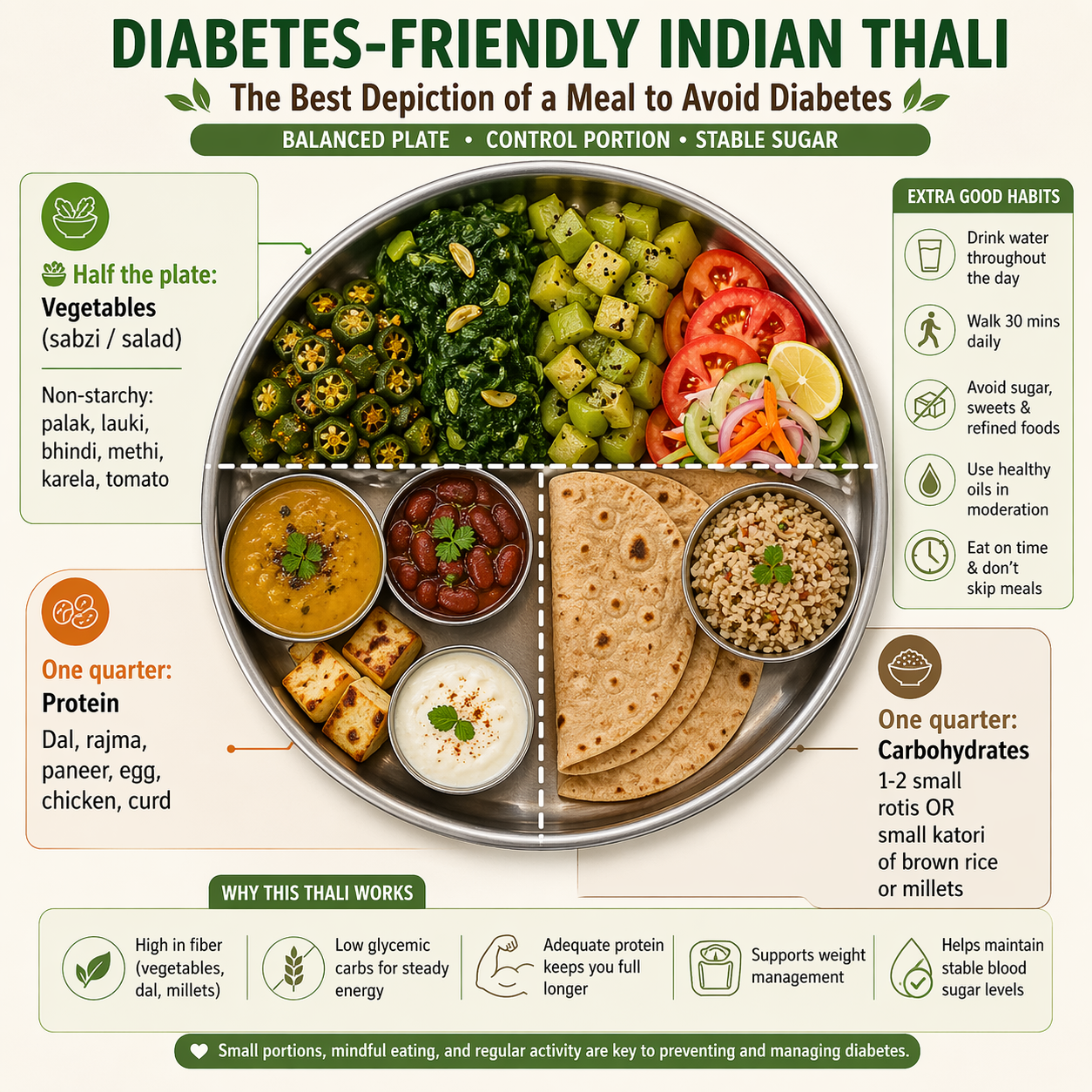
- Fill 50% of your plate with non-starchy vegetables (think Bhindi, Palak, or a fresh salad).
- Fill 25% of your plate with high-quality protein (Dal, Paneer, or Sprouts).
- Fill the remaining 25% with your choice of Low-GI rice.
By following these four steps, you are no longer a “victim” of your blood sugar levels. You are the architect of your own metabolism. You don’t have to give up the food that connects you to your family and your culture—you just have to eat it with the wisdom of modern science.
6 Practical Tips to Lower Rice GI
Think of these tips as your “Metabolic Toolkit.” You don’t need to change your entire life; you just need to change your technique. By applying these six clinically-backed strategies, you can transform a high-sugar meal into a slow-release energy source.
1. Upgrade to a “Low-GI Super Grain”
You don’t have to settle for standard, highly polished white rice that acts like “fast fuel” for your blood sugar.
- The Pro Choice: Upgrade to Telangana Sona (RNR 15048). This variety is a miracle of Indian agricultural science, boasting a clinically proven GI of just 51.0.
- The Alternatives: If you can’t find Telangana Sona, aged white Basmati (GI 50–58) or steamed brown rice (GI 50–55) are your best evidence-based alternatives.
2. Use the “24-Hour Cooling Hack”
This is my absolute favorite piece of “Kitchen Chemistry.” When you cook rice and let it cool in the refrigerator for 12 to 24 hours, the starch molecules undergo a structural shift called Retrogradation.
- The Result: It creates Resistant Starch Type 3 (RS3). This “new” starch resists digestion, passing through your system unabsorbed, behaving exactly like dietary fiber. This drastically blunts the post-meal sugar spike.
3. Never Eat “Naked” Rice (The Power of Pairing)
In diabetes management, “naked” rice (rice eaten by itself) is a recipe for a spike. Carbohydrates need a “chaperone” to slow them down.
- The Fix: Always pair your rice with low-GI pulses like Rajma, Chana Dal, or a thick, vegetable-heavy Sambar. The soluble fiber in these legumes acts as a physical barrier in your gut, slowing down glucose absorption.
4. Try the “Acid Hack” (Lemon & Curd)
Adding a touch of acidity is a brilliant domestic trick to control the “insulin roller coaster.”
- The Science: Squeezing fresh lemon juice over your rice or having a bowl of curd with your meal lowers the pH in your stomach. This acidity inhibits salivary alpha-amylase—the main enzyme responsible for breaking down starch into sugar—resulting in a much steadier release of glucose.
5. Buffer with Healthy Fats
You can actively manipulate how quickly your stomach empties its contents. The presence of healthy fat acts as a “speed limit” for digestion.
- The Fix: Adding a small, controlled amount of visible fat—like a teaspoon of ghee or cold-pressed vegetable oil—delays the absorption of carbohydrates. Pairing your meal with fiber-rich nuts or seeds adds another layer of protection.
6. Master the “Half-Plate” Rule (ICMR-NIN 2024)
Even with the best rice in the world, the volume you eat still matters. This is what we call Glycemic Load.
- The Formula: Follow the latest ICMR-NIN 2024 dietary guidelines by visually dividing your plate. Fill exactly half of your plate with non-starchy vegetables (fiber), one quarter with protein, and keep the final quarter for your strictly controlled portion of low-GI rice.
FAQ
Glycemic index of rice?
White Rice: 70–87, Brown Rice: 50–55, Red Rice: 45–52, Basmati Rice: 50–58
Glycemic index of wheat?
Refined Wheat Flour (Maida): 71–95, Standard Whole Wheat (Atta): 54–74, Ancient Wheat (Khapli/Emmer): 45–55, Wheat Chapati: 62.43
What food has 0 glycemic index?
Yes there are certain food items which has zero GI;
Stevia
Monk Fruit
Erythritol
What 7 fruits diabetics should avoid?
there are specific high-GI fruits, ripening stages, and physical preparations that can act like pure sugar in your bloodstream. If you want to optimize your glucose levels, here are the 7 fruits and fruit forms you need to avoid or strictly limit.
Watermelon
Sapota (Chikoo)
Overripe Bananas
Fruit Juices (Even 100% Fresh)
Pineapple Juice
Canned Fruits Packed in Sugar
Pureed Fruits and Smoothies
Is chapati low glycemic?
No, the traditional Indian wheat chapati is not a low-GI food; it actually falls into the medium (or moderate) Glycemic Index category. Clinical tests show that a standard chapati has a GI score of approximately 62.43. For context, the medium GI range is between 56 and 69.
About the author
It’s me Mohammad Junaid Rain an MBBS student at GMC Nagpur, passionate about making evidence-based medical information accessible to every Indian. “medstuffs.com” is dedicated to clear, disease education for patients and caregivers.
Disclaimer: This article is for educational purposes only and does not substitute professional medical advice. Please consult your doctor for diagnosis and treatment.
1 thought on “Glycemic Index of Rice: The Ultimate Patient’s Guide to Loving Rice Without the Sugar Spikes in 2026”